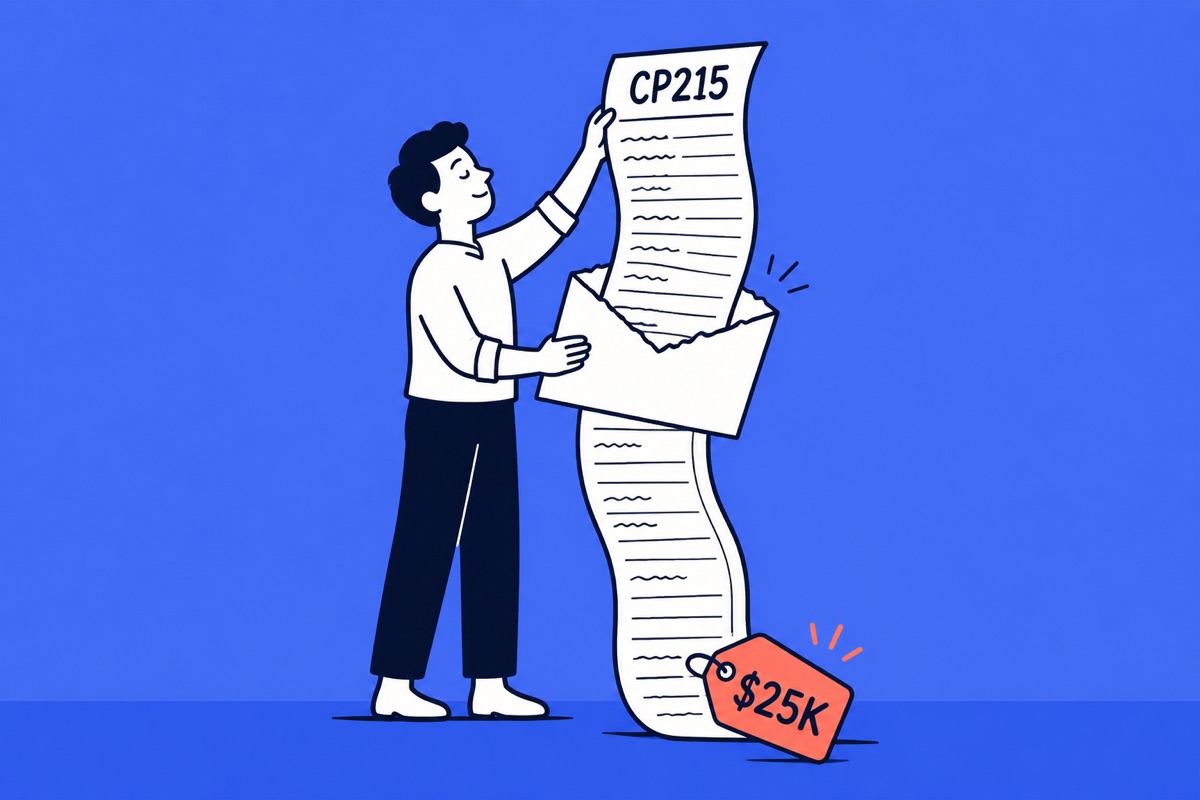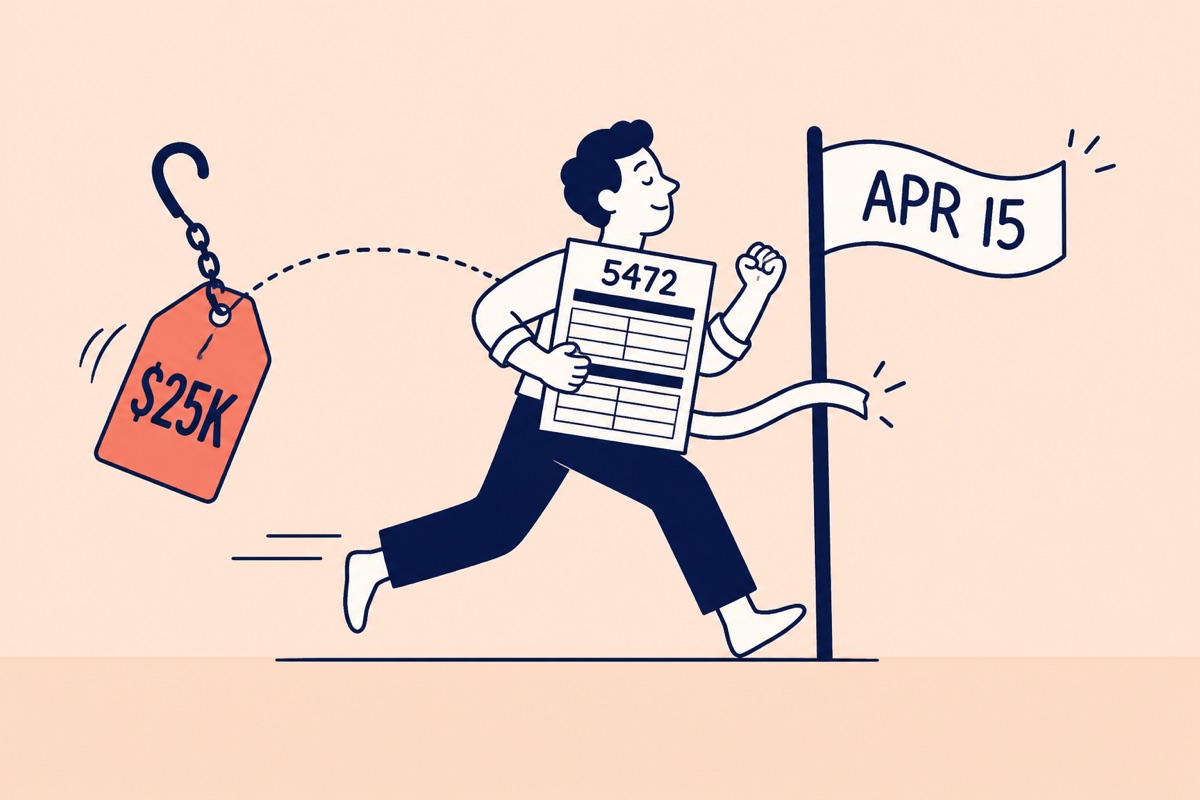
Here is a number that should get your attention: $25,000. That is the IRS penalty for failing to file a single Form 5472 or filing it late, incomplete, or with inaccurate information. And it is assessed per form, per year.
For foreign-owned LLC owners, this penalty is one of the most financially devastating consequences of non-compliance in the US tax system. The form itself is an informational return it does not even calculate tax owed. Yet the penalty for getting it wrong is larger than most small business owners earn in a month.
This guide explains exactly how the Form 5472 late filing penalty works, what triggers it, how to avoid it, and what to do if you have already missed a deadline. Not sure exactly when your 2026 deadline falls? Check that first.
What Is the Form 5472 Late Filing Penalty?
The penalty for Form 5472 non-compliance is codified under IRC Section 6038A(d). The statute authorizes the IRS to impose a penalty when a reporting corporation fails to file Form 5472, files it after the due date, or files a substantially incomplete or inaccurate form.
Importantly, this is a strict liability penalty. The IRS does not need to prove intent or negligence. If the form was not filed correctly and on time, the penalty is assessed automatically. There is no warning letter or probation period.
The penalty applies to each Form 5472 separately. If your corporation had reportable transactions with three different foreign related parties and failed to file three forms, the penalty could reach $75,000 for a single tax year.
How Much Is the Penalty?
The penalty structure has two components:
| Penalty Component | Amount | Trigger |
|---|---|---|
| Initial penalty | $25,000 | Failure to file, late filing, or substantially incomplete/inaccurate filing |
| Continuation penalty | $25,000 per 30-day period | Continued non-compliance after IRS issues a formal notice (no upper cap) |
Let that sink in. If the IRS sends you a notice and you do not respond within 30 days, the penalty jumps to $50,000. Another 30 days: $75,000. There is no statutory maximum.
How Penalties Stack Across Multiple Years
The math gets worse when you factor in multiple tax years of non-compliance:
| Years Missed | Minimum Penalty (1 form/year) | With 1 Continuation Period |
|---|---|---|
| 1 year | $25,000 | $50,000 |
| 2 years | $50,000 | $100,000 |
| 3 years | $75,000 | $150,000 |
| 5 years | $125,000 | $250,000 |
Can the IRS Really Charge $25,000?
Yes. They do. Regularly.
The IRS has been ramping up enforcement of Form 5472 penalties since 2018, when the penalty amount was increased from $10,000 to $25,000 per the Tax Cuts and Jobs Act (TCJA). Before that increase, many foreign-owned LLCs flew under the radar. Now the IRS actively cross-references EIN registrations, bank account openings, and registered agent records to identify non-filers.
Common scenarios where penalties are assessed:
- The “I did not know” LLC owner: A non-US entrepreneur forms a Wyoming LLC, gets an EIN, opens a Mercury or Relay bank account, and starts doing business. Two years later, an IRS notice arrives with a $50,000 penalty assessment.
- The incomplete filing: A filer submits Form 5472 but forgets to attach the pro forma 1120, or leaves Part V blank. The IRS treats this as a failure to file.
- The late extension: A filer misses the April 15 deadline, files Form 7004 in May, and assumes everything is fine. The extension request was late, so the original deadline was missed.
How to Avoid the Penalty
Avoiding the Form 5472 penalty is straightforward if you follow these steps:
1. Know Your Deadline
For calendar-year filers (most foreign-owned LLCs), the deadline is April 15 of the year following the tax year. For tax year 2025, that means April 15, 2026.
2. File Form 7004 Early If You Need More Time
If you cannot file by April 15, submit Form 7004 (Application for Automatic Extension) before the deadline. This gives you an automatic 6-month extension to October 15. Form 7004 can be e-filed and takes minutes to complete.
3. Use a Digital Filing Tool
Manual preparation of Form 5472 is error-prone. Missing a single required field can result in the form being treated as incomplete, which triggers the same penalty as not filing at all.
Tools like Form5472.io validate every field before generating your documents. The tool ensures your Form 5472 and pro forma 1120 are complete, correctly formatted, and ready for IRS submission.
4. Keep Records of All Transactions
Throughout the year, maintain a simple log of all transactions between you (the foreign owner) and your LLC. This includes capital contributions, distributions, payments for services, and loans. Having organized records makes filing fast and accurate.
5. Set Calendar Reminders
This sounds basic, but the most common reason for late filing is simply forgetting. Set reminders for:
- March 15: Begin preparing your Form 5472
- April 1: File Form 7004 if you need an extension
- April 15: Final deadline for filing
What If You Already Missed the Deadline?
If you have already missed the filing deadline, you have several options. The key principle is: file as soon as possible. Every day of delay increases your risk and potential penalty exposure.
Option A: File Immediately (Delinquent Return)
Prepare and submit your Form 5472 and pro forma 1120 right away. If the IRS has not yet assessed a penalty, filing a delinquent return is your best path. Include a reasonable cause statement explaining why the filing was late.
Option B: IRS Delinquent International Information Return Procedures
The IRS has a formal program for taxpayers who have not filed required international information returns. If you qualify, you can submit late returns with a reasonable cause statement and potentially avoid all penalties. You must not be under IRS examination or investigation to use this program.
Option C: Respond to an IRS Notice
If you have already received a penalty notice (typically Letter 5318 or CP15), you have 90 days to respond. You can file the missing return and request penalty abatement with a reasonable cause letter.
Need to file a late Form 5472? Form5472.io generates your completed Form 5472 and pro forma 1120 in minutes even for prior tax years. Get your IRS-ready documents now and reduce your penalty risk.
File now →How to Request Penalty Abatement
The IRS allows penalty abatement if you can demonstrate reasonable cause for your failure to file on time. This is not automatic you must submit a written request explaining the circumstances.
Your reasonable cause letter should include:
- Your identifying information (name, EIN, tax year in question)
- The specific penalty you are requesting abatement for (reference the notice number if applicable)
- A detailed explanation of why you failed to file on time, with dates and specifics
- Supporting documentation (medical records, proof of natural disaster, correspondence with tax preparers, etc.)
- Steps taken to prevent future non-compliance
IRS Reasonable Cause Criteria
Not all excuses carry equal weight with the IRS. Here is a breakdown of what tends to work and what does not:
| Reasonable Cause Argument | IRS Acceptance Likelihood | Notes |
|---|---|---|
| Serious illness or medical emergency | High | Must provide medical documentation with dates overlapping the filing period |
| Natural disaster affecting access to records | High | FEMA-declared disaster areas get automatic deadline extensions |
| Death of the sole person responsible for filing | High | Death certificate and proof of role required |
| Reliance on a tax professional who failed to file | Moderate | Must show you provided all information timely and the professional acknowledged responsibility |
| First-time filer unaware of the requirement | Moderate | Stronger if the LLC was recently formed and had minimal activity; the IRS has been less lenient in recent years |
| Inability to obtain records from abroad | Moderate | Must document efforts made to obtain records and explain specific barriers |
| “I did not know about the form” | Low | Ignorance of the law is generally not reasonable cause, but can work for first-year LLCs with no professional guidance |
| “I was too busy” | Very Low | Rarely accepted unless combined with other factors |
| “The penalty is too high” | None | Not a valid reasonable cause argument |
Step-by-Step: Filing a Late Form 5472
If you need to file a late Form 5472, follow these steps to minimize your penalty exposure:
Step 1: Gather Your Information
Collect your LLC’s EIN, the foreign owner’s personal information (name, address, country of citizenship, taxpayer ID if any), and records of all transactions between the owner and the LLC for the relevant tax year.
Step 2: Complete Form 5472
Fill out all applicable parts of Form 5472. For most foreign-owned single-member LLCs, you will complete Parts I, II, III, and V. Use a tool like Form5472.io to ensure accuracy and completeness.
Step 3: Prepare the Pro Forma 1120
Generate a pro forma Form 1120 with the appropriate tax year dates. Most fields will be zero for disregarded entities. This form serves as the required “cover page” for your 5472 submission.
Step 4: Write a Reasonable Cause Statement
Draft a letter explaining why the filing was late. Be specific, honest, and provide documentation. Reference the criteria in the table above to strengthen your case.
Step 5: Submit to the IRS
Mail your complete package (Form 1120 + Form 5472 + reasonable cause letter) to the appropriate IRS address. Keep copies of everything you submit, and consider sending via certified mail or using a fax with confirmation for proof of submission.
Step 6: Monitor for IRS Response
The IRS typically responds within 60–120 days. If your reasonable cause request is accepted, you will receive a letter confirming penalty abatement. If denied, you have the right to appeal.
Tips to Prevent Future Late Filing
- Maintain a transaction log year-round. Record every capital contribution, distribution, payment, or loan between you and your LLC as it happens. Do not wait until tax season to reconstruct records.
- File your extension early. Submit Form 7004 by March 15 to give yourself a comfortable buffer. The extension is automatic no reason needed.
- Use a digital filing tool. Manual preparation takes hours and invites errors. Digital tools complete the process in minutes and validate your inputs automatically.
- Set up annual reminders. Add recurring calendar events for March 15 (prepare), April 1 (extension if needed), and April 15 (deadline).
- Know your obligations before forming the LLC. If you are considering forming a US LLC, understand the annual compliance requirements before incorporation not after.
- Do not assume your registered agent files for you. Registered agents receive mail on your behalf. They do not prepare or file tax returns unless you specifically hire them for that service.
Key Takeaways
- The Form 5472 late filing penalty is $25,000 per form per year, with no upper cap if non-compliance continues.
- The penalty is a strict liability assessment no intent or negligence needs to be proven.
- Penalties have been aggressively enforced since 2018 following the TCJA increase from $10,000 to $25,000.
- You can avoid the penalty by filing on time, requesting extensions via Form 7004, and using validated digital tools.
- If you missed a deadline, file immediately with a reasonable cause statement to maximize your chance of penalty abatement.
- The IRS Delinquent International Information Return Procedures offer a path to penalty-free late filing for eligible taxpayers.
- Do not ignore an IRS penalty notice. You have 90 days to respond, and continued non-compliance adds $25,000 per 30-day period.
Frequently Asked Questions
Can the IRS waive the $25,000 Form 5472 penalty?
Yes. The IRS can abate the penalty if you demonstrate reasonable cause for the late or non-filing. You must submit a written reasonable cause statement explaining the circumstances and providing supporting documentation. Acceptance is not guaranteed and depends on the specifics of your situation.
Is the $25,000 penalty per LLC or per form?
Per form. If your LLC had reportable transactions with multiple foreign related parties, each unreported relationship can generate a separate $25,000 penalty. For most single-member LLCs with one foreign owner, this means one penalty per year of non-compliance.
What if I filed Form 5472 but forgot the pro forma 1120?
The IRS may treat your filing as incomplete or invalid, which triggers the same penalty as not filing at all. Form 5472 must be attached to a Form 1120 (or pro forma 1120 for disregarded entities) to be considered a valid submission.
How long does the IRS have to assess the Form 5472 penalty?
The standard statute of limitations is three years from the filing date. However, if you never filed, there is no statute of limitations the IRS can assess the penalty at any time. This is why filing a late return is always better than not filing at all.
Can I appeal a Form 5472 penalty?
Yes. If your reasonable cause request is denied, you can appeal to the IRS Independent Office of Appeals. You can also challenge the penalty in US Tax Court if you receive a statutory notice of deficiency. Many taxpayers have successfully reduced or eliminated penalties through the appeals process.
Does filing an extension protect me from the penalty?
Yes, if filed on time. Filing Form 7004 before the April 15 deadline extends your filing date to October 15. As long as you file your Form 5472 by the extended deadline, no penalty applies. However, filing Form 7004 after April 15 does not protect you the extension request itself must be timely.
File Your Form 5472 in Minutes
Skip the paperwork. Our digital tool generates IRS-ready Form 5472 and Pro Forma 1120 instantly.
Start Filing Now