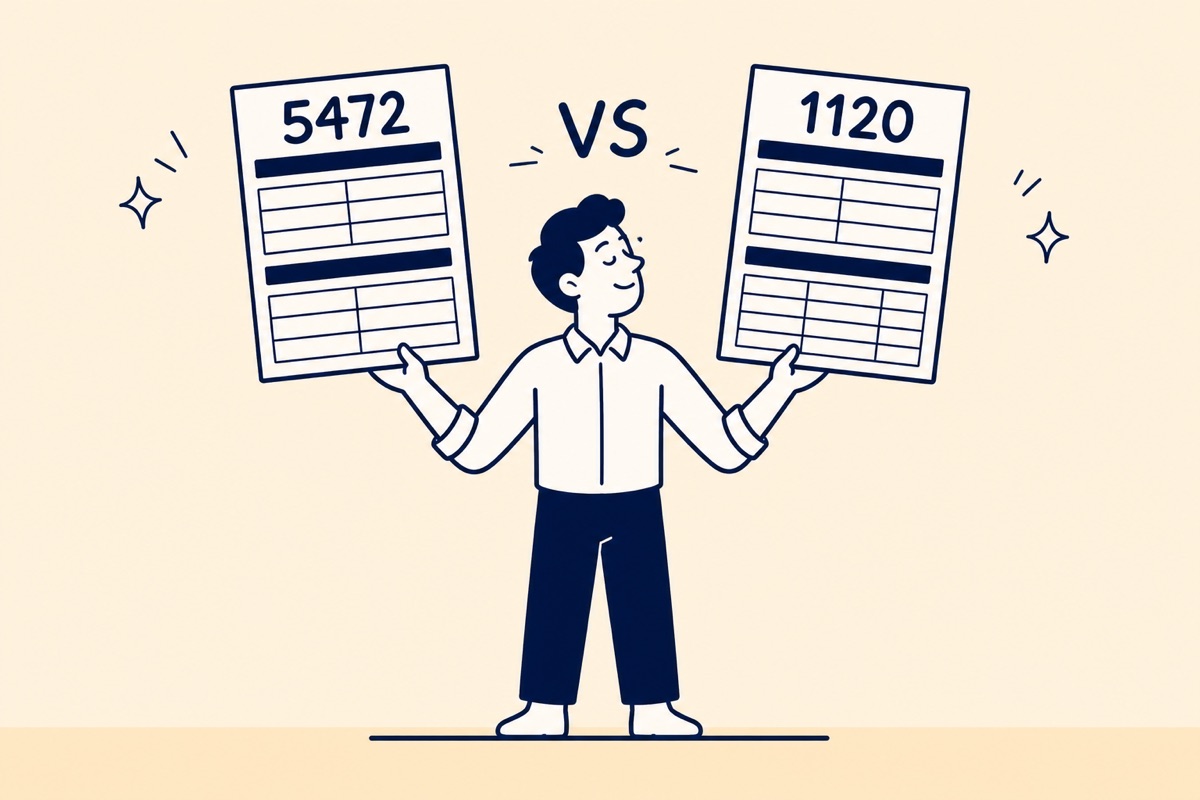
If you own a foreign-owned US LLC, you have probably encountered two IRS forms that sound confusingly similar: Form 5472 and Form 1120. They appear on the same filing package, they share overlapping deadlines, and the IRS expects you to submit them together. Yet they serve entirely different purposes.
Understanding the difference is not optional. Filing the wrong form, omitting one, or mixing up the information on each can trigger a $25,000 penalty per form, per year. This guide breaks down exactly what each form does, who needs to file which, and how they work together in 2026. Confusing Form 5472 with Form 5471 instead is a separate, equally common mistake, worth ruling out too.
What Is Form 5472?
IRS Form 5472 (officially titled "Information Return of a 25% Foreign-Owned U.S. Corporation or a Foreign Corporation Engaged in a U.S. Trade or Business") is an information return. It does not calculate taxes owed. Instead, it reports reportable transactions between a US entity and its foreign owner or related foreign parties.
Think of Form 5472 as a transparency document. The IRS uses it to track cross-border money flows and ensure that foreign-owned US entities are not shifting profits overseas to avoid taxation.
Key characteristics of Form 5472:
- It is an information return, not an income tax return
- It reports transactions such as capital contributions, loans, rent, royalties, and service payments
- A separate Form 5472 is required for each foreign related party with reportable transactions
- Even single-member LLCs with no income must file if they had any reportable transactions
- It must be attached to a Form 1120 (or Pro Forma 1120) when submitted
What Is Form 1120?
IRS Form 1120 (titled "U.S. Corporation Income Tax Return") is the standard corporate income tax returnfor C-corporations. It reports the corporation's income, deductions, gains, losses, and calculates the tax liability for the year.
For a traditional C-corporation, Form 1120 is a comprehensive, multi-page return that includes schedules for cost of goods sold, dividends, compensation of officers, and much more.
Key characteristics of Form 1120:
- It is an income tax return that calculates taxes owed
- Required for all domestic C-corporations
- Reports revenue, expenses, net income, and tax due
- Includes numerous schedules (Schedule M-1, M-2, L, etc.)
- Serves as the "cover page" or vehicle for attaching Form 5472
Form 5472 vs Form 1120: Side-by-Side Comparison
The following table highlights the most important differences between these two forms:
| Feature | Form 5472 | Form 1120 |
|---|---|---|
| Purpose | Information return reporting related-party transactions | Corporate income tax return calculating tax owed |
| Who files | 25%+ foreign-owned US corporations and foreign-owned disregarded entities | All domestic C-corporations; Pro Forma version for disregarded entities |
| Calculates tax? | No | Yes (full version); No (Pro Forma version) |
| Standalone filing? | No must be attached to a Form 1120 | Yes can be filed independently |
| Penalty for non-filing | $25,000 per form, per year | Varies; percentage of unpaid tax |
| Pages | Typically 2–4 pages | Full: 5+ pages with schedules; Pro Forma: cover page only |
| Income reported | No income only transactions with related parties | All corporate income, deductions, and credits |
| Frequency | One per related foreign party, per year | One per entity, per year |
| E-filing available? | Only when attached to an e-filed 1120 | Yes, for C-corps; Pro Forma typically paper/fax filed |
Why Do You Need Both?
The IRS requires Form 5472 to be attached to a Form 1120. You cannot submit Form 5472 on its own. This means every foreign-owned entity that must file Form 5472 also needs some version of Form 1120 as a "carrier" document.
For foreign-owned C-corporations, this is straightforward: you file your regular corporate tax return (Form 1120) and attach Form 5472 to it.
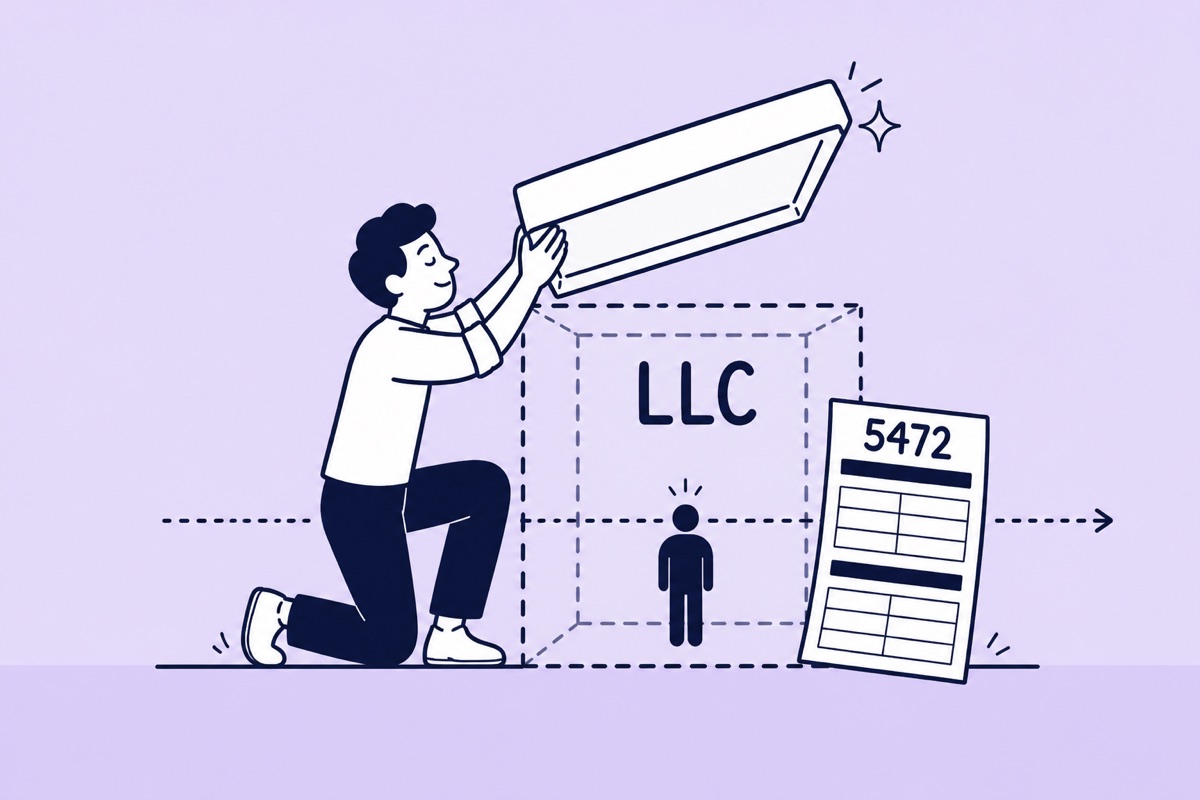
For foreign-owned single-member LLCs (which are typically treated as disregarded entities for US tax purposes), the situation is different. Disregarded entities do not normally file Form 1120 because they are not taxed as corporations. However, the IRS still requires a Form 1120 to serve as the carrier for Form 5472. This is where the Pro Forma 1120 comes in.
What Is a Pro Forma 1120?
A Pro Forma 1120is a simplified version of Form 1120 that exists solely to act as the "envelope" for Form 5472. It is not a real income tax return and does not calculate any tax liability.
What goes on a Pro Forma 1120:
- The entity's name, address, and EIN
- The tax period (calendar year or fiscal year)
- A check mark in the "initial return," "final return," or "amended return" box as applicable
- Zeros on all income and expense lines
- The phrase "Filed pursuant to Rev. Proc. 2004-66 and Treas. Reg. 301.7701-2(c)(2)(vi)" written across the top
The Pro Forma 1120 tells the IRS: "This entity is a disregarded entity with no separate tax liability, but we are submitting this form as required so that we can attach Form 5472."
Let Form5472.io handle both forms for you
Our tool automatically generates a complete Form 5472 and the matching Pro Forma 1120 in minutes. No tax knowledge required.
Generate Your Forms NowWho Files What?
The forms you need depend on your entity type and ownership structure. Use this table to determine your requirements:
| Entity Type | Form 1120 | Pro Forma 1120 | Form 5472 |
|---|---|---|---|
| Foreign-owned single-member LLC (disregarded entity) | No | Yes | Yes |
| Foreign-owned C-corporation | Yes (full) | No | Yes (attached to full 1120) |
| Foreign-owned multi-member LLC (partnership) | No (files 1065) | No | Possibly (if 25%+ foreign-owned) |
| US-owned domestic corporation | Yes (full) | No | No |
| Foreign corporation with US trade or business | No (files 1120-F) | No | Yes (attached to 1120-F) |
Filing Deadlines Compared
Both forms follow the same deadline when filed together, but understanding the rules matters for extensions and late filings:
| Deadline | Form 5472 + Pro Forma 1120 | Form 1120 (C-Corp) |
|---|---|---|
| Original due date | April 15 (calendar year filers) | April 15 (calendar year filers) |
| Extension available? | Yes automatic 6-month extension via Form 7004 | Yes automatic 6-month extension via Form 7004 |
| Extended due date | October 15 | October 15 |
| Where to file | IRS Ogden, UT (paper/fax) | Varies by state; e-filing available |
| Extension form | Form 7004 (entity type code 1120) | Form 7004 (entity type code 1120) |
Important: Filing an extension gives you more time to file, but it does not give you more time to pay taxes owed (relevant for C-corps filing a full 1120). For disregarded entities filing a Pro Forma 1120, there is typically no tax payment due.
Penalties Compared
The penalty structures for these two forms differ significantly:
| Penalty Type | Form 5472 | Form 1120 (Full) |
|---|---|---|
| Late filing penalty | $25,000 per form, per year | 5% of unpaid tax per month (max 25%) |
| Failure to file | $25,000 per form, per year | Same as late filing, plus potential fraud penalties |
| Incomplete/inaccurate filing | $25,000 per form | Accuracy-related penalty: 20% of underpayment |
| Continued non-compliance (after IRS notice) | Additional $25,000 for each 30-day period (uncapped) | Additional interest and penalties accrue |
| Penalty abatement available? | Yes via reasonable cause letter | Yes via reasonable cause or first-time penalty abatement |
Notice the stark difference: the Form 5472 penalty is a flat $25,000 regardless of whether you owe any tax. A disregarded entity with zero income and zero tax liability still faces a $25,000 fine for a late or missing Form 5472. This catches many foreign LLC owners off guard.
How Form5472.io Handles Both Forms
Filing two interconnected IRS forms with different rules and formats is exactly the kind of complexity that leads to costly mistakes. Form5472.io eliminates that risk by generating both documents from a single set of inputs.
Here is how it works:
- Enter your LLC details entity name, EIN, address, formation date, and foreign owner information
- Report your transactions capital contributions, distributions, loans, or other reportable transactions using plain-language prompts
- Instant generation Form5472.io produces a complete, IRS-ready Form 5472 and the matching Pro Forma 1120 with the correct header language, zeros on all income lines, and proper formatting
- Download and file get print-ready PDFs that you can fax or mail to the IRS Ogden service center
No tax expertise needed. No guessing which boxes to check. Both forms, generated correctly, in minutes.
Key Takeaways
- Form 5472 is an information return that reports transactions between a US entity and its foreign owner. It does not calculate tax.
- Form 1120 is the standard corporate income tax return for C-corporations. Disregarded entities use a simplified Pro Forma version.
- Form 5472 cannot be filed alone it must be attached to a Form 1120 (full or Pro Forma).
- The penalty for a missing or late Form 5472 is $25,000, regardless of income or tax owed.
- Most foreign-owned single-member LLCs need a Pro Forma 1120 + Form 5472 filed by April 15 (or October 15 with an extension).
- Using a tool like Form5472.io ensures both forms are generated correctly and consistently.
Frequently Asked Questions
Can I file Form 5472 without Form 1120?
No. The IRS requires Form 5472 to be attached to a Form 1120. For disregarded entities (single-member LLCs), you attach it to a Pro Forma 1120 a simplified version that reports no income or tax. The two forms are always filed together.
Is a Pro Forma 1120 the same as a regular Form 1120?
Not exactly. A Pro Forma 1120 uses the same IRS form but is filled out with zeros on all financial lines. It includes a specific header statement referencing Rev. Proc. 2004-66. It exists purely to serve as the carrier document for Form 5472 and does not calculate any tax liability.
What if my LLC had no transactions this year?
If your foreign-owned LLC had absolutely no reportable transactions during the tax year (no capital contributions, no distributions, no payments of any kind), you may not need to file Form 5472. However, most LLCs have at least one reportable transaction such as the initial capital contribution to open a bank account. Consult with a tax professional if you are unsure.
Do I file Form 5472 with my personal tax return?
No. Form 5472 is attached to the entity's Form 1120 (or Pro Forma 1120), not to your personal income tax return. If you are a non-resident with no US-source income, you may not have a personal US tax return at all but you still must file Form 5472 for your LLC.
What happens if I filed Form 1120 but forgot Form 5472?
The IRS can assess the $25,000 penalty for each missing Form 5472. If you realize the omission, you should file the missing Form 5472 as soon as possible and consider including a reasonable cause statement explaining why it was late. Early voluntary compliance can improve your chances of penalty abatement.
Can Form5472.io generate both forms at once?
Yes. When you complete the Form5472.io questionnaire, the system automatically generates both your Form 5472 and the corresponding Pro Forma 1120 (or attaches to a full 1120 if applicable). Both documents are included in your downloadable PDF package, ready for submission to the IRS.
File Your Form 5472 in Minutes
Skip the paperwork. Our digital tool generates IRS-ready Form 5472 and Pro Forma 1120 instantly.
Start Filing Now