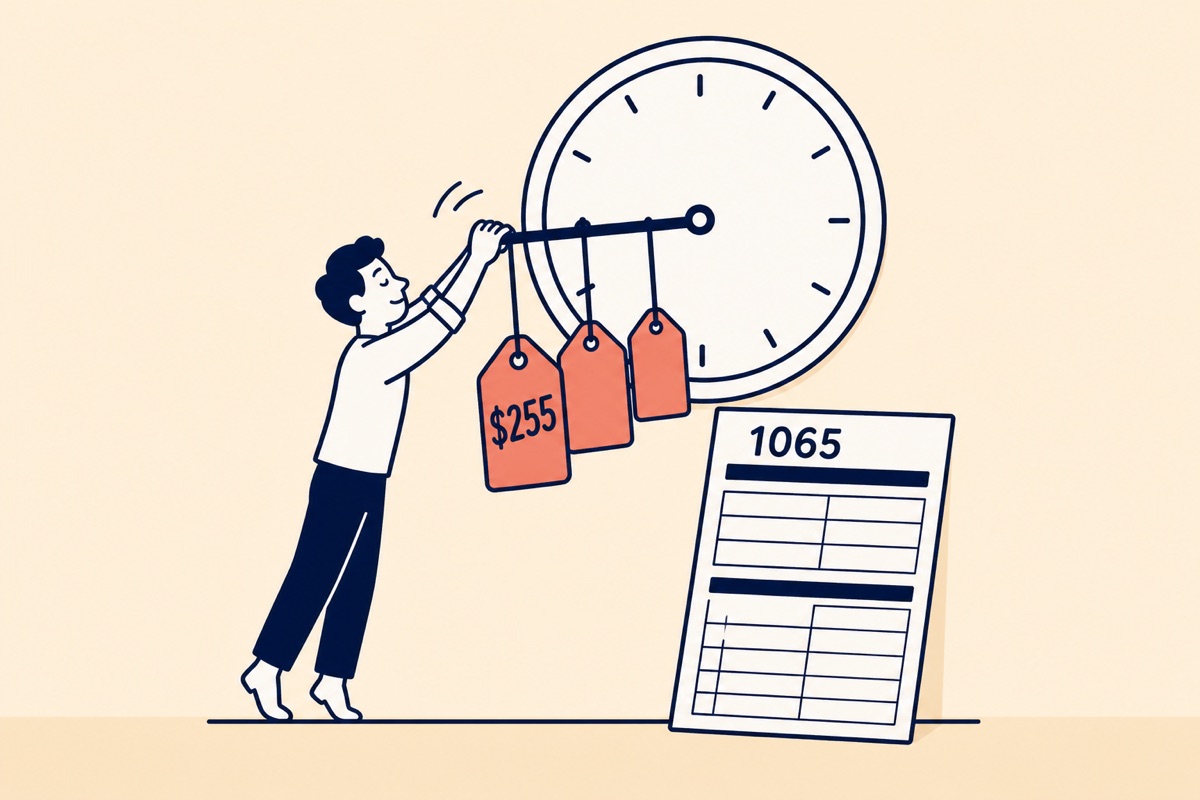
Here is the deadline mistake that costs foreign-owned LLCs real money: Form 1065 is not due in April. It is due in March a full month before the deadline most founders have in their head. And the penalty for missing it runs $255 per partner, per month (2026 rate), even if the LLC made no money at all.
Most non-resident founders find this out the same way: they calendar “US taxes” for April 15, open their laptop in early April, and discover the partnership return was already three weeks late. This guide lays out every date that matters for the Form 1065 deadline original due dates, weekend shifts, K-1 furnishing, fiscal years, and extensions so that never happens to you.
TL;DR: Form 1065 is due the 15th day of the 3rd month after the tax year ends for calendar-year LLCs, that meant March 16, 2026 (March 15 fell on a Sunday) for 2025 returns, and March 15, 2027 for 2026 returns. Schedule K-1s are due to partners the same day. Form 7004 extends filing to September 15. Miss the deadline and a $255/partner/month penalty clock starts the next day.
The Dates That Matter
The rule behind every date in this table is the same: Form 1065 is due the 15th day of the 3rd month after the end of the partnership’s tax year. For the calendar-year LLCs that make up nearly all foreign-owned multi-member LLCs, that means March 15 shifted to the next business day when the 15th lands on a weekend or holiday.
| Tax year | Original due date | Extension deadline (Form 7004) | Extended due date |
|---|---|---|---|
| 2025 (calendar year) | March 16, 2026 (March 15 was a Sunday) | March 16, 2026 | September 15, 2026 (Tuesday) |
| 2026 (calendar year) | March 15, 2027 (Monday) | March 15, 2027 | September 15, 2027 (Wednesday) |
| Fiscal year (example: ends June 30, 2026) | September 15, 2026 | September 15, 2026 | March 15, 2027 |
Two details worth pinning down. First, the extension request (Form 7004) must be filed by the original due date the same March date, not April. Second, the “extended due date” is six months after the original one, which lands on September 15 for calendar-year filers. If you are new to the form itself, start with our complete Form 1065 guide for foreign-owned LLCs. The official form and instructions live at irs.gov.
Why Form 1065 Is a Month Earlier Than Most Founders Expect
Almost every US tax date a founder absorbs from the internet is April 15: personal returns, single-member LLC filings, and the Form 5472 + pro forma 1120 package that foreign-owned single-member LLCs file. Partnership returns are the exception, and the reason is practical: partners need their Schedule K-1s before they can file their own returns. Congress moved the partnership deadline to March 15 precisely so the K-1s exist a month before the April personal deadline.
This creates a specific trap for founders who own both kinds of entity. Say you have a single-member LLC that files Form 5472 with a pro forma 1120 by April 15, and you later add a partner to a second LLC. Your brain says “US deadline = April 15.” But the new multi-member LLC is a partnership, and its Form 1065 was due in March. By the time you sit down for your “April filing,” the partnership return is already a month late with the per-partner penalty clock running.
The safe mental model: partnerships file in March; everything else you are used to files in April. Put both dates on the calendar the day the second member joins the LLC.
The K-1 Furnishing Deadline Is the Same Day
Form 1065 itself goes to the IRS, but the partnership must also furnish a Schedule K-1 to each partner and that deadline is the same as the 1065 due date, including extensions. For 2026 returns, that means each partner should have their K-1 by March 15, 2027 (or September 15, 2027 on extension).
This matters more than it sounds. Your partners cannot correctly file their own returns Form 1040-NR for non-resident individuals, or a home-country filing that asks about foreign income until they know their share of the LLC’s income and deductions. A late 1065 does not just create a penalty for the LLC; it can force every partner to extend or amend their personal filings. If you extend the partnership, tell your partners early so they can extend their own returns too.
Fiscal-Year LLCs: The 15th-Day-of-the-3rd-Month Rule
A small number of partnerships use a fiscal year instead of the calendar year. The deadline formula does not change: the 15th day of the 3rd month after the tax year ends.
Worked example: a partnership whose tax year ends June 30, 2026 counts three months forward July, August, September and lands on September 15, 2026. A 7004 extension adds six months, moving the extended due date to March 15, 2027. The same arithmetic works for any year-end; just remember the weekend shift rule if the 15th falls on a Saturday, Sunday, or federal holiday.
In practice, nearly every foreign-owned LLC should simply use the calendar year unless a professional has given a specific reason not to partnerships generally need IRS permission or a valid business purpose to use anything else.
Deadline coming up? Form5472.io prepares your complete, IRS-ready Form 1065 + Schedule K-1 package for $147 one-time answer plain-English questions, download your filing. No CPA required.
Start your 1065 filing →Extensions: How Form 7004 Works
If March is too close, Form 7004 buys an automatic six-month extension no reason or signature required. The mechanics:
- File it by the original due date (March 16, 2026 for 2025 returns; March 15, 2027 for 2026 returns). A 7004 filed on March 20 extends nothing.
- The extension is automatic when properly filed the IRS does not send an approval letter. Keep your proof of filing.
- It extends the time to file, not the time to pay. For most foreign-owned LLCs this is painless, because a partnership return itself usually carries no tax. The exception: if the partnership owes §1446 withholding on effectively connected income allocable to foreign partners, that money is still due on schedule the 7004 does not delay it.
Our Form 7004 extension guide walks through the form line by line, and the IRS publishes the form at irs.gov. One habit worth copying from CPAs: if there is any doubt you will file on time, file the 7004 early in March. It costs nothing, and an unused extension has no downside.
What Happens the Day After the Deadline
The penalty math is simple and unforgiving. Starting the day after the due date (original or extended), the IRS can assess $255 per partner, per month or part of a month (the 2026 inflation-adjusted rate), for up to 12 months. A two-partner LLC that files one day late owes the same $510 as one that files 30 days late a partial month counts as a full month.
Twelve months late, that two-partner LLC is looking at $6,120 and separate penalties can apply for failing to furnish K-1s to partners. The full breakdown, including how first-time abatement and reasonable cause work for partnerships, is in our Form 1065 late-filing penalty guide. The short version: if the deadline has already passed, file now the clock counts months, and every month you wait adds another $255 per partner.
Filing Checklist to Hit the Deadline
Everything Form 1065 needs is easier to gather in February than at 11pm on deadline day:
- EIN and legal details the LLC’s EIN, legal name, formation date, and US address. No EIN yet? See our EIN guide for foreign owners.
- Partner information each partner’s name, address, tax ID (ITIN or foreign TIN where applicable), and ownership percentage at year end.
- The year’s numbers income, expenses by category, and any distributions or contributions. Bank and Stripe statements are usually enough for a small LLC.
- Capital account figures each partner’s beginning balance, contributions, share of profit or loss, and withdrawals.
- A decision on extension if the numbers will not be final by early March, file Form 7004 immediately rather than gambling on the deadline.
- Proof of filing whatever method you use, keep the confirmation. It is your evidence of a timely filing if a notice ever arrives.
The Bottom Line
The Form 1065 deadline is the 15th day of the 3rd month after year end: March 16, 2026 for 2025 calendar-year returns, March 15, 2027 for 2026 returns, with K-1s due to partners the same day. Form 7004 filed by that March date extends filing to September 15, but not any §1446 withholding due. Miss the date and the $255/partner/month clock starts immediately. Form5472.io prepares the complete 1065 + K-1 package for $147, IRS-ready, no subscription.
Frequently Asked Questions
When is Form 1065 due in 2027?
March 15, 2027 for calendar-year partnerships filing their 2026 return it falls on a Monday, so there is no weekend shift. With a Form 7004 extension filed by that date, the extended deadline is September 15, 2027.
Why was the 2025 return due March 16, 2026 instead of March 15?
Because March 15, 2026 was a Sunday. When a due date lands on a Saturday, Sunday, or federal holiday, it shifts to the next business day Monday, March 16, 2026. The same rule applies to extended deadlines and to fiscal-year due dates.
Is the Form 1065 deadline the same as the Form 5472 deadline?
No and this trips up a lot of founders. The Form 5472 + pro forma 1120 package for foreign-owned single-member LLCs is due April 15 (extendable to October 15). Form 1065 for multi-member LLCs is due a month earlier, on March 15. If you own both entity types, you have two different deadlines.
Do I still have to file by March 15 if the LLC had no income?
Generally yes. A multi-member LLC that existed during the year and had any activity even just contributions or expenses generally must file Form 1065 by the normal deadline, and the $255/partner/month penalty applies to late zero-income returns too. Truly no activity at all is the narrow exception, and it is safer to file than to assume you qualify.
Does Form 7004 give my partners more time to file their own returns?
No. Form 7004 extends only the partnership’s filing deadline. Each partner’s personal return keeps its own due date, so partners who will not have a K-1 in time should file their own extensions (Form 4868 for individuals). Coordinate early a September K-1 arriving after a partner’s unextended April deadline creates an amendment headache.
File Your Form 5472 in Minutes
Skip the paperwork. Our digital tool generates IRS-ready Form 5472 and Pro Forma 1120 instantly.
Start Filing Now