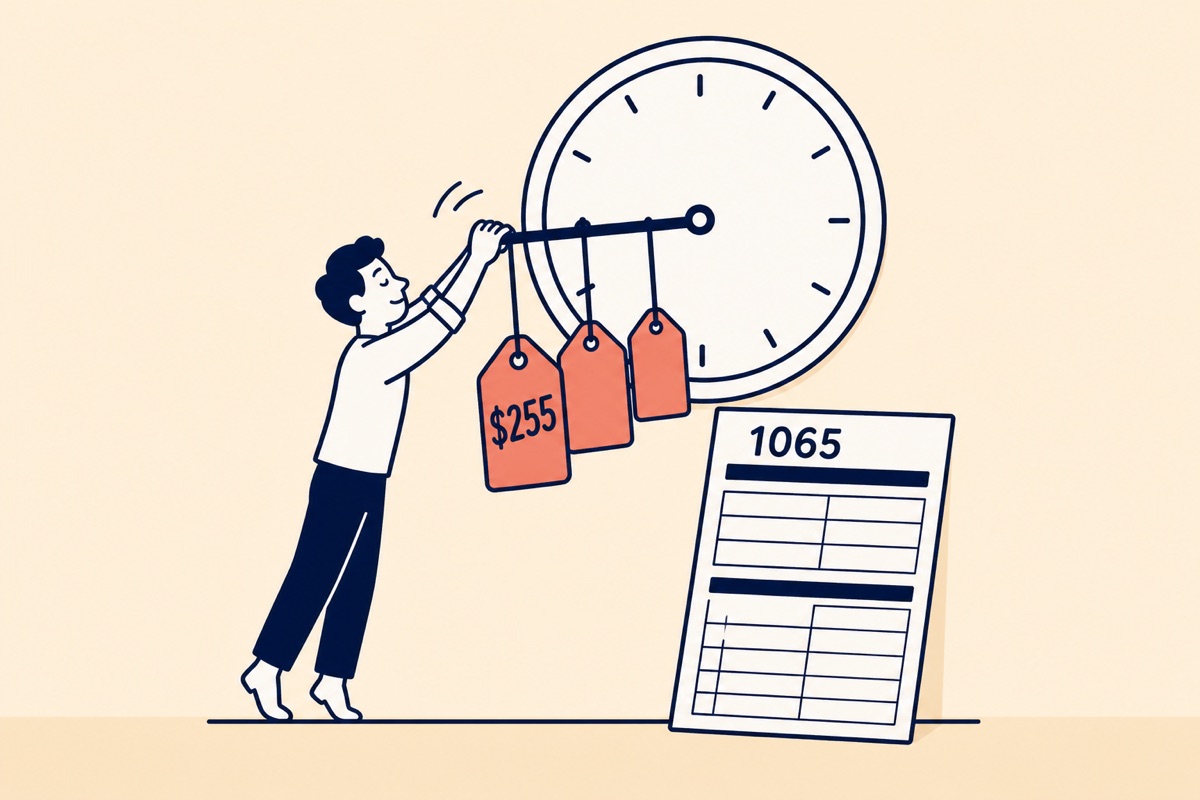
Miss the Form 1065 deadline and the meter starts the very next day: $255 per partner, per month, for up to 12 months. For a two-partner LLC that sounds survivable until you do the math and realize six months of silence costs more than $3,000, and a five-partner company can rack up $15,300 on a single late return.
Most non-resident founders discover this penalty only when the notice arrives. Nobody told them a multi-member LLC is a partnership in the eyes of the IRS, and that partnerships owe a return even in years with zero profit.
This guide breaks down exactly how the Form 1065 late filing penalty is calculated, what it looks like in real dollars, and the two established routes to getting it removed. It is based on the same rules we apply when preparing partnership filings for foreign-owned LLCs every week.
TL;DR: The IRS penalty for filing Form 1065 late is $255 per partner, per month (or part of a month), up to 12 months, for returns required to be filed in 2026. The clock starts the day after the March 15 deadline (or the extended deadline if you filed Form 7004). Separate penalties apply for late Schedule K-1s. Relief is possible through reasonable cause and, for some small partnerships, Rev. Proc. 84-35 but foreign partners complicate the second route.
How the Form 1065 Late Filing Penalty Works
The penalty lives in IRC §6698, and the formula is brutally simple:
Penalty = number of partners × months late (or part of a month) × $255
Three details make it worse than it first appears:
- “Part of a month” counts as a full month. File one day after the deadline and you owe a full month. File on day 32 and you owe two.
- Every partner multiplies it. The penalty is charged per partner who was in the partnership at any time during the year not per return.
- It applies even with zero income. Form 1065 is an information return. The IRS does not care that the LLC made no money; it cares that the return did not arrive.
The $255 figure applies to returns required to be filed in 2026 (set by Rev. Proc. 2024-40) and is adjusted for inflation every year, so it creeps upward over time. The cap is 12 months after that the monthly accrual stops, but the assessed amount, plus interest once assessed, does not go away on its own. The IRS explains the mechanics on its failure-to-file penalty page.
If your LLC is foreign-owned, the same return usually travels with other obligations K-1s for each partner and, for many, Form 5472 exposure on the owners’ side. Our complete Form 1065 guide for foreign-owned LLCs covers the full picture.
What the Penalty Looks Like in Real Dollars
Abstract formulas hide the pain. Here is the §6698 penalty for common foreign-owned LLC setups at the 2026 rate:
| Partners | Months late | Calculation | Penalty |
|---|---|---|---|
| 2 | 1 | 2 × 1 × $255 | $510 |
| 2 | 3 | 2 × 3 × $255 | $1,530 |
| 3 | 6 | 3 × 6 × $255 | $4,590 |
| 4 | 9 | 4 × 9 × $255 | $9,180 |
| 5 | 12 (max) | 5 × 12 × $255 | $15,300 |
Notice the shape of the problem: the penalty grows every month you wait, so a return that is already late is still worth filing today rather than next month. A two-partner LLC that files four months late instead of three saves nothing; filing three months late instead of four saves $510.
When the Clock Starts (and How an Extension Changes It)
For a calendar-year partnership, Form 1065 is due on March 15 (the 15th day of the third month after year-end, pushed to the next business day if it lands on a weekend or holiday). The penalty clock starts the day after the deadline.
| Scenario | Deadline | Penalty starts |
|---|---|---|
| No extension filed | March 15 (calendar year) | March 16 each month or part-month after adds $255 per partner |
| Form 7004 filed on time | September 15 (six-month extension) | September 16 the extension fully protects you until then |
| Form 7004 filed late | March 15 still applies | March 16 a late extension request does not extend anything |
The extension is the cheapest insurance in the US tax system: Form 7004 is a half-page form, costs nothing to file, and buys six penalty-free months. It must be filed by the original deadline to work our Form 7004 guide for foreign-owned LLCs walks through it. One caution: the extension extends the filing deadline, not any payment obligations the partnership or its partners may have.
The K-1 Side: A Second Penalty Most Owners Miss
Form 1065 does not travel alone. The partnership must also furnish a Schedule K-1 to each partner by the same deadline. Failing to do so triggers a separate penalty under IRC §6722 for each K-1 not furnished on time generally several hundred dollars per statement (inflation-adjusted annually), with much larger amounts possible if the IRS treats the failure as intentional disregard.
In practice, a late Form 1065 usually means late K-1s too, so the exposure stacks: the §6698 per-partner-per-month penalty on the return, plus per-statement penalties on the K-1s. The fix is the same for both file the complete package (1065 + all K-1s) as soon as possible. If your partners are non-residents, our Schedule K-1 guide for non-resident partners explains what each partner does with their copy.
Behind on Form 1065? Form5472.io prepares your complete, IRS-ready Form 1065 + Schedule K-1 package for $147 one-time plus an optional professionally drafted penalty abatement letter for $39.99. No CPA required.
Start your filing →How to Get the Penalty Removed
A §6698 penalty is not necessarily final. There are two established routes to relief and for foreign-owned LLCs, one of them usually closes.
Route 1: Reasonable cause
The statute itself waives the penalty if the failure was due to reasonable cause. That means showing you exercised ordinary business care and prudence and still could not file on time for example, reliance on a professional who never mentioned the obligation, a serious illness, a disaster, or a first-year foreign owner who fixed the problem promptly upon discovering it. The argument is made in a signed statement attached to the late return or sent in response to the penalty notice. We cover the structure, the factors the IRS weighs, and five worked examples in our reasonable cause statement guide.
Route 2: Rev. Proc. 84-35 small-partnership relief
Revenue Procedure 84-35 treats certain small partnerships as automatically meeting the reasonable-cause test. The criteria are strict, and all of them must hold:
- The partnership is domestic with 10 or fewer partners;
- Every partner is a natural person (other than a nonresident alien) or an estate no corporate, partnership, or trust partners;
- Each partner’s share of every partnership item is the same as their share of every other item; and
- All partners fully reported their shares of the partnership’s income and deductions on their own timely filed income tax returns.
Read that second bullet again if your LLC is foreign-owned. Because the relief excludes nonresident alien partners, a typical foreign-owned multi-member LLC does not qualify for Rev. Proc. 84-35 even with only two partners. For most readers of this article, reasonable cause is the route that actually matters. There is also no first-time-abatement shortcut you should assume applies: eligibility depends on your specific filing history, so treat any relief request as a case you have to make, not a box you tick.
How the penalty actually arrives
The IRS typically assesses the §6698 penalty automatically when a late Form 1065 is processed, and the partnership receives a notice stating the amount and the period. From that point, interest accrues on the assessed penalty until it is paid or abated another reason to send the reasonable-cause statement with the late return rather than waiting for the notice. If you respond to a notice instead, reference the notice number and tax period, attach your supporting documents, and keep proof of mailing. A denial is not necessarily the end either: abatement requests can be appealed, though the cleanest wins happen at the first request with well-documented facts.
How to Avoid the Penalty Entirely
The cheapest penalty is the one that never accrues. Three habits keep partnerships clean:
- Put March 15 on the calendar the day you form the LLC. The partnership deadline is a month earlier than the personal one, and that gap catches people every year.
- File Form 7004 by default. If there is any chance you will not be ready, file the extension in February. It is free, and an unused extension costs nothing.
- Prepare early, not perfectly. Form 1065 for a small LLC is mostly a matter of organized bank records. A return filed on time with good-faith numbers beats a flawless return filed in July.
And if you missed a year entirely rather than filing late, the catch-up logic mirrors what we describe for single-member LLCs in our guide on never having filed Form 5472 file every missed year, oldest first, with a reasonable-cause statement attached.
The Bottom Line
The Form 1065 late filing penalty is $255 per partner, per month or part of a month, capped at 12 months for returns due in 2026 so a five-partner LLC can face $15,300 for one late return, plus separate K-1 furnishing penalties. The clock starts the day after March 15 unless a timely Form 7004 moved the deadline to September 15. Rev. Proc. 84-35 relief excludes partnerships with nonresident alien partners, so for foreign-owned LLCs the realistic path is a specific, honest reasonable-cause statement. Form5472.io prepares the complete 1065 + K-1 package for $147, with the abatement letter as a $39.99 add-on.
Frequently Asked Questions
What is the penalty for filing Form 1065 one month late?
$255 per partner. A two-partner LLC owes $510; a five-partner LLC owes $1,275. Any part of a month counts as a full month, so filing even one day late triggers the first month’s penalty.
Does the penalty apply if my LLC had no income?
Yes. Form 1065 is an information return, and the §6698 penalty is charged for failing to file it not for failing to pay tax. A multi-member LLC that existed during the year generally owes the return even with zero revenue, and the late-filing penalty is calculated the same way.
Is there a maximum Form 1065 late filing penalty?
The monthly accrual caps at 12 months. At 2026 rates that means a ceiling of $3,060 per partner ($255 × 12). But separate K-1 furnishing penalties under §6722 can add to the total, and interest accrues on assessed penalties until they are paid or abated.
Can I use first-time abatement for a Form 1065 penalty?
Sometimes, but do not assume it. Administrative relief based on a clean prior filing history exists, but eligibility depends on your entity’s specific record and how the IRS classifies the penalty. For most foreign-owned LLCs the stronger, more reliable route is a documented reasonable-cause request ideally attached to the late return itself.
Does Rev. Proc. 84-35 help a foreign-owned LLC?
Usually not. The relief requires every partner to be a natural person other than a nonresident alien or an estate. A partnership with even one nonresident alien partner falls outside the safe harbor, so foreign-owned multi-member LLCs generally must argue reasonable cause on the facts instead.
File Your Form 5472 in Minutes
Skip the paperwork. Our digital tool generates IRS-ready Form 5472 and Pro Forma 1120 instantly.
Start Filing Now