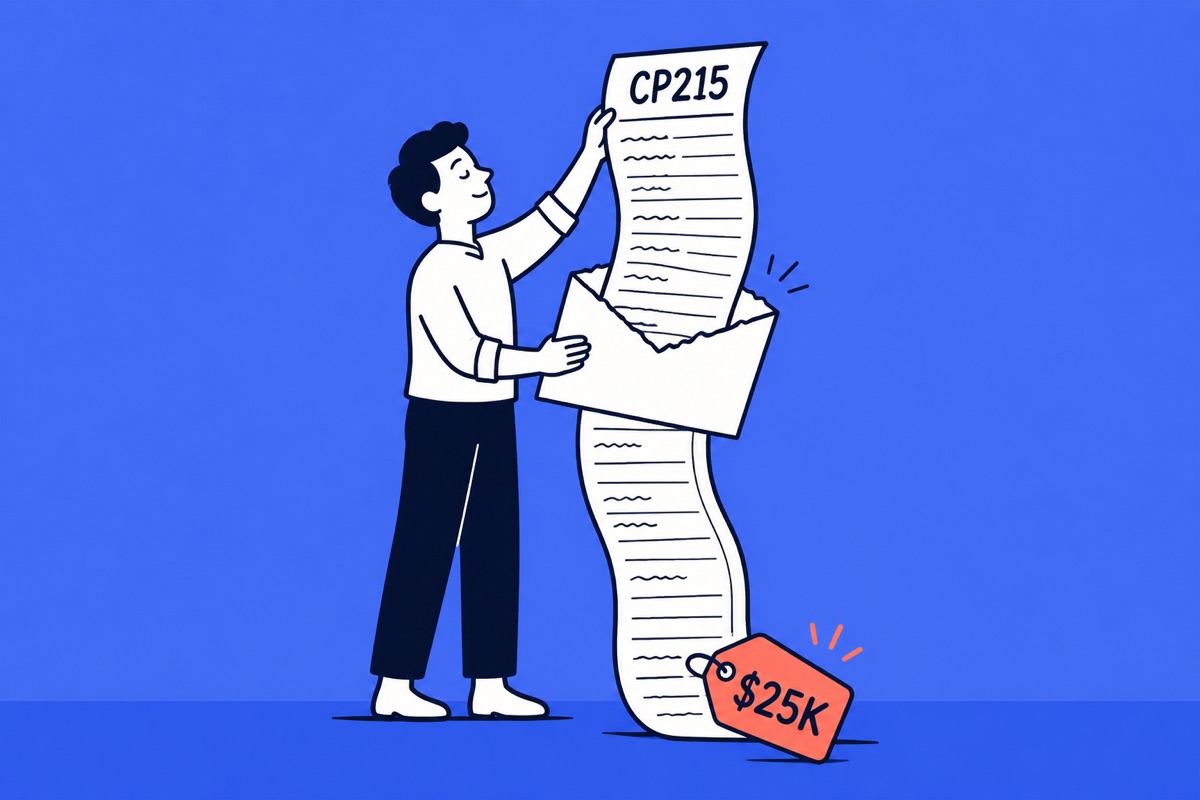
A well-written reasonable cause statement is often the difference between a $25,000 penalty assessed and a penalty abated yet most late filers either skip it entirely or write two vague sentences that give the IRS nothing to work with.
If you are catching up on Form 5472 or Form 1065 filings, or responding to a penalty notice, the statement is your one chance to tell your story before a human decides your case. Most non-resident founders have genuinely sympathetic facts; they just do not know how to present them.
This guide explains what “reasonable cause” actually means, which arguments carry weight and which fall flat, and then gives you five worked example statements you can adapt to your own facts. One thing up front: outcomes vary case by case, and nothing no template, no service, no professional can guarantee abatement.
TL;DR: Reasonable cause means you exercised ordinary business care and prudence and still failed to file on time. Strong statements are specific: dates, names, documents, what you relied on, and proof you corrected the problem promptly once you discovered it. Ignorance of the law alone rarely works but ignorance plus reliance on advisers, a first-year obligation, and prompt correction often does. Attach the statement to the late return or send it in response to the penalty notice.
What “Reasonable Cause” Actually Means
Reasonable cause is not a form or a checkbox. It is a legal standard the IRS applies to the facts of your case, and the core question is always the same: did you exercise ordinary business care and prudence and still fail to comply?
“Ordinary business care and prudence” means acting the way a reasonably careful business owner would keeping records, asking professionals when out of your depth, and dealing with obligations as they arise. You do not have to be perfect. You have to show that the failure happened despite reasonable behavior, not because of careless behavior.
That framing should shape every sentence you write. The statement is not an apology and not a plea for mercy. It is a factual narrative demonstrating care and prudence: what you knew, what you did, what happened anyway, and how fast you fixed it. The IRS describes the standard on its penalty relief for reasonable cause page.
What the IRS Weighs
Reviewers evaluate reasonable cause on the whole picture. The recurring factors:
- The reason itself. What event or circumstance caused the failure, and does it plausibly explain this failure in this period?
- Your compliance history. A clean record or a first-ever US obligation with no history at all reads very differently from repeated late filings.
- The time between the event and the filing. A hospitalization in March explains an April deadline missed by weeks. It does not, by itself, explain a return filed two years later. The gap must match the story.
- Circumstances beyond your control. Events you could not have prevented or planned around disasters, serious illness, undelivered mail weigh far more than events you could manage, like being busy.
- What you did once you knew. Prompt correction after discovery is the single most consistent thread in successful requests. It converts “I failed” into “I acted with care as soon as care was possible.”
What Usually Does NOT Work Alone
Three arguments show up in almost every weak statement:
| Argument | Why it fails alone | What can rescue it |
|---|---|---|
| “I didn’t know the law” | Everyone is presumed to know their filing obligations; plain ignorance is not reasonable cause by itself | Pair it with reliance on professionals who never flagged the form, a first-year obligation, and prompt correction on discovery |
| “I was too busy / understaffed” | Workload is within your control; a prudent owner delegates or extends | Very little drop it unless a specific uncontrollable event consumed the period |
| “My LLC made no money” | Information returns like Form 5472 and Form 1065 are due regardless of profit, so this does not explain the failure at all | Reframe: a dormant company made the obligation less visible, which supports the discovery story but do not offer it as the cause |
None of these facts hurt you when stated honestly as background. They fail only when asked to carry the argument by themselves.
What Strengthens a Case
- Reliance on professional advice. You hired a formation service, accountant, or lawyer, reasonably believed your US filings were handled, and were never told about the form. Name the provider, the dates, and what you were told.
- First year of the obligation. A brand-new entity, a first-ever US filing requirement, and a foreign owner with no US tax background all support the good-faith picture.
- Serious illness or disaster. Hospitalization, a family medical crisis, natural disaster, or civil unrest during the filing window documented with dates and, where possible, records.
- Records genuinely inaccessible. Bank access lost, documents destroyed, or a departed bookkeeper together with what you did to reconstruct them.
- Prompt correction once discovered. The capstone of every strong statement: the date you learned of the obligation and the short interval before you filed.
Notice the pattern: every strengthener is specific, dated, and checkable. That is the difference between a narrative and an excuse.
Want it drafted for you? Form5472.io prepares a professionally drafted, personalized reasonable-cause abatement letter for $39.99 as an add-on to your $147 filing built around your specific facts and ready to attach.
Start your filing →5 Worked Example Statements
The examples below are illustrative templates, not documents to copy verbatim. Adapt every fact to your actual situation the statement is signed under penalties of perjury, and an invented detail that unravels destroys the whole request. None of these examples guarantees any outcome.
Example 1: First-year founder who filed promptly on discovery
“I am the sole owner of [LLC], a Wyoming limited liability company formed on [date]. I am a citizen and resident of [country] and have never previously had any US tax filing obligation. [Tax year] was the company’s first year of existence, and its only activity was my initial capital contribution of [$amount] and payment of state fees. I was unaware that a foreign-owned disregarded entity must file Form 5472 with a pro forma Form 1120; neither the formation service that created the company nor the bank that opened its account mentioned any federal filing requirement. I first learned of the obligation on [date], while researching US compliance requirements. I engaged a preparation service the same week and filed the enclosed return on [date], [number] weeks after discovery. I have set up annual reminders and engaged ongoing support to ensure every future return is timely. I respectfully request that no penalty be assessed, as the failure resulted from a good-faith lack of awareness in my first year of any US obligation, corrected promptly upon discovery.”
Example 2: Owner given wrong advice by a formation service
“I formed [LLC] on [date] through [formation service], purchasing their compliance package, which I understood to cover all required government filings. On [date] I asked their support team whether my company owed any US tax filings, and I was told in writing that a single-member LLC with no US income had ‘no federal filing requirements.’ A copy of that correspondence is enclosed. Relying on that advice, I made no federal filings for [tax year]. I first learned the advice was wrong on [date], when [how you discovered it]. I obtained the correct forms and filed the enclosed return on [date], within [number] weeks. I acted with ordinary business care by seeking guidance from the professional service I had engaged for exactly this purpose, and I corrected the failure promptly once I learned their guidance was incorrect. I respectfully request abatement of the penalty on the basis of reasonable reliance on professional advice.”
Example 3: Medical emergency during the filing window
“I am the sole owner of [LLC] and was responsible for its [tax year] return, due [date]. On [date], approximately [number] weeks before the deadline, I was hospitalized in [city, country] for [condition] and remained under treatment until [date]. Enclosed are medical records confirming the dates of admission, surgery, and recovery. During this period I was unable to manage the company’s affairs, and as its only member there was no one else authorized to act. I returned to work on [date] and filed the enclosed return on [date], [number] weeks after my recovery. My filing history before this event was clean [or: this was the company’s first required return]. The failure to file on time resulted directly from a serious medical event outside my control that coincided with the filing window, and the return was filed as soon as I was reasonably able. I respectfully request that the penalty be abated for reasonable cause.”
Example 4: Natural disaster in the owner’s home country
“I own [LLC] and reside in [city, country]. On [date], [region] was struck by [disaster earthquake, flood, typhoon], which [specific impact: destroyed my office, cut power and internet for X weeks, forced evacuation]. The company’s financial records were kept at [location] and were inaccessible until [date]. Enclosed are [news reports, government emergency declarations, photographs, insurance correspondence] documenting the event and its duration. The company’s [tax year] return was due [date], during the period I was displaced. Once I regained access to my records on [date], I reconstructed the company’s transactions from bank statements and filed the enclosed return on [date]. The failure was caused by a natural disaster entirely outside my control, and I filed within [number] weeks of regaining the ability to do so. I respectfully request abatement of the penalty for reasonable cause.”
Example 5: IRS notices never delivered abroad
“I am the owner of [LLC] and reside at [foreign address], which has been my address of record since formation. I filed the company’s [tax year] return on [date] [or: I was unaware of the outstanding obligation described below]. I did not receive the notices the IRS states were issued on [dates]; international mail to [country] is unreliable, and during [period] postal service to my region was suspended entirely [attach documentation if available postal service announcements, returned-mail records]. I first became aware of the assessed penalty on [date], when [how my bank flagged it, I called the IRS, a notice finally arrived]. I responded within [number] days by [filing the enclosed return / submitting this statement] and have provided a reliable mailing address and authorized [representative] to receive correspondence going forward. Because I acted promptly once I had actual notice, and the delay resulted from circumstances outside my control, I respectfully request abatement of the penalty.”
How to Submit a Reasonable Cause Statement
There are two on-ramps, depending on where you are in the process:
- Filing late, before any penalty: attach the signed statement to the late return itself. For Form 5472 catch-up filings this means one statement accompanying the package it asks the IRS not to assess in the first place, which is the strongest posture available. Our guide on what happens when you never filed Form 5472 covers the full catch-up process.
- Penalty already assessed: respond to the notice (for Form 5472 penalties, typically a CP215) with the statement and supporting documents, referencing the notice number and tax period. See our CP215 notice guide for deadlines and the response address.
Either way: sign it, date it, attach the documents you reference, and keep proof of delivery. For the letter-format version and the full structure the IRS expects, see our penalty abatement letter guide. If the underlying penalty itself is news to you, start with the numbers in our $25,000 Form 5472 penalty guide.
Mistakes That Get Statements Rejected
| Mistake | Why it sinks the request |
|---|---|
| No dates | Without a timeline, the reviewer cannot connect the cause to the failure and an unverifiable story carries no weight |
| Cause does not cover the whole delay | A two-week illness cannot explain a two-year gap; the unexplained period defeats the explained one |
| Ignorance as the entire argument | “I didn’t know” with nothing else no reliance, no first-year facts, no prompt correction is routinely denied |
| Exaggerated or invented facts | The statement is signed under penalties of perjury; one detail that fails verification poisons everything else |
| No evidence attached | Claims about medical events, disasters, or professional advice need the records, correspondence, or reports that back them up |
| Emotional appeals instead of facts | Hardship and remorse are human, but the standard is care and prudence argue the standard |
The Bottom Line
A reasonable cause statement succeeds by showing ordinary business care and prudence with specifics: what caused the failure, why it was outside your control or reasonably relied upon, dates that cover the entire delay, evidence attached, and prompt correction once you knew. Weak statements argue ignorance or hardship in the abstract; strong ones read like a documented timeline. Adapt the five examples above to your true facts and remember that no statement guarantees abatement. Form5472.io can prepare your complete late filing for $147 with a professionally drafted, personalized abatement letter for $39.99.
Frequently Asked Questions
What qualifies as reasonable cause for the IRS?
Facts showing you exercised ordinary business care and prudence and still could not comply. Established grounds include serious illness, natural disasters, inability to obtain records, and reasonable reliance on professional advice each judged on the full circumstances, your compliance history, and how promptly you corrected the failure.
Is ignorance of the law ever reasonable cause?
Rarely on its own. The IRS presumes taxpayers know their obligations. But ignorance combined with supporting facts a first-year foreign owner, professionals who never flagged the form, and a filing made within weeks of discovery forms a genuinely different and much stronger argument.
How long should a reasonable cause statement be?
Usually one page roughly 150 to 400 words. Long enough to give the full timeline with dates, short enough that every sentence works. Attach evidence rather than describing it at length, and cut anything that does not support the care-and-prudence standard.
Where do I send a reasonable cause statement?
Attach it to the late return, or send it in response to the penalty notice. Before assessment, it travels with the filing itself. After assessment, mail it to the address on the notice (for Form 5472 penalties, the CP215), citing the notice number and tax period, with copies of your supporting documents.
Does a reasonable cause statement guarantee the penalty is removed?
No. Every request is decided on its own facts, and outcomes vary no template, preparer, or professional can promise abatement. What a strong statement does is give a sympathetic set of facts its best possible presentation, and filing it promptly costs little compared to accepting a penalty unchallenged.
File Your Form 5472 in Minutes
Skip the paperwork. Our digital tool generates IRS-ready Form 5472 and Pro Forma 1120 instantly.
Start Filing Now