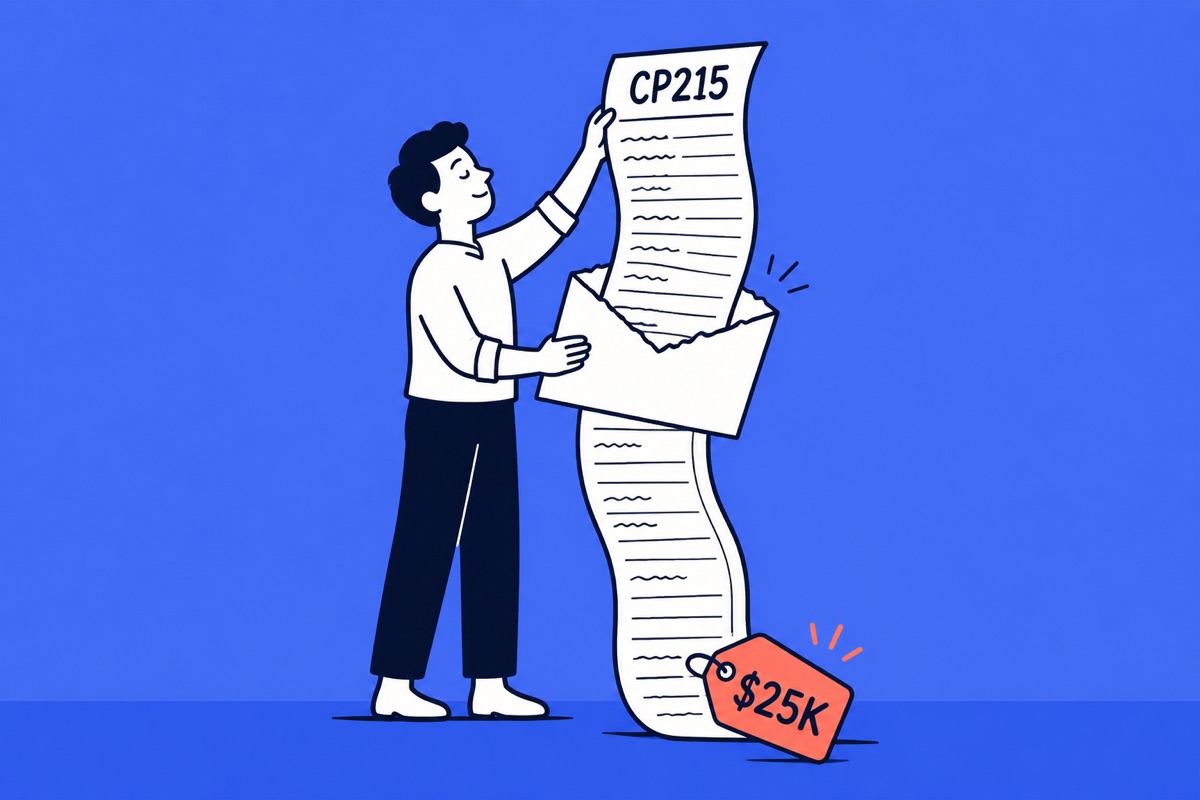
A letter from the IRS demanding $25,000 is frightening especially when you live thousands of miles from the United States and did not even know the form existed. If a CP215 notice just landed for your foreign-owned LLC, take a breath.
You are not the first non-resident founder to receive one, and receiving it does not mean you must pay the full amount, that you are being audited, or that you are in criminal trouble. It is a civil penalty assessment and civil penalties can be contested, reduced, and in many cases removed entirely.
What matters now is how you respond and how quickly. This guide explains exactly what a CP215 notice is, why it was triggered by Form 5472, what each part of the letter means, your four response options, and the step-by-step process for answering it before the deadline printed on the notice.
What Is a CP215 Notice?
A CP215 is a Notice of Penalty Charge the letter the IRS sends a business entity to tell it a civil penalty has been assessed against it. It states the penalty amount, the law it was assessed under, the tax period involved, and when payment is due.
The key word is assessed. By the time a CP215 arrives, the penalty is already on your account this is not a warning or a proposed adjustment. For foreign-owned LLCs, the most common trigger is a late, missing, or incomplete Form 5472, penalized at $25,000 per form, per year under IRC §6038A. These penalties are typically assessed automatically when a return arrives late no audit, no human review of your circumstances.
That automation cuts both ways. It means the notice says nothing about you personally nobody at the IRS reviewed your story and rejected it. It also means the system will not pause on its own. Until you respond, the assessment stands, interest runs, and the file stays open.
Why You Received It for Form 5472
Every foreign-owned US disregarded entity (and every 25% foreign-owned corporation) with reportable transactions must file Form 5472 attached to a pro forma Form 1120 by April 15 each year. A CP215 for Form 5472 usually means one of three things:
- You filed late. Even one day past the deadline (or past your Form 7004 extension) can trigger the full $25,000.
- You never filed. The IRS matched your EIN or a prior-year filing against the current year and found nothing.
- Your filing was incomplete or defective. A Form 5472 submitted without the pro forma 1120, or with substantial information missing, is treated as not filed.
Notice what is not on that list: owing tax. Form 5472 is an information return, so the penalty has nothing to do with unpaid tax a completely dormant LLC that never earned a dollar can receive the same $25,000 assessment as a thriving one. That feels unjust to most owners, and it is precisely why the abatement process exists.
The statute behind all of this is IRC §6038A, and the exposure does not stop at $25,000: if the failure continues after the IRS notifies you, an additional $25,000 accrues for each 30-day period beginning 90 days after notification, with no upper cap. That is exactly why a CP215 should never sit unanswered. Our Form 5472 penalty guide covers the mechanics in depth.
Anatomy of the Notice: What Each Section Means
CP215 notices follow a standard layout. Find each of these items on your letter before deciding anything:
| Section on the notice | What it tells you | Why it matters |
|---|---|---|
| Notice number (CP215) and date | The type of notice and when it was issued | Deadlines run from the notice date |
| Tax period | Which year the penalty relates to | Multiple missed years mean multiple notices check each one |
| Penalty amount and code section | Usually $25,000 citing §6038A for Form 5472 | Confirms exactly what is being penalized |
| Payment due date | When the IRS expects payment | Interest accrues on unpaid balances after assessment |
| Contact and response address | Where to send payment, questions, or a dispute | Responses go to the address on your notice, not a generic IRS address |
Verify the basics too: is the EIN yours, is the entity name correct, and is the tax period one where you actually had a filing obligation? Errors happen, and a mismatched notice is itself a ground for response.
Also check whether this is the only notice. If you never filed for several years, more CP215s for other periods may already be in the mail behind this one. Your response plan should cover every exposed year, not just the one in front of you see our guide on catching up on unfiled Form 5472 years.
Your 4 Options After a CP215
There are exactly four legitimate responses to a CP215. (A fifth ignoring it leads to collection activity, accruing interest, and potentially the uncapped continuation penalty, so it is not on the list.) Here is how they compare:
| Option | Best when | Cost / effort | Realistic outcome |
|---|---|---|---|
| 1. Pay the penalty | You have no defensible reason for the failure and want it closed | $25,000 + any accrued interest | Case closed; stops interest and continuation risk |
| 2. Request reasonable-cause abatement | Circumstances beyond your control caused the failure, and you acted in good faith | A written statement; low cost | Full or partial removal if the facts support it outcomes vary case by case |
| 3. Explore first-time abatement | Clean compliance history | A phone call or letter | Limited FTA formally covers failure-to-file, failure-to-pay, and deposit penalties, and generally does not extend to §6038A information return penalties |
| 4. Appeal | Abatement was denied, or you dispute that the penalty applies at all | Written protest; more time and possibly professional help | Independent review by the IRS Office of Appeals |
For most foreign-owned LLCs whose failure came down to genuinely not knowing the rule, option 2 is the main path. Note the honest caveat on option 3: first-time abatement is an administrative waiver aimed at other penalty types, so do not build your whole response around it but a clean history still strengthens a reasonable-cause request. Our guide to writing a reasonable-cause abatement letter covers what the IRS actually looks for.
Behind on filings? Form5472.io prepares your overdue Form 5472 + pro forma 1120 as IRS-ready PDFs for $147, and can add a professionally structured penalty abatement letter for $39.99 the two documents a CP215 response needs most.
Start your filing →How to Respond, Step by Step
Respond before the deadline printed on the notice. A silent CP215 is the worst outcome: interest keeps accruing, and continued non-filing feeds the continuation penalty clock.
- Fix the underlying failure first. If the Form 5472 for that year was never filed or was incomplete, prepare and submit a complete Form 5472 + pro forma 1120 now. An abatement request for a still-missing return is far weaker. See how to file Form 5472 step by step.
- Write your reasonable-cause statement. Lay out the facts chronologically: what happened, why the failure was outside your control, and what you did to fix it once you knew. Strong statements are specific dates, names of advisors you relied on, copies of correspondence and honest about what went wrong. Sign it under penalties of perjury and attach supporting documents.
- Send everything to the address on the notice. Include a copy of the CP215 itself, reference your EIN and the tax period on every page, and use a mail service with tracking. Keep complete copies.
- Decide about payment. Some owners pay to stop interest and then pursue a refund of the abated amount (a claim often made on Form 843); others request abatement first and pay only what survives. If $25,000 is simply not payable, installment arrangements exist ask using the contact details on the notice.
- Follow up in writing. IRS processing can take months, and international mail adds more. Keep a dated log of every call and letter. If you receive a denial, you can typically request Appeals consideration the denial letter explains how and by when.
One thing not to do: do not re-file the same return repeatedly or send duplicate responses to different IRS addresses hoping one sticks. Duplicate submissions confuse processing and can delay the very abatement decision you are waiting for. One complete, tracked response to the address on the notice then documented follow-up.
How to Prevent the Next One
A CP215 is painful once. It is inexcusable twice because after the first notice, “I didn’t know about Form 5472” is off the table as a reasonable-cause argument, and a prior penalty on your record weighs against future abatement. The prevention list is short:
- Calendar April 15 as a hard annual deadline for Form 5472 + pro forma 1120 every year, even with zero revenue.
- File Form 7004 by April 15 whenever you might be late; it extends you to October 15 automatically.
- Keep proof of filing. Fax to (855) 887-7737 with a transmission confirmation, or mail with tracking our fax filing guide shows how.
- Log owner transactions during the year so the form is accurate and complete an incomplete filing is penalized like a missing one.
The Bottom Line
A CP215 is the IRS telling you a civil penalty for foreign-owned LLCs, usually the $25,000 Form 5472 penalty under §6038A has already been assessed. It is serious but fixable: file the missing or corrected return, send a reasonable-cause abatement request to the address on the notice before the printed deadline, and appeal if denied. Ignoring it is the one move that only makes things worse, because continued non-compliance can add another $25,000 every 30 days. Form5472.io prepares the overdue filing for $147 and the abatement letter for $39.99.
Frequently Asked Questions
Is a CP215 notice the same as an audit?
No. A CP215 is a penalty assessment notice, not an examination of your books. Most Form 5472 penalties are assessed automatically when a return is late or missing. Responding to the notice does not open an audit, and an audit does not automatically follow one.
How long do I have to respond to a CP215?
Use the date printed on your notice that is the operative deadline for your case. Respond before it even if your abatement request is still being polished, because interest accrues on the unpaid balance and unresolved non-filing risks continuation penalties.
Will a CP215 affect my visa or immigration status?
Generally, an IRS civil penalty is separate from immigration decisions. It is not a criminal matter, and receiving one does not create a criminal record. That said, unresolved federal debt can be relevant in some immigration and visa contexts, and rules change so resolve the penalty promptly and consult an immigration attorney about your specific application. This is an area where cautious, individual advice matters.
Can the $25,000 penalty really be removed?
Yes, penalties assessed under §6038A can be abated for reasonable cause. There is no guarantee outcomes depend on your facts but well-documented requests from first-time, good-faith filers who corrected the failure quickly are the strongest candidates. A weak request is still better than silence.
What if I got multiple CP215 notices for different years?
Each year is a separate assessment requiring its own corrected filing and its own response, though one reasonable-cause statement can address the common facts. Deal with every notice resolving one year does not clear the others. See what happens when Form 5472 was never filed for the multi-year catch-up process.
Should I hire a lawyer or CPA to respond?
It depends on the stakes and complexity. A single late year with a clear good-faith story is something many owners handle themselves with a solid abatement letter. Multiple years, large continuation penalties, an Appeals protest, or facts involving other unfiled international forms are worth professional representation.
File Your Form 5472 in Minutes
Skip the paperwork. Our digital tool generates IRS-ready Form 5472 and Pro Forma 1120 instantly.
Start Filing Now