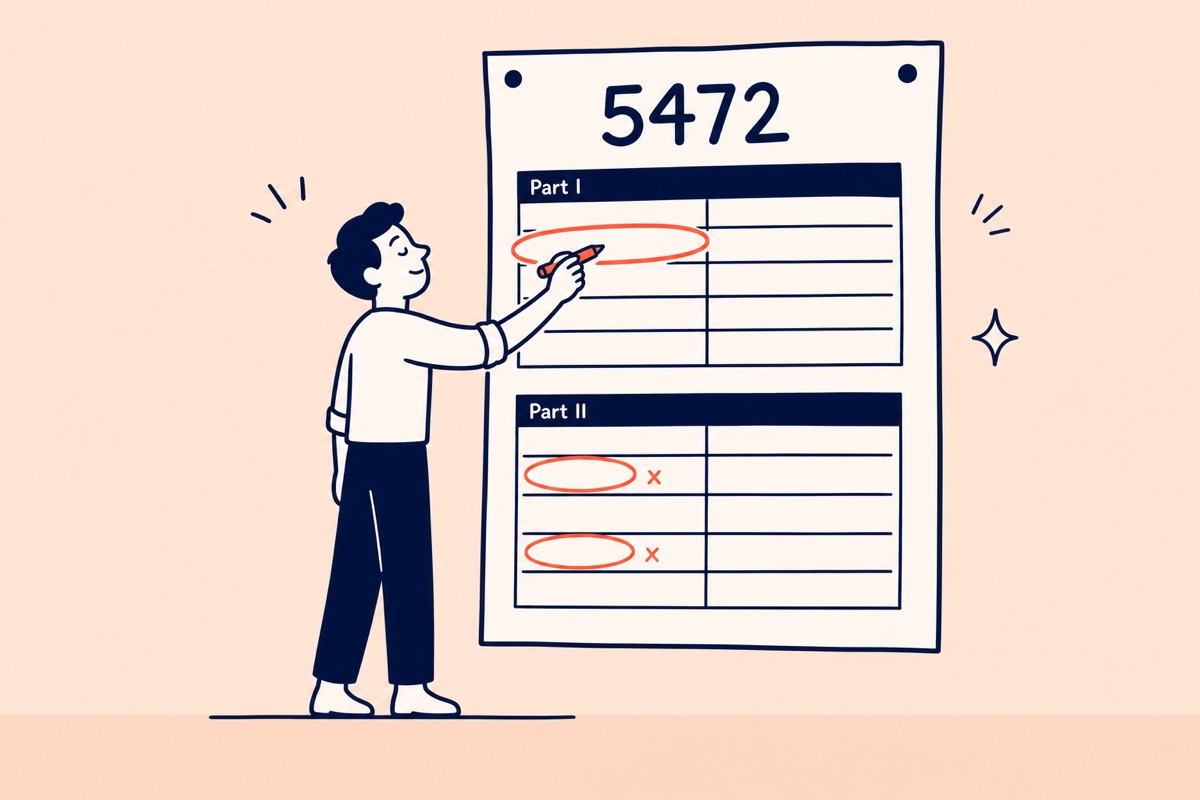
One wrong box on Form 5472 can cost you $25,000. The IRS treats an incomplete or inaccurate form the same way it treats a form that was never filed at all the penalty is identical.
The official IRS instructions run over a dozen pages of dense tax language written for corporate tax departments, not for a founder in Berlin or Bangalore who owns one small Wyoming LLC. Most filers don’t need 90% of the form but they need to know which 90% to skip.
This guide walks through all nine parts of Form 5472 in plain English: what each line asks, what a typical foreign-owned single-member LLC should enter, and which parts you can safely leave blank. It follows the current December 2023 revision of the form and the December 2024 IRS instructions.
How Form 5472 Is Organized
Form 5472 has nine partsspread across three pages. For a simple foreign-owned single-member LLC (a “foreign-owned U.S. disregarded entity,” or DE), only Parts I, II, III, and V do the heavy lifting. Here is the full map:
| Part | What it covers | Applies to a typical single-member LLC? |
|---|---|---|
| Part I | Reporting corporation (your LLC): name, EIN, address, activity | Yes always |
| Part II | The 25% foreign shareholder (you, the owner) | Yes always |
| Part III | The related party involved in the transactions | Yes usually the same person as Part II |
| Part IV | Monetary transactions: sales, rents, royalties, interest, loans | Sometimes often blank for a simple DE |
| Part V | Foreign-owned U.S. DE transactions: formation, contributions, distributions | Yes this is where your transactions usually go |
| Part VI | Nonmonetary and less-than-full consideration transactions | Rarely |
| Part VII | Additional information (hybrid payments, FDII, section 385) | Yes, but usually all “No” answers |
| Part VIII | Cost sharing arrangements (CSA) | Almost never |
| Part IX | Base erosion payments under section 59A (BEAT) | Almost never |
You can download the current form and official instructions directly from the IRS at irs.gov/forms-pubs/about-form-5472. Keep them open in another tab as you read the line references below match the current revision.
Part I Reporting Corporation
Part I identifies your LLC. It looks simple, but this is where the most penalty-triggering errors happen. Line by line:
- Line 1a Name and address.Enter the exact legal name from your Articles of Organization, plus the LLC’s mailing address. A foreign address is fine.
- Line 1b EIN.Your LLC’s Employer Identification Number. Copy it from your CP 575 confirmation letter. If you don’t have an EIN yet, get one before filing see our guide to getting an EIN for a foreign-owned LLC.
- Line 1c Total assets.The corporation’s total assets at year end.
- Lines 1d and 1e Principal business activity and code.A short description (e.g., “e-commerce retail”) plus the matching six-digit NAICS-based code from the Form 1120 instructions.
- Line 1f Total value of gross payments. The total dollar value of all reportable transactions on this Form 5472.
- Lines 1g and 1h.How many Forms 5472 you are filing this year (one per related party) and the combined value of transactions across all of them. Most single-member LLCs file exactly one, so 1g is “1” and 1h equals 1f.
- Line 1i. Consolidated filing checkbox leave blank for an LLC.
- Line 1j. Check this box if this is the first year your entity is filing Form 5472.
- Line 1k. Number of Parts VIII attached (cost sharing arrangements) typically zero or not applicable.
- Lines 1l and 1m Country and date of incorporation. For a US LLC, the country is the United States and the date is your formation date.
- Lines 1n and 1o. The country (or countries) where the entity files an income tax return as a resident, and the principal country where it does business.
Then come two critical checkboxes. Question 2 asks whether a foreign person owns, directly or indirectly, at least 50% of the entity for a wholly foreign-owned LLC, check yes. Question 3 is the foreign-owned U.S. DE checkbox. If your LLC is a single-member LLC that has not elected corporate taxation, you must check this box. It tells the IRS you are filing as a disregarded entity attached to a pro forma 1120 and it activates Part V of the form.
Part II 25% Foreign Shareholder
Part II identifies the foreign owner. For a single-member LLC, that is you (or your foreign company, if the LLC is owned by an entity).
- Line 4a. Name and address of the direct 25% foreign shareholder.
- Line 4b(1) U.S. identifying number.Your SSN or ITIN, if you have one. Most non-resident owners don’t and you are not required to get an ITIN just to file Form 5472.
- Line 4b(2) Reference ID number. If you have no US tax ID, you must create a reference ID: an alphanumeric code (up to 50 characters, no special characters) that you invent yourself, such as MARIASILVA001. The rule that matters: use the same reference ID every year. Changing it breaks the IRS’s ability to match your filings.
- Line 4b(3) Foreign taxpayer identification number (FTIN).For a foreign-owned U.S. DE, the instructions ask for the owner’s tax ID from their home country, if one exists.
- Lines 4c through 4e. The country where the shareholder mainly does business, their country of citizenship (or organization, for entities), and the country where they file income tax as a resident.
Lines 5a–5e repeat the same questions for a second direct 25% shareholder, and lines 6 and 7 cover ultimate indirect shareholders (relevant when your LLC is owned through a holding company). A single-member LLC owned directly by one person leaves all of these blank.
Part III Related Party
Part III identifies the specific related party your LLC transacted with during the year. Each Form 5472 covers one related party if you transacted with two (say, you personally and your foreign company), you file two forms.
For most single-member LLCs, the related party is the same person as the Part II shareholder, so Part III largely repeats Part II:
- Checkboxes for whether the related party is a foreign or US person.
- Lines 8a and 8b. Name, address, and identifying numbers use the same reference ID you created in Part II.
- Lines 8c and 8d.The related party’s principal business activity and code. For an individual owner, describe what you do (e.g., “consultant”).
- Line 8e. The relationship checkbox for an owner-member, check that the related party is the 25% foreign shareholder.
- Lines 8f and 8g. Country where the related party conducts business and where they file income tax.
Nine parts, three pages, one $25,000 mistake waiting to happen. Form5472.io asks you plain-English questions, fills every applicable line of Form 5472 plus the pro forma 1120, and gives you IRS-ready PDFs in about 15 minutes $147 one-time, no CPA required.
Start your filing →Part IV Monetary Transactions
Part IV is a grid of dollar amounts for transactions between the reporting corporation and the foreign related party named in Part III. The categories include:
- Sales and purchases of inventory and tangible property
- Rents and royalties received or paid
- Fees for technical, managerial, or engineering services
- Commissions received or paid
- Amounts borrowed or loaned, and interest received or paid
- Insurance premiums and other amounts
Here is the part that confuses almost everyone: capital contributions and distributions do not go in Part IV. If you are a foreign-owned disregarded entity, the money you put into your LLC and the money you take out are reported in Part V, not Part IV. A simple DE with no rent, loans, or service fees between owner and company will often leave Part IV entirely blank and that is correct.
If your LLC did pay you (or your foreign company) for services, rent, or interest, enter the annual totals on the matching lines. Not sure what counts? Our breakdown of Form 5472 reportable transactions covers every category with examples.
Part V Foreign-Owned U.S. DE Transactions
Part V exists only for foreign-owned U.S. disregarded entitiesthe box you checked on Part I, question 3. It captures the transactions that Part IV was never designed to hold:
- Amounts paid or received in connection with the formation, dissolution, acquisition, or disposition of the entity
- Contributions to the entity (money you put in)
- Distributions from the entity (money you took out)
Mechanically, Part V is a checkbox plus an attached statement. You check the box, then attach a short statement describing each transaction and its dollar amount for example: “Capital contribution from sole member: $5,000. Distribution to sole member: $1,200. State formation fee paid by member on behalf of entity: $102.”
For the vast majority of foreign-owned single-member LLCs, Part V is where the real reporting happens. Even an LLC with zero revenue almost always has a Part V entry, because funding your own LLC is a reportable contribution. If your LLC had no income and no operations, Part V may be the only place with dollar amounts on the entire form see our guide to filing Form 5472 with no activity for exactly how a zero-year filing looks.
A worked example. Lena, a resident of Austria, formed a Wyoming LLC in March, paid the $102 state fee and a $125 registered agent fee personally, and wired $3,000 into the LLC’s account in June. Her Part V statement reports three items: formation costs of $227 paid by the sole member on behalf of the entity, and a capital contribution of $3,000. Her Part I, line 1f total is $3,227 and Parts IV and VI stay blank because nothing else happened.
Parts VI–IX When They Apply (Usually They Don’t)
The last four parts exist mainly for multinational groups. Most simple LLCs interact with them only by answering “No” or leaving them blank:
| Part | What it asks | Typical single-member LLC answer |
|---|---|---|
| Part VI Nonmonetary transactions | Exchanges of property, rights, or services without cash, or for less than full value | Check the box and attach a schedule only if it happened; otherwise blank |
| Part VII Additional information | Questions 37–43 on hybrid payments (section 267A), FDII deductions (section 250), safe-haven interest rates, and section 385 debt reclassification | Answer the questions almost always all “No” |
| Part VIII Cost sharing arrangement | Details of any CSA for developing intangibles with related parties | Not applicable “No” answers |
| Part IX Base erosion payments | BEAT amounts under section 59A, including base erosion tax benefits and qualified derivative payments | Not applicable BEAT targets corporations with $500M+ in gross receipts |
One caution on Part VII: don’t skip the questions. An unanswered yes/no question can make the form “substantially incomplete,” which the IRS treats the same as not filing. Answer every question, even when every answer is “No.”
The Lines That Trigger IRS Scrutiny
Penalty notices rarely come from exotic errors. They come from a handful of basic lines filled in wrong the same ones we see again and again:
- A blank or mistyped EIN (line 1b). The IRS matches Form 5472 to your pro forma 1120 by EIN. A typo means no match, and no match can mean an automatic penalty.
- Missing reference ID (line 4b(2)). If the owner has no US tax ID and no reference ID is entered, the shareholder section is incomplete.
- An inconsistent reference ID.Using “OWNER1” one year and “JSMITH2026” the next looks like a different owner.
- Totals that don’t reconcile. Line 1f should equal the sum of everything reported in Parts IV, V, and VI. If 1f says $10,000 and your Part V statement says $6,000, expect questions.
- The DE checkbox left unchecked. Skipping question 3 while filing with a pro forma 1120 creates a contradiction the IRS flags.
- Unanswered Part VII questions see above.
For the full list of penalty-triggering errors, see our guide to the 10 most common Form 5472 mistakes.
One final mechanical point: a perfectly completed Form 5472 can still earn a penalty if it is submitted wrong. The form attaches to a pro forma Form 1120 and cannot be e-filed through consumer software it goes by mail to the IRS service center in Ogden, Utah, or by fax to (855) 887-7737, and it must arrive by April 15 unless you extended to October 15 with Form 7004.
The Bottom Line
Form 5472 has nine parts, but a typical foreign-owned single-member LLC only completes four of them: Part I (your LLC), Part II (you), Part III (you again, as the related party), and Part V (contributions, distributions, and formation costs). Parts IV and VI apply only when specific transactions occurred, and Parts VII–IX are usually “No” answers or blank.
The form attaches to a pro forma Form 1120 and is due April 15, extendable to October 15 with Form 7004. An incomplete form carries the same $25,000 penalty as no form at all so answer every applicable line, keep your reference ID consistent, and make the totals reconcile. When you are ready to file, our step-by-step filing guide covers submission by mail or fax or let Form5472.io generate the whole package for you.
Frequently Asked Questions
Do I need to complete all nine parts of Form 5472?
No. You complete only the parts that apply. A typical foreign-owned single-member LLC completes Parts I, II, III, and V, answers the yes/no questions in Part VII, and leaves Parts IV, VI, VIII, and IX blank unless those specific transactions occurred. Skipping a part that does apply, however, makes the filing incomplete.
Where do capital contributions go on Form 5472?
For a foreign-owned U.S. disregarded entity, capital contributions and distributions are reported in Part V, not Part IV. You check the Part V box and attach a statement describing each contribution or distribution with its dollar amount. Part IV is reserved for transactions like sales, rents, service fees, loans, and interest.
What is a reference ID number on Form 5472?
A reference ID is an alphanumeric code (up to 50 characters) you create yourself to identify a foreign owner who has no US SSN, ITIN, or EIN. It goes on line 4b(2) in Part II and line 8b in Part III. The critical rule: use the exact same reference ID every year so the IRS can link your filings.
Do I need an ITIN to file Form 5472?
No. If the foreign owner has no US taxpayer identification number, you enter a self-created reference ID instead. You do not need to apply for an ITIN just to file Form 5472, though you should provide your foreign tax ID (FTIN) where the form requests it.
What happens if I file Form 5472 with a mistake?
A substantially incomplete or inaccurate Form 5472 carries the same $25,000 penalty as not filing. If you discover an error after submitting, file a corrected Form 5472 with an amended pro forma 1120 as soon as possible. Small typos rarely draw penalties on their own, but missing parts, blank identifying numbers, and unreported transactions do.
File Your Form 5472 in Minutes
Skip the paperwork. Our digital tool generates IRS-ready Form 5472 and Pro Forma 1120 instantly.
Start Filing Now