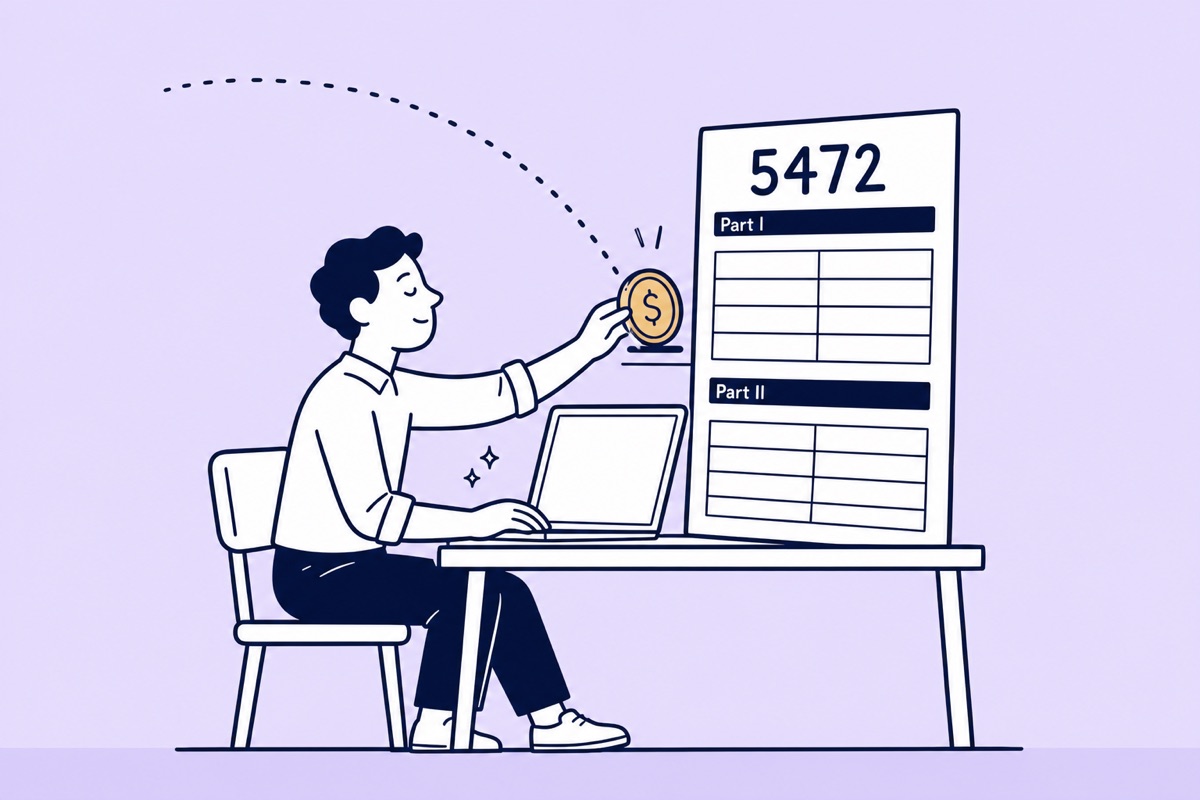
If you freelance through a US LLC on Upwork, Fiverr, Toptal, or straight-to-client contracts and you are not a US resident, there is a federal filing almost no freelancer has heard of: Form 5472. It is not an income tax return, it has nothing to do with the W-8BEN you gave the platform, and missing it carries an automatic $25,000 penalty even if you billed $3,000 all year. This guide maps every step of the freelancer money loop client to platform to LLC bank account to your pocket onto what the IRS actually wants reported.
The reason freelancers get blindsided is structural. Upwork asks for a tax form, you submit it, and the platform goes quiet. That feels like compliance. It is not: the form you gave Upwork answered Upwork’squestion about whether to withhold. Nobody ever asked the IRS’s question about your LLC.
Do Freelancers With a Foreign-Owned US LLC Have to File Form 5472?
Almost certainly yes. If your single-member US LLC is owned by a non-US person and had even one transaction with you during the year a withdrawal to your personal account, a formation fee you paid on your own card, money you put in to open the bank account you must file Form 5472 attached to a pro forma Form 1120.
The rule applies to any US disregarded entity (a single-member LLC that has not elected corporate taxation) that is 25% or more foreign-owned and had a reportable transaction with a foreign related party. For a freelancer, the related party is normally just you. And unlike a product business, a freelancer does not need inventory, staff, or a launch to trip the wire the very first time you move earnings out of the LLC, you have created a reportable transaction.
This article covers the single-member case, which is the standard freelancer setup. If you formed the LLC with a partner, you file a partnership return instead see single-member vs multi-member LLC filing. Not sure which bucket you are in? Our free filing requirement quiz answers it in under a minute.
“I’m Just One Freelancer” Why There Is No Small-Business Exemption
Form 5472 has no revenue floor, no headcount test, and no small-business carve-out. The requirement attaches to the entity’s classification a foreign-owned US disregarded entity and to whether transactions occurred with a related party. Nothing about the size of your business enters the analysis.
This surprises freelancers more than any other group, because every other rule they have met scales with size. Sales tax has nexus thresholds. Home-country tax systems have personal allowances. VAT registration has turnover limits. Form 5472 has none of that. A solo designer with $8,000 of Fiverr income and a New Mexico LLC has exactly the same obligation as a company moving eight figures.
The penalty is flat for the same reason. It is $25,000 per form, per year regardless of income which means the penalty for a $10,000-a-year freelance LLC can exceed two years of revenue. Run your own numbers in the penalty calculator if you have missed a year. Small businesses are not spared here; they are simply the ones for whom the fine is catastrophic.
What Form 5472 Actually Is (and What It Is Not)
Form 5472 is an information return: it discloses transactions between your US LLC and its foreign owner so the IRS can see money crossing the border between related parties. It calculates zero tax. Filing it does not create a tax bill, and it is not evidence that you owe anything.
It is also not a substitute for or substituted by anything else you have signed. It is not your income tax return, not the platform’s W-8BEN, not your state annual report, and not the FinCEN BOI report. The form travels attached to a pro forma Form 1120, which is just a cover page: your LLC’s name, address, EIN, tax year, with “Foreign-owned U.S. DE” written across the top and the income lines left blank. For the full mechanics and history, see our complete Form 5472 guide.
The Freelancer Money Loop: Which Flows Are Reportable?
A reportable transaction is any exchange of money or value between your LLC and a foreign related party primarily you. Client payments and platform fees involve unrelated parties and stay off the form entirely, however large they are.
Freelance money travels a predictable loop: the client pays the platform, the platform holds the funds and takes its cut, the platform pays out to your LLC’s US bank account, and eventually you move the money to your own account at home. Only the last leg is reportable. Here is the whole loop, step by step the table nobody publishes:
| Step in the freelancer money loop | Reportable on Form 5472? | Why |
|---|---|---|
| Client funds an Upwork escrow / Fiverr order for your work | No | Unrelated customer paying an unrelated platform |
| Upwork or Fiverr deducts its service fee before payout | No | Expense paid to an unrelated party |
| Platform payout lands in the LLC’s US bank account | No | Business revenue from unrelated sources |
| Payout routed via Payoneer or Wise into the LLC account | No | Same revenue, different rails still unrelated parties |
| You transfer LLC funds to your personal foreign account | Yes | Distribution to the foreign owner |
| You spend from the LLC card on personal living costs | Yes | A distribution in substance, whatever you call it |
| You pay a software subscription for the business on your personal card | Yes | Owner paid an LLC expense treated as a contribution |
| You wire personal money in to open or top up the LLC account | Yes | Capital contribution from the foreign owner |
| State formation fee or registered agent you paid personally | Yes | Formation amounts are expressly reportable |
| You lend money to the LLC, or the LLC lends to you | Yes | Loans with a related party, in either direction |
| The LLC pays a subcontractor who is unrelated to you | No | Ordinary vendor payment |
| The LLC pays your spouse, sibling, or your own home-country company | Yes | Service payment to a foreign related party |
The pattern in one line: client money and platform money stay off the form; your money goes on it. For the full taxonomy with form line references, see reportable transactions explained.
Do Upwork and Fiverr Payouts Go on Form 5472?
No. A platform payout is revenue earned from unrelated clients and routed through an unrelated marketplace. Neither the client nor Upwork nor Fiverr is a related party to you, so the deposit itself never appears on Form 5472.
This is the question freelancers ask most, because payouts are the biggest and most frequent numbers in the account. But size is irrelevant to this form. A $120,000 year of Upwork disbursements adds nothing, while a single $400 transfer from your personal account to cover the LLC’s registered agent renewal must be reported. The only thing that matters is who is on the other side of the transaction.
The same logic covers every channel a freelancer uses Stripe invoices to a direct client, PayPal from a retainer customer, a wire from an agency. Our Stripe & PayPal guide for foreign-owned LLCs runs the identical analysis for non-marketplace payments.
The Withdrawal Trap: Every Transfer to Yourself Is a Distribution
Any transfer from the LLC to you is a distribution, and distributions are reportable every time, in every amount. It makes no difference whether you call it salary, drawings, profit, a reimbursement, or “moving my own money.”
This is where freelancers are exposed in a way product sellers are not. An importer contributes large sums into the LLC to buy inventory, so contributions dominate their form. A freelancer contributes almost nothing the business needs a laptop and a Notion subscription and concludes there is nothing to report. The opposite is true: freelancers withdraw more often than anyone, because the LLC account is how they pay themselves. Twelve monthly transfers to your bank at home is twelve reportable events, totaled on the form.
Two habits worth adopting now. First, keep the LLC account separate from personal spending paying your rent from the business card is a distribution in substance, and untangling it in April is painful. Second, keep a one-line ledger of each transfer out (date, amount). See our guide to US LLC bank accounts for non-residents for how to structure the accounts cleanly from the start.
“But I Already Filed a W-8BEN With Upwork”
A W-8BEN is not a tax return, and it does not go to the IRS from you. It is a certificate of foreign status you hand to a payer Upwork, Fiverr, a direct client so that payer knows you are not a US person and can decide how much, if anything, to withhold. The payer keeps it on file.
The false comfort is understandable. Upwork prompts you for a tax form during onboarding, you submit W-8BEN (or W-8BEN-E if the account is held by the LLC as an entity), and the platform marks your tax profile complete. Nothing else ever asks you for anything. So the natural conclusion is that your US tax obligations are handled when in fact only the platform’s withholding question was answered.
Form 5472 asks a completely different question: what money moved between this US entity and its foreign owner? Upwork has no visibility into that, no obligation to tell you about it, and no role in filing it. You can read what the certificate is actually for at irs.gov/forms-pubs/about-form-w-8ben.
W-8BEN vs Form 5472 vs Form 1040-NR: Who Files What
Three documents get confused constantly because all three involve a non-resident and US money. They have different authors, different recipients, and completely different consequences:
| Form W-8BEN / W-8BEN-E | Form 5472 (+ pro forma 1120) | Form 1040-NR | |
|---|---|---|---|
| What it is | Certificate of foreign status | Information return about the LLC | Non-resident income tax return |
| Who submits it | You, as the payee | The LLC | You, as the individual owner |
| Who receives it | The payer (Upwork, Fiverr, a client) | The IRS | The IRS |
| Triggered by | Being paid by a US payer as a foreign person | Any reportable transaction with a foreign related party | Having US-source effectively connected income |
| Tax calculated | None it governs withholding | None information only | Yes |
| If you skip it | The payer may withhold at the default rate | Automatic $25,000 per form, per year | Interest and penalties on unpaid tax |
Read the bottom row across. The W-8BEN you already filed protects your payout rate. It does nothing about the $25,000 column in the middle and that column is the one with an automatic penalty attached.
Freelancing through a US LLC and haven’t filed? Form5472.io prepares your Form 5472 and pro forma 1120 withdrawals, contributions, and owner-paid expenses in the right boxes, IRS-ready and faxed for you in about 15 minutes for $147 one-time. No CPA required.
Start your filing →Money In: The Contributions Freelancers Forget
Every dollar you personally put toward the business is a capital contribution, and contributions are reportable including money that never touched the LLC bank account.
Freelancers assume this section is empty because they never “invested” in the business. Then the year’s receipts turn up items like these:
- The state formation fee and first-year registered agent, paid on your personal card before the LLC had an account
- The opening deposit that activated the business bank account
- A year of Adobe, Figma, or Upwork Connects billed to your personal card out of habit
- A laptop or camera bought personally and used for client work
- The formation service’s package fee and any EIN assistance
Each one is an LLC expense settled with the owner’s money, which the IRS treats as a contribution to the entity. In year one these items alone usually make the filing mandatory before a single client has paid you which is exactly why a dormant freelance LLC still has a Form 5472 obligation.
Paying Subcontractors: When a Freelancer Creates a Related-Party Transaction
Payments to unrelated subcontractors the editor you found on Upwork, an agency you white-label to are ordinary business expenses and stay off Form 5472. Payments to someone related to you are a different story.
Growing freelancers often build a small team from people close to them: a spouse handling admin, a sibling doing design, or a company you own in your home country invoicing the US LLC for “development services.” When the LLC pays any of those, it is a related-party service payment and the gross amounts must be reported on Form 5472. The related-party net is wide: close relatives, and any entity you or your family control at 25% or more.
Report the gross figures accurately and keep the invoices. A substantially incomplete Form 5472 carries the same $25,000 penalty as an unfiled one, and a two-company structure with unreported service fees is precisely the arrangement the form exists to surface.
Do You Owe US Income Tax on Freelance Income?
Form 5472 discloses transactions; it does not decide whether you owe US income tax. That turns on whether your earnings are US-source effectively connected income (ECI)a separate, fact-specific question.
The honest summary for freelancers is more favorable than for product sellers. Many foreign-owned service LLCs with no US office, no US employees, and an owner performing all the work from abroad owe no US income tax yet they still must file Form 5472. The analysis changes if you have US-based staff, a US office, or spend meaningful working time physically in the United States, and a tax treaty with your home country may affect the outcome. If your income is effectively connected, you would file Form 1040-NR as the owner.
Two takeaways. Get a professional read on your ECI position, because it depends on your country and setup. And whatever that answer is, Form 5472 is due either way it is the one filing that does not wait for the income-tax question to be settled. Our overview of foreign-owned LLC tax obligations shows how the pieces fit together.
Deadlines, Penalties, and How to File
Form 5472 is due April 15 following the tax year for calendar-year filers, attached to a pro forma Form 1120, and the penalty for missing it is $25,000 per form, per yearunder IRC §6038A with another $25,000 for each 30-day period the failure continues once you are 90 days past an IRS notice. The penalty is automatic: no audit, no hearing, just a notice in the mail.
Step 1: Total your owner transactions
Add up your distributions (every transfer out to yourself, plus personal spending on the business card), your contributions (money in, plus LLC costs you paid personally), any loans in either direction, and any service payments to related people or companies. Platform payouts, platform fees, and unrelated vendor invoices stay out of these totals.
Step 2: Prepare Form 5472 + pro forma 1120
The pro forma 1120 is the cover page: name, address, EIN, tax year, “Foreign-owned U.S. DE” across the top, income lines blank. Form 5472 carries the substance the LLC in Part I, you in Part II, the related party in Part III, related-party service payments in Part IV, and contributions and distributions in Part V. You need an EIN; an ITIN is not required for this form. Official instructions: irs.gov/instructions/i5472.
Step 3: Fax or mail it you cannot e-file
Foreign-owned disregarded entities cannot e-file this package. It goes by fax to (855) 887-7737 or by mail to the IRS in Ogden, Utah. Need more time? A Form 7004 extension faxed or mailed by April 15 moves the deadline to October 15.
Key Takeaways
- A non-resident freelancing through a US single-member LLC almost always must file Form 5472 + pro forma 1120 regardless of income.
- There is no small-freelancer exemption and no minimum dollar threshold; the $25,000 penalty is flat at every revenue level.
- Upwork and Fiverr payouts, platform service fees, and client payments are not reportable no foreign related party is involved.
- Every transfer from the LLC to your personal account is a reportable distribution, however you label it.
- Business costs you paid on a personal card formation fees, software, hardware are reportable contributions.
- The W-8BEN you gave Upwork is a withholding certificate held by the payer; it satisfies nothing at the IRS.
- Paying a spouse, relative, or your own foreign company for services creates a related-party transaction that must be reported.
- Form 5472 calculates no tax; whether freelance income is US-taxable is a separate ECI / Form 1040-NR question.
- Deadline: April 15, extendable to October 15 with Form 7004 filed by April 15; fax to (855) 887-7737 or mail to Ogden, UT e-filing is not available.
- Keep a running ledger of transfers to yourself it turns April into a 15-minute task instead of a bank-statement archaeology project.
Frequently Asked Questions
Do freelancers on Upwork or Fiverr with a foreign-owned US LLC need to file Form 5472?+
Almost always yes. The filing is triggered by transactions between you and your LLC money you withdraw to your personal account, formation fees you paid yourself, capital you put in not by how much you earned or how many clients you have. There is no exemption for solo freelancers and no minimum dollar threshold.
Are Upwork or Fiverr payouts reportable transactions on Form 5472?+
No. Platform payouts are revenue from unrelated clients paid through an unrelated marketplace, so they are not related-party transactions. What becomes reportable is the next step: when you move that money out of the LLC to your own personal foreign account, that withdrawal is a distribution and goes on the form.
I already submitted a W-8BEN to Upwork. Isn't that my US tax filing?+
No. Form W-8BEN is a withholding certificate you give to a payer so it knows you are not a US person it is never sent to the IRS by you. Form 5472 is an information return you file with the IRS about your LLC. Submitting a W-8BEN does nothing to satisfy the Form 5472 requirement.
Does the platform's service fee count as a reportable transaction?+
No. Upwork's and Fiverr's service fees are payments to an unrelated party, exactly like any other vendor expense. They are ordinary business costs for bookkeeping purposes, but they never appear on Form 5472 because no foreign related party is on the other side.
My freelance LLC earned very little. Is there a minimum before Form 5472 applies?+
There is no de minimis threshold. A single reportable transaction of any size triggers the filing, and the $25,000 penalty is flat identical for an LLC that earned $2,000 and one that earned $2 million. Low income is a reason to file yourself rather than hire a CPA, not a reason to skip filing.
When is Form 5472 due, and can I e-file it?+
April 15 following the tax year for calendar-year filers, attached to a pro forma Form 1120, extendable to October 15 by filing Form 7004 by April 15. Foreign-owned disregarded entities cannot e-file this package it goes to the IRS by fax to (855) 887-7737 or by mail to Ogden, Utah.
File Your Form 5472 in Minutes
Skip the paperwork. Our digital tool generates IRS-ready Form 5472 and Pro Forma 1120 instantly.
Start Filing Now