Adding a co-founder to your US LLC or dropping one does not just change your operating agreement. It changes which IRS forms you file, when they are due, and how much a missed deadline costs you. A single-member foreign-owned LLC and a multi-member one live under two completely different sets of tax filing rules.
Most non-resident founders discover this the hard way: they assume the filing they did last year still applies, miss a deadline they did not know existed, and get a penalty notice months later. The difference is not small one structure risks a $25,000 flat penalty, the other racks up per-partner, per-month charges.
This guide compares single-member vs multi-member LLC tax filing for non-US residents: the forms, the deadlines, the penalties, the costs, and what happens when you switch from one structure to the other mid-year.
Quick Verdict: The Comparison at a Glance
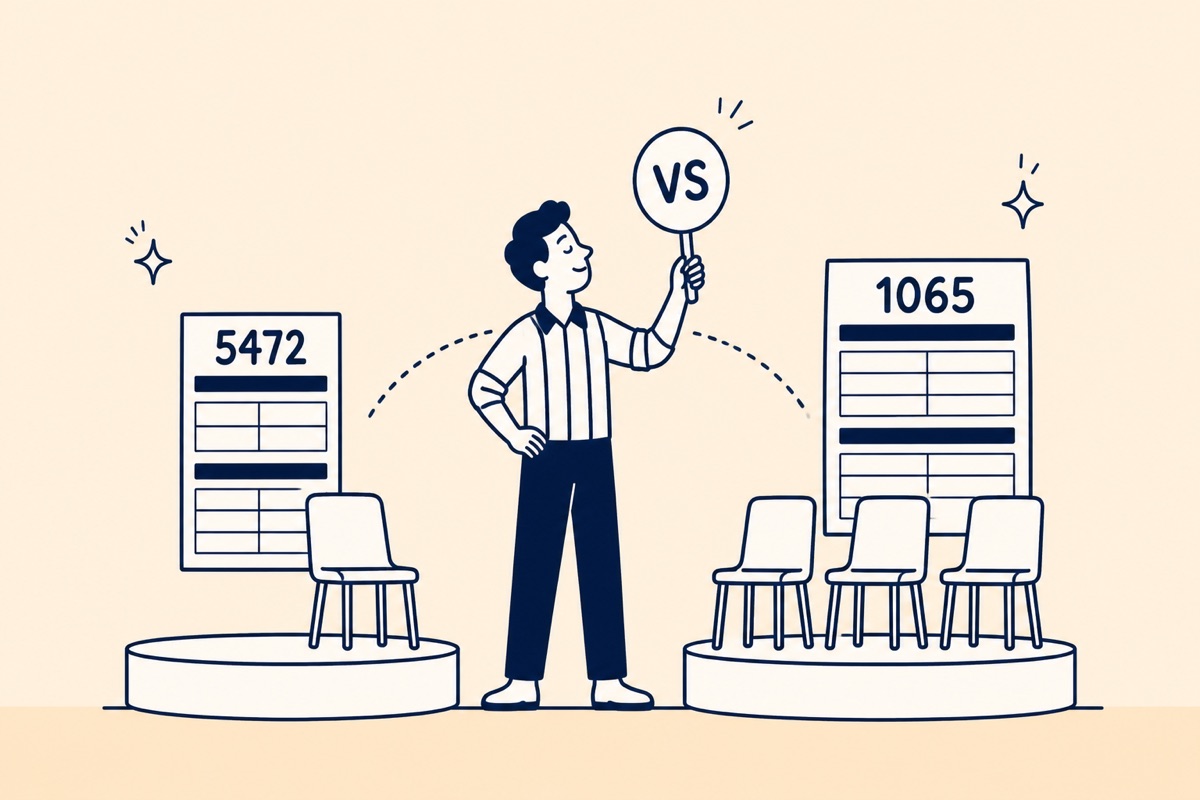
Here is the short version. A foreign-owned single-member LLC files Form 5472 attached to a pro forma Form 1120, due April 15. A foreign-owned multi-member LLC files Form 1065 plus a Schedule K-1 for each member, due March 15. Everything else flows from that split.
| Factor | Single-Member LLC | Multi-Member LLC |
|---|---|---|
| IRS classification | Disregarded entity | Partnership (default) |
| Forms filed | Form 5472 + pro forma Form 1120 | Form 1065 + Schedule K-1 per member |
| Deadline (calendar year) | April 15 | March 15 |
| Extension | October 15 (Form 7004) | September 15 (Form 7004) |
| Late-filing penalty | $25,000 per form, per year | $255 per partner, per month (2025 tax year) |
| Complexity | Lower mostly informational | Higher income allocation across members |
| Typical filing cost | $147 with Form5472.io; $500+ with a CPA | $147 with Form5472.io; $800–$2,000+ with a CPA |
A few things are the same on both sides, and it helps to name them up front. Both structures are pass-throughs by default the LLC itself generally pays no federal income tax. Both filings are required even with zero income. Both deadlines can be extended six months with the same form, Form 7004. And both leave state-level obligations (annual reports, franchise taxes) untouched those vary by state and run on their own calendars. Everything else diverges, so let’s take each structure in turn.
How Single-Member LLCs Are Taxed
By default, the IRS treats a single-member LLC as a disregarded entity. The company does not exist separately from its owner for income tax purposes. The LLC itself usually pays no US income tax; whether the owner owes any US tax depends on whether the business has US-source income effectively connected with a US trade or business.
But “disregarded” does not mean “invisible.” Since 2017, a foreign-owned disregarded LLC is treated as a domestic corporation solely for reporting purposes under IRC §6038A. That means it must file:
- Form 5472 reporting transactions between the LLC and its foreign owner (capital contributions, distributions, loans, payments)
- A pro forma Form 1120 a mostly blank corporate return that acts as the cover sheet for Form 5472
Two things surprise most solo founders here. First, the filing is required even if the LLC earned nothing the trigger is a reportable transaction, and simply funding your own company counts. Second, the pro forma 1120 is not a real tax return; it is a mostly blank cover sheet with the LLC’s name, EIN, and a checkbox, existing only so the Form 5472 has something to attach to.
The package is due April 15 for calendar-year filers, with an automatic extension to October 15 available via Form 7004. It cannot be e-filed through consumer software it goes to the IRS by mail or by fax at (855) 887-7737. For the full picture, see our complete Form 5472 guide.
How Multi-Member LLCs Are Taxed
The moment an LLC has two or more members, the default classification flips to partnership. The entity now files its own information return:
- Form 1065 the US partnership return, reporting the LLC’s income, deductions, and balance sheet
- Schedule K-1 one per member, showing each member’s share of income, losses, and distributions
Like a disregarded entity, a partnership is a pass-through: the LLC itself generally pays no US income tax. Instead, the return exists to show the IRS how the year’s results were divided. Form 1065 is required even in a loss year or a zero-revenue year the obligation attaches to being a partnership, not to being profitable.
Each member then reports their K-1 amounts on their own return, if they have a US filing obligation. Partnerships with foreign partners may also face withholding requirements (Forms 8804/8805) if the partnership has income effectively connected with a US trade or business a layer single-member LLCs never deal with.
The deadline comes one month earlier: Form 1065 and the K-1s are due March 15 for calendar-year partnerships, extendable to September 15 with Form 7004. Our Form 1065 guide for foreign-owned LLCs walks through the return line by line.
One common point of confusion: a multi-member LLC taxed as a partnership generally does not file Form 5472 that form applies to 25% foreign-owned corporations and foreign-owned disregarded entities. We cover the nuances in Form 5472 and multi-member LLCs.
Side-by-Side Deep Dive: Deadlines and Penalties
Deadlines
| Event | Single-Member LLC | Multi-Member LLC |
|---|---|---|
| Original deadline | April 15 | March 15 |
| Extension request | Form 7004 by April 15 | Form 7004 by March 15 |
| Extended deadline | October 15 | September 15 |
| K-1s to members | Not applicable | By March 15 (or extended date) |
Penalties
The penalty structures are built differently, and that difference matters enormously depending on how late you are and how many members you have.
| Scenario | Single-Member (Form 5472) | Multi-Member (Form 1065) |
|---|---|---|
| Base penalty | $25,000 per form, per year (IRC §6038A) | $255 per partner, per month, up to 12 months (2025 tax year; inflation-adjusted) |
| 2 owners, 6 months late | Not applicable | $255 × 2 × 6 = $3,060 |
| 1 owner, any lateness | $25,000 flat | Not applicable |
| If non-compliance continues | Additional $25,000 per 30-day period, starting 90 days after IRS notification no cap | Caps at 12 months per return |
Notice the asymmetry: the single-member penalty is instant and enormous one day late can trigger the full $25,000. The partnership penalty accrues gradually but multiplies with headcount. Details on the 5472 side are in our $25,000 penalty breakdown.
Both penalty types can be contested. The IRS accepts reasonable-cause requests for each, and partnerships have additional relief avenues in some cases. But relief is never guaranteed, and the cleanest strategy is the boring one: know which deadline is yours and file early.
Filing complexity and cost
The single-member package is largely informational: you report who owns the LLC and the year’s owner transactions, and the pro forma 1120 carries almost no numbers. A careful founder can complete it without an accounting background.
Form 1065 is a fuller return. It reports the partnership’s income statement and balance sheet, allocates every dollar of profit or loss across members according to the operating agreement, and produces a K-1 for each member that must reconcile with the totals. Add foreign-partner withholding questions and the professional-fee gap makes sense: CPAs commonly charge $800–$2,000+ for a foreign-owned 1065, versus roughly $500–$1,500 for a 5472 package. Purpose-built tools compress both: Form5472.io prepares either filing for a flat $147.
Whichever structure you have, Form5472.io prepares the right package Form 5472 + pro forma 1120 for single-member LLCs, or Form 1065 + K-1s for multi-member LLCs as IRS-ready PDFs for a flat $147.
Start your filing →Which Structure Should You Choose?
Tax filing is only one input into the decision, but here is how it plays out by persona:
Solo founder
A single-member LLC keeps compliance simplest: one Form 5472, one pro forma 1120, one April 15 deadline. There is no income allocation, no K-1s, and no partner withholding regime. The trade-off is the unforgiving $25,000 penalty if you forget so put the deadline on your calendar the day you form the company.
Resist the temptation to add a second member purely for appearances (a nominee friend, a 1% “partner”). It buys you nothing tax-wise and converts your one simple filing into a partnership return with an earlier deadline.
Co-founders
Two or more genuine owners means a partnership by default. Expect the earlier March 15 deadline, a more involved return, and a K-1 for each member. The upside: the penalty accrues monthly instead of hitting all at once, and profit splits are formally documented useful when co-founders contribute unevenly.
One practical warning for co-founder teams: the March 15 deadline catches people because it arrives a month before the tax deadlines most of the world associates with the US. If your partnership was formed late in the year, the first Form 1065 can be due within a few months of formation before many founders have even thought about US taxes.
Adding a spouse
Some founders add a spouse as a second member for estate or banking reasons. Be aware: for foreign owners, this generally converts the LLC into a partnership with the full Form 1065 + K-1 obligation. (The special “qualified joint venture” election is limited to spouses who are US persons filing jointly, and community-property rules vary.) Do not add a member casually you are signing up for a second filing regime.
What Happens When You Add or Remove a Member Mid-Year
Changing your member count changes your entity classification on the date of the change not at year-end. That can leave you with two filings for a single calendar year.
Adding a member (going from one owner to two): the LLC stops being a disregarded entity and becomes a partnership on that date. You will typically need a Form 5472 + pro forma 1120 covering the disregarded period, and a Form 1065 + K-1s covering the partnership period.
Removing a member (going from two owners to one): the partnership terminates and the LLC becomes a disregarded entity. A final Form 1065 covers the partnership period; Form 5472 reporting takes over from there.
A worked example: you own 100% of an LLC and bring in a co-founder on July 1. For January through June, the LLC was a disregarded entity that period’s owner transactions belong on a Form 5472 with a pro forma 1120. From July 1 through December 31, it was a partnership that period’s activity belongs on Form 1065 with K-1s for both members. Two regimes, two deadlines, one calendar year.
Each short period has its own deadline rules, and missing either piece exposes you to that regime’s penalties. If you changed ownership mid-year, map out both filings early or review the IRS entity classification rules directly at irs.gov.
The Bottom Line
A foreign-owned single-member LLC files Form 5472 + pro forma 1120 by April 15 and risks a flat $25,000 penalty for missing it. A foreign-owned multi-member LLC files Form 1065 + K-1s by March 15 and risks $255 per partner, per month. Both can extend six months with Form 7004 but only if the extension is filed before the original deadline. Choose your structure for business reasons, then commit to that structure’s calendar. Form5472.io handles either filing for $147, IRS-ready in minutes.
Frequently Asked Questions
Does a single-member LLC file Form 1065?
No. A single-member LLC is a disregarded entity by default and cannot file a partnership return. If it is foreign-owned, it files Form 5472 attached to a pro forma Form 1120 instead. Form 1065 only applies once the LLC has two or more members.
Does a multi-member LLC file Form 5472?
Generally no. An LLC taxed as a partnership files Form 1065 and K-1s, not Form 5472. Form 5472 applies to foreign-owned disregarded entities and 25% foreign-owned corporations so it would only return if your multi-member LLC elected corporate taxation.
Which deadline applies if I formed my LLC mid-year?
The same deadlines apply: April 15 for a single-member LLC and March 15 for a multi-member LLC, covering the portion of the calendar year the company existed. Forming in November does not push your first filing back the first deadline arrives the following spring.
Is the multi-member penalty really cheaper?
It depends on how late you are. A two-member LLC that files four months late owes roughly $2,040 far less than $25,000. But a five-member LLC that is 12 months late owes $15,300, and the partnership penalty applies even if the LLC made no money. Neither regime is safe to ignore.
Can I switch from multi-member back to single-member to simplify taxes?
You can, but it is a real ownership change a member must actually transfer or give up their interest, which can have its own tax consequences. The LLC becomes a disregarded entity on the date it drops to one member, and a final Form 1065 is still due for the partnership period. Talk to a professional before restructuring purely for filing convenience.
File Your Form 5472 in Minutes
Skip the paperwork. Our digital tool generates IRS-ready Form 5472 and Pro Forma 1120 instantly.
Start Filing Now