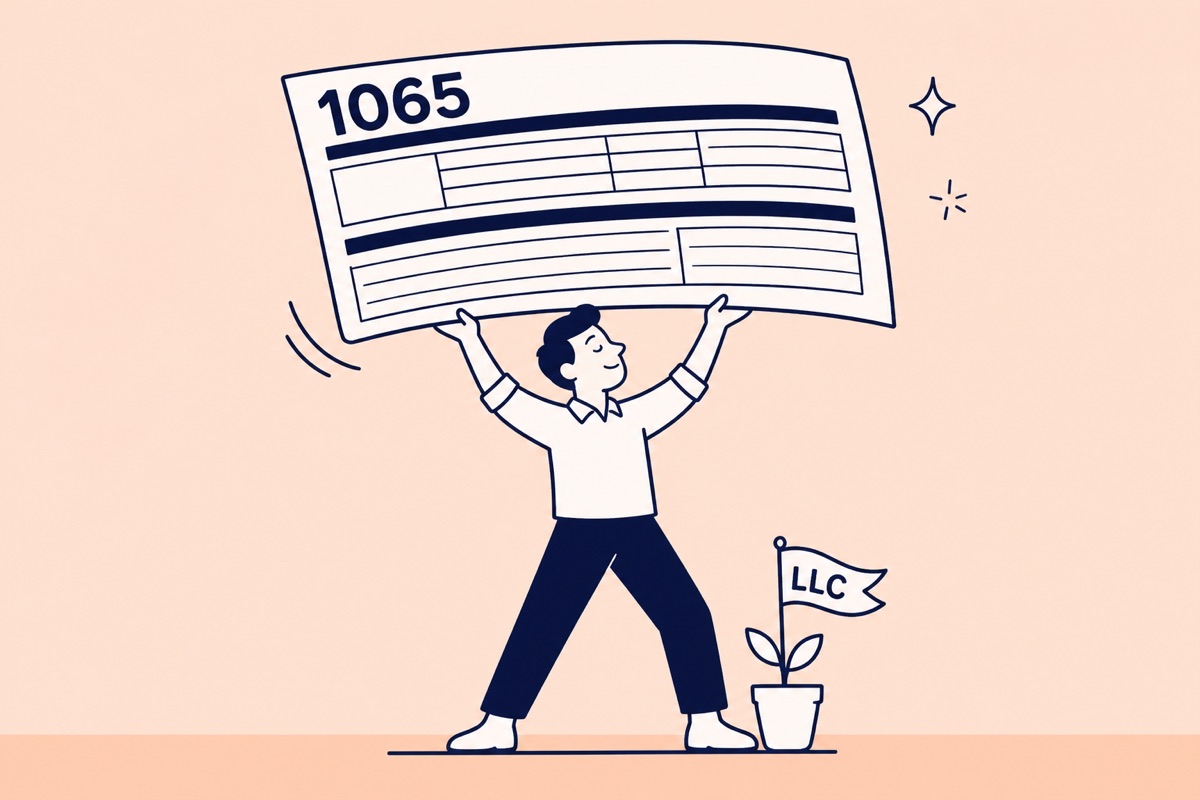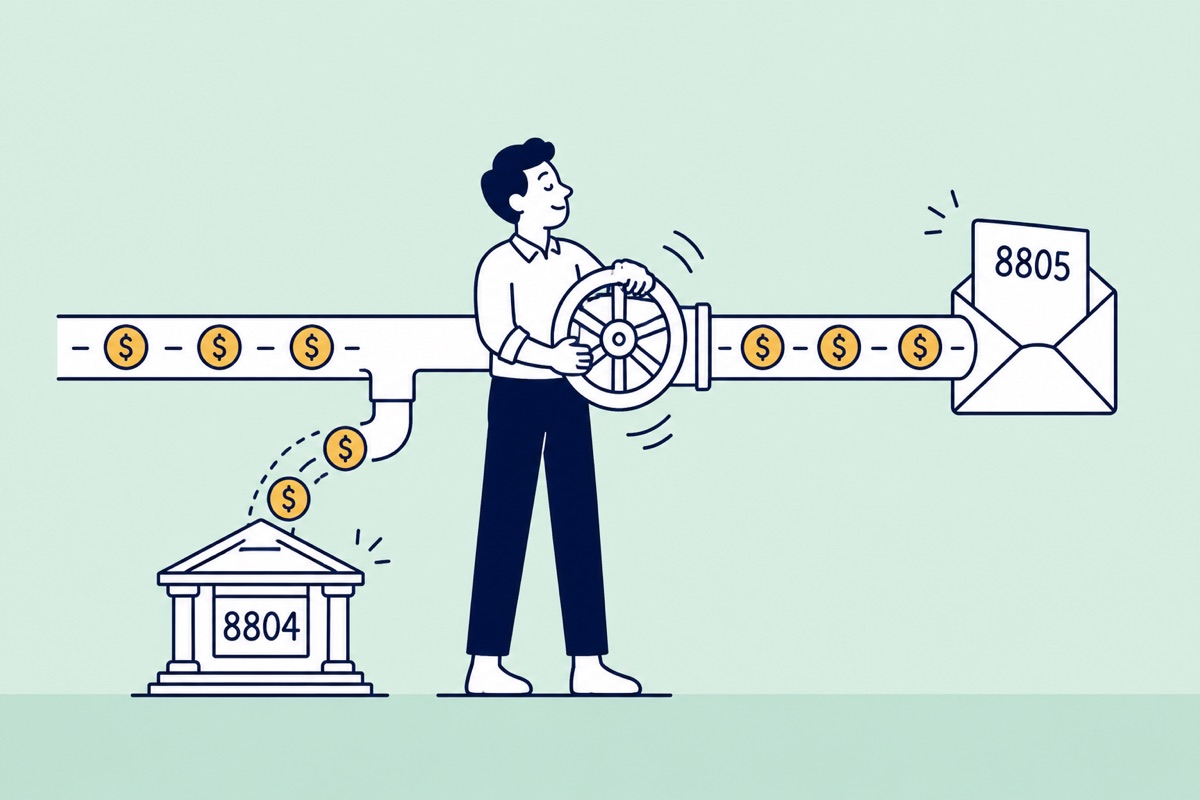
Somewhere between forming your multi-member LLC and filing your first Form 1065, someone mentions Forms 8804 and 8805 and suddenly you are reading about a 37% withholding tax on foreign partners and wondering if you owe the IRS a third of everything.
Take a breath. For a large share of foreign-owned LLCs offshore service businesses, holding companies, founders with no US operations the honest answer is that no withholding is due at all. But you need to understand why, because the reason (no effectively connected income) is a conclusion about your facts, not a box you get to tick by default.
This guide explains §1446 withholding in plain English: what ECI and ECTI actually mean, when withholding is genuinely required, what each of the three forms does, and how it all interacts with your Form 1065 filing.
TL;DR:A US partnership must withhold tax under IRC §1446 only on effectively connected taxable income (ECTI) allocable to foreign partners currently at 37% for individual partners and 21% for corporate partners. Form 8804 is the annual withholding return, Form 8805 is the per-partner statement, and Form 8813 is the quarterly payment voucher. An LLC with no US trade or business has no ECTI and typically owes no §1446 withholding though Form 1065 and K-1s are still required.
The 30-Second Answer
Section 1446 says: when a partnership earns income that is effectively connected with a US trade or business, and some of that income is allocable to foreign partners, the partnership must withhold US tax on those partners’ shares and pay it over during the year.
The key phrase is effectively connected. If your LLC has no US trade or business two founders in Berlin running a software agency for European clients through a Wyoming LLC, say then none of its income is effectively connected, its ECTI is zero, and 37% of zero is zero. No withholding, and in most such cases no Form 8804 package either.
But that conclusion depends entirely on your facts. Hire a US employee, and the analysis changes. So the rest of this guide walks through the line between the two worlds.
What Is ECI and ECTI, in Plain English?
Effectively connected income (ECI) is income from actually running a business in the United States as opposed to income that merely passes through a US entity or US bank account. The classic markers of a US trade or business are people and activity physically in the US: employees, offices, dependent agents, inventory being fulfilled and managed in the US.
Effectively connected taxable income (ECTI) is the partnership’s ECI reduced by the deductions connected to it roughly, the taxable slice of the US business income. §1446 withholding is computed on the portion of ECTI allocable to foreign partners.
Two things ECI is not:
- It is not triggered by having a US LLC. The entity’s state of formation does not create a US trade or business by itself.
- It is not triggered by US customers alone. Selling services performed entirely outside the US to American clients generally does not make the income effectively connected.
When §1446 Withholding IS Required
Withholding becomes real when the LLC genuinely operates inside the United States. Typical fact patterns:
| Fact pattern | Why it likely creates ECI | §1446 withholding? |
|---|---|---|
| LLC employs staff in the US | People performing the business’s work on US soil is the core of a US trade or business | Likely yes, on ECTI allocable to foreign partners |
| US office or warehouse the business runs | A fixed US place of business conducting operations | Likely yes |
| Dependent agent in the US who habitually concludes contracts for the LLC | The agent’s activity is attributed to the business | Likely yes |
| Partner physically working in the US on the business | Services performed in the US generate US-source ECI | Possibly depends on scope and duration |
| US rental real estate with an election to treat income as ECI | The election makes the net rental income effectively connected | Yes, on the taxable rental income |
One nuance worth knowing: routine third-party services like using a US registered agent, a US mailbox, or US cloud hosting are not the kind of dependent-agent activity that creates a trade or business. The concern is people acting for your business, doing its actual work, in the US.
When Withholding Is NOT Required
The mirror-image fact patterns extremely common among our users generally produce no ECI, no ECTI, and no §1446 withholding:
- Pure offshore service businesses. All partners and contractors work outside the US; clients may be anywhere. Services are sourced where they are performed, so the income is foreign-source and not effectively connected.
- Holding companies. An LLC that passively holds assets or investments without conducting a US business typically has no ECI (specific investment types can carry their own withholding regimes, which is a separate analysis from §1446 on business income).
- E-commerce run entirely from abroad using independent third-party logistics, with no US staff or dependent agents though this area is fact-sensitive and the more your fulfillment looks like your own US operation, the weaker the position gets.
The honest hedge: facts matter, and edge cases are real. If your setup involves any physical US presence, US contractors doing core work, or inventory arrangements you are unsure about, get advice from a cross-border tax professional before deciding you owe nothing. Deciding wrongly in the “no withholding” direction is the expensive kind of wrong, because the partnership itself is liable for tax it should have withheld.
For the broader map of what a foreign-owned LLC does and does not owe the US, see our guide to US tax obligations for foreign-owned LLCs.
The Three Forms Explained: 8804 vs 8805 vs 8813
When withholding does apply, it travels on a trio of forms that confuse everyone the first time:
| Form | What it is | Who gets it | When |
|---|---|---|---|
| Form 8804 | Annual return reporting the partnership’s total §1446 withholding liability for the year | IRS | 15th day of the 3rd month after year-end (March 15 for calendar-year partnerships) |
| Form 8805 | Per-partner statement showing each foreign partner’s share of ECTI and the tax withheld on it the partner uses it to claim credit on their own US return | IRS (attached to 8804) + each foreign partner | Same deadline as Form 8804 |
| Form 8813 | Payment voucher for sending in the withholding during the year | IRS, with each installment payment | Quarterly installments (generally April, June, September, and December for calendar-year partnerships) |
Think of it as: 8813 pays during the year, 8804 reconciles after the year, 8805 tells each partner their share. The official instructions for all three live at irs.gov.
Whatever your withholding answer, your multi-member LLC still owes Form 1065 + K-1s every year. Form5472.io prepares the complete IRS-ready package for $147 one-time built for foreign-owned LLCs, no CPA required.
Start your 1065 filing →Rates and Deadlines
The withholding rate is the highest tax rate applicable to that type of partner currently 37% for non-corporate foreign partners (individuals, trusts) and 21% for foreign corporate partners. Lower rates can apply to specific income types allocable to non-corporate partners, such as long-term capital gains, and partners can sometimes certify deductions to reduce the withholding base details that matter once real numbers are involved.
Note what the rate is not: it is not the partner’s final tax. Withholding is a prepayment. Each foreign partner files their own US return, computes actual tax on their share, and credits the Form 8805 amount against it often producing a refund when the top-rate withholding exceeded the real liability.
On timing: Form 8804 and the 8805s follow the partnership return calendar March 15 for calendar-year partnerships, extendable with Form 7004 while the actual tax goes in quarterly with Form 8813. An extension extends the paperwork, not the payments.
Penalties for Ignoring It
When withholding was actually due, the penalty stack is serious:
- The partnership owes the tax itself. Tax that should have been withheld becomes the partnership’s liability, with interest.
- Late filing of Form 8804 draws a percentage-of-unpaid-tax penalty that grows monthly, in the style of the standard failure-to-file penalty.
- Late payment and missed 8813 installments add their own penalties and interest.
- Failing to furnish Forms 8805 to partners triggers per-statement information-return penalties (several hundred dollars each, inflation-adjusted, and far more for intentional disregard).
If your LLC truly has no ECTI, none of this applies but document your reasoning, because the difference between “we analyzed it and had no US trade or business” and “we never thought about it” matters a great deal if the question is ever asked. And if you are already facing IRS penalty notices on other forms, our CP215 notice guide explains how assessments and abatement requests work.
How This Interacts With Your Form 1065 Filing
Forms 8804/8805 are a separate workstream from Form 1065, on the same calendar:
- Form 1065 + K-1s are required regardless. Every US multi-member LLC files the partnership return and issues K-1s, whether or not any withholding is due. Zero ECTI does not excuse the 1065. Our complete Form 1065 guide covers that filing end to end.
- The K-1 and the 8805 answer different questions. The K-1 reports each partner’s share of everything; the 8805 reports only ECTI and the tax withheld on it. A foreign partner in a withholding partnership receives both.
- No ECTI usually means no 8804 package the withholding forms exist to report §1446 tax, and a partnership with no effectively connected income allocable to foreign partners typically has nothing to report on them. When in doubt about your specific facts, ask a professional rather than guessing in either direction.
The Bottom Line
Section 1446 withholding reported on Form 8804 (annual return), Form 8805 (per-partner statement), and Form 8813 (quarterly payments) applies only to effectively connected taxable income allocable to foreign partners, at 37% for individuals and 21% for corporations. An LLC with no US trade or business has no ECTI and typically owes no withholding but it still owes Form 1065 and K-1s every year, due March 15. Form5472.io prepares that package for $147, one-time.
Frequently Asked Questions
Does my foreign-owned LLC have to withhold 37% of its profits?
Only if it has effectively connected taxable income. The 37% (individuals) / 21% (corporations) withholding applies to ECTI allocable to foreign partners. An LLC with no US trade or business no US employees, office, or dependent agents generally has no ECTI and no §1446 withholding obligation.
Do I file Form 8804 if the withholding amount is zero?
Generally, a partnership with no §1446 tax to report has no 8804 package to file. The forms exist to report and reconcile withholding on ECTI. But confirm the conclusion rests on facts (no US trade or business), not on wishful thinking if there was ECTI, filing is required even when certificates or deductions reduce the tax.
What is the difference between Schedule K-1 and Form 8805?
The K-1 reports a partner’s full share of the partnership’s results; the 8805 reports only effectively connected income and the tax withheld on it. Every partner gets a K-1. Only foreign partners in a partnership with ECTI also get an 8805, which they use to claim the withholding as a credit on their own US return.
When are Forms 8804 and 8805 due?
The 15th day of the third month after year-end March 15 for calendar-year partnerships, the same day as Form 1065. Form 7004 can extend the filing deadline, but the underlying withholding is paid during the year in quarterly installments with Form 8813, and an extension does not delay those payments.
Do the foreign partners get the withheld money back?
They can, if their actual tax is lower. §1446 withholding is a prepayment at the top rate. Each foreign partner files a US income tax return, computes the real tax on their share, and credits the amount shown on their Form 8805 any excess is refundable through that return.
File Your Form 5472 in Minutes
Skip the paperwork. Our digital tool generates IRS-ready Form 5472 and Pro Forma 1120 instantly.
Start Filing Now