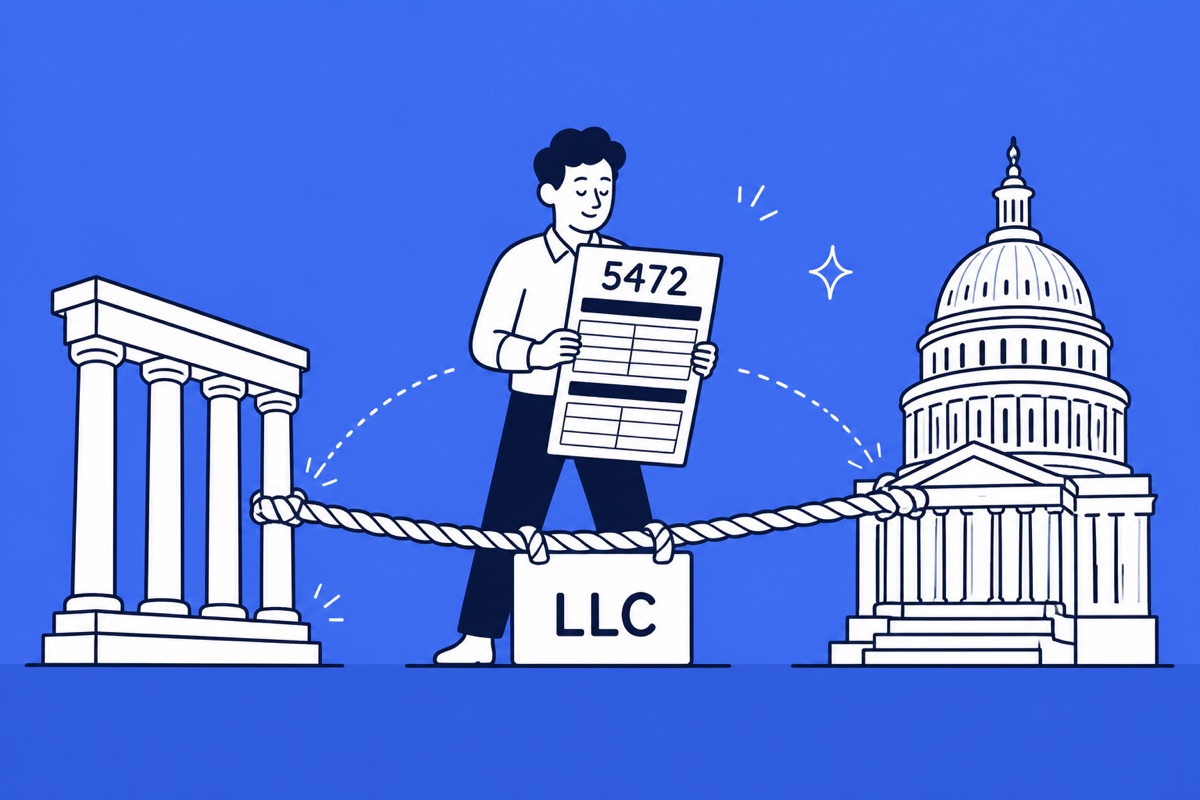
If you live in Germany and own or are about to form a US LLC, there is one thing you need to understand before anything else: Germany does not accept your US tax election at face value. The IRS may treat your single-member LLC as a disregarded entity, but German tax authorities decide for themselves what your LLC is, using a comparison test called the Typenvergleich.
That single fact drives everything else: whether your profits are taxed as they arise or only when distributed, whether Gewerbesteuer (trade tax) shows up, and whether the US tax you pay is creditable in Germany at all. Meanwhile the US side runs on its own clock Form 5472 and a pro forma 1120 every year, with penalties starting at $25,000.
This guide covers the US filings your LLC owes in full detail, then maps the German side in plain English. The German analysis here is orientation, not advice this is one of the few areas of cross-border tax where a German Steuerberater with international experience is genuinely necessary, and we will say so repeatedly because it matters.
TL;DR: A US LLC owned by a German resident must file Form 5472 + pro forma 1120 (single-member, due April 15) or Form 1065 + K-1s (multi-member, due March 15) every year penalty from $25,000. The German trap: German tax authorities run their own Typenvergleich and may classify your LLC as a corporation, a partnership, or a branch of you personally, regardless of your US election. If you manage the LLC from Germany, German corporate and trade tax exposure becomes very hard to avoid. Confirm your position with a German Steuerberater before profits build up.
The Short Answer: Legal, But Germany Decides What Your LLC Is
German residents can legally own US LLCs, and there is no German or US rule against it. What German founders underestimate is that the LLC’s US tax status has no automatic effect in Germany the German tax administration classifies the entity independently.
The practical consequence is that two German founders with identical-looking LLCs can end up with completely different German tax outcomes, because their operating agreements and chosen states differ. There is no “the LLC is taxed like X in Germany” answer. There is only your LLC, read against German entity types, by your Finanzamt.
For the baseline picture that applies to every nationality EIN, banking, US filings start with our complete non-resident LLC guide. This article layers the German-specific problems on top.
The US Side: Exactly What Your LLC Must File
A US LLC owned by a German resident with no US office, employees, or dependent agents typically owes no US income tax. It must still file information returns every single year, profitable or not, active or dormant.
| Your LLC | Forms due | Deadline | Penalty if missed |
|---|---|---|---|
| Single-member (just you) | Form 5472 + pro forma Form 1120 | April 15; extendable to October 15 with Form 7004 | $25,000 per form, per year plus $25,000 more per 30-day period if it continues after IRS notice |
| Multi-member (you plus a partner) | Form 1065 + Schedule K-1 for each partner | March 15; extendable to September 15 with Form 7004 | Roughly $255 per partner, per month (2026 figure, indexed annually), up to 12 months |
Two details catch German founders out. First, a foreign-owned disregarded LLC cannot e-file its Form 5472 package it goes to the IRS by fax or mail only. Second, the filing obligation is triggered by reportable transactions, not income: money you moved into the LLC to open its bank account, the state formation fee you paid personally, a loan either direction, or money you drew out all count. A German founder with a dormant LLC and €0 of revenue still normally files.
The mechanics which parts of the form apply, what goes on the pro forma 1120, how the fax submission works are covered end to end in our complete Form 5472 guide for foreign-owned LLCs. You will also need an EIN before you can file anything; see the EIN guide for foreign-owned LLCs. The official instructions live on IRS.gov About Form 5472.
The German Problem: Typenvergleich, Not Your US Election
German tax authorities classify a US LLC using a Typenvergleich a “type comparison” that measures the LLC’s actual characteristics against German entity types. They are not bound by whatever you checked, or did not check, on the US side.
The framework German advisers point to is a Federal Ministry of Finance (BMF) letter of 19 March 2004, commonly called the LLC-Erlass, which sets out the features used to decide whether a given LLC resembles a German corporation or a German partnership more closely. German practitioners are candid that the test leaves real uncertainty: it is an individual analysis of your operating agreement and your state’s LLC statute, not a lookup table. Have a Steuerberater run it on your actual documents.
| Question | How the US answers it | How Germany answers it |
|---|---|---|
| What decides the classification? | Your election (or the default): disregarded entity, partnership, or corporation | A Typenvergleich of the operating agreement and state LLC law against German entity types |
| Possible outcomes | Disregarded entity / partnership / C-corporation | Kapitalgesellschaft (corporation), Personengesellschaft (partnership), or a branch / permanent establishment of the owner |
| Is the other country’s view binding? | No | No classification is made independently |
| When are profits taxed to the owner? | As they arise, if transparent for US purposes | As they arise if treated as a partnership or branch; broadly on distribution if treated as a corporation |
| Practical effect | Usually no US income tax for a services LLC with no US presence but annual information filings | Outcome is fact-specific; two similar LLCs can be classified differently |
Read that table as a map of the questions to ask your adviser, not as a determination of your case. Nothing here substitutes for a German Steuerberater reviewing your operating agreement.
What Happens When the Two Countries Disagree
When the US and Germany classify the same LLC differently, the result is a Qualifikationskonflikt a qualification conflict. German advisory firms describe the consequences as potentially severe, and the mechanism is easy to see once it is spelled out.
Suppose the US treats your LLC as transparent, so its profits are your income in the US in the year they arise. Suppose Germany, after its Typenvergleich, treats the same LLC as a corporation, so Germany taxes you only when profits are distributed. The two countries now tax the same money in different years, in different characters, in different hands. Foreign tax credit relief depends on matching income to tax and mismatched timing is exactly what breaks that match.
The reverse mismatch causes its own version of the problem: German tax on profits you have not distributed and may not have received in cash. Either way, the risk is not theoretical it is the specific reason German-language advisory content calls the US LLC a Steuerfalle for unwary founders.
This is the point where general reading stops being useful. Whether your particular LLC produces a conflict, and what relief might be available, is a question for a Steuerberater with US–Germany experience. Founders in the UK face a structurally similar problem for different reasons see our US LLC guide for UK residents if you want to see how the same mismatch plays out under a different tax system.
Whatever the German analysis concludes, the US filings are owed every year. Form5472.io generates your IRS-ready Form 5472 + pro forma 1120 (or 1065 + K-1s) in about 15 minutes for $147 one-time built for foreign-owned LLCs, no CPA required.
Handle my US filing →The Biggest Risk: Managing Your LLC From Germany
The classification question is important, but the place of management question is usually more decisive. If the LLC’s actual management the day-to-day business decisions happens in Germany, German tax law can treat the LLC as having its Geschäftsleitung there, which pulls it into German taxation regardless of where it was registered.
German practitioners are blunt about how this plays out for one-person businesses: a sole member who lives in Germany generally cannot demonstrate that management sits anywhere else. There is no office in Wyoming, no board meeting in Delaware, no US-resident manager there is you, at your desk, in Germany, making every decision. A registered agent and a mailing address do not change that analysis.
Three practical implications follow:
- Residency can attach to the entity, not just to you. An LLC managed from Germany may be treated as German tax resident, which can bring German corporate income tax and trade tax into play on profits that were never taxed in the US.
- A dual-resident entity is a bad place to be. German commentary notes that an entity treated as resident in both countries can struggle to claim treaty benefits, because the tie-breaker position is not clean for these structures.
- “Offshore” marketing is not a defence. Providers selling a US LLC as a zero-tax structure for German residents are describing the US side only. The German side is where the tax actually lands. Ask a Steuerberater before, not after.
Gewerbesteuer: The Tax Most Founders Forget
Gewerbesteuer German municipal trade tax is the line item German founders most often leave out of their LLC arithmetic. Where LLC activity is treated as German business income, trade tax generally applies in addition to income or corporate tax.
The general shape, which your Steuerberater should confirm for your municipality and your classification:
- Trade tax is levied at municipal level, and the rate depends on the local multiplier (Hebesatz), which varies widely between municipalities typically in a range of roughly 300–600%.
- Individuals and partnerships generally benefit from a trade tax allowance (commonly cited at €24,500) before trade tax bites; corporations do not get that allowance.
- For individuals and partnerships, part of the trade tax paid is generally creditable against personal income tax, so the combined burden is lower than simply adding the two rates.
- Whether your LLC generates gewerbliche income at all depends on classification and on where management sits which is why the earlier sections matter before this one.
Do not model your business on these figures alone. The interaction between classification, place of management, the local multiplier, and the crediting mechanism is exactly the calculation a German Steuerberater is for.
LLC vs UG vs GmbH: An Honest Comparison
For a founder who actually lives and works in Germany, the real comparison is not “LLC or nothing” it is LLC versus a German entity. The honest summary: the LLC wins on US market access and setup speed, and loses on certainty.
| US LLC | UG (haftungsbeschränkt) | GmbH | |
|---|---|---|---|
| Minimum capital | None | From €1 (with mandatory reserve build-up) | €25,000 (part payable at formation) |
| Setup speed | Days, fully online in most states | Weeks notary and register required | Weeks notary and register required |
| German tax treatment | Uncertain decided by Typenvergleich | Settled and well understood | Settled and well understood |
| Double-taxation risk | Real, via qualification conflict | None from this mechanism | None from this mechanism |
| US filings | Form 5472 + pro forma 1120, or 1065 + K-1s, every year | None unless it has US activity | None unless it has US activity |
| Stripe / US payment access | Strong the main reason founders choose it | Workable but more friction for US-facing sales | Workable but more friction for US-facing sales |
| Credibility with German clients | Mixed unfamiliar form | Recognised, sometimes seen as thin | Strongest |
| Ongoing admin | US filings plus a German adviser who understands both systems | German accounting and filing obligations | German accounting and filing obligations |
The pattern most advisers land on: use the LLC when the US market is the point and you genuinely operate outside Germany; use a UG or GmbH when you live and manage the business in Germany and want a tax position that is settled rather than argued. Which applies to you is a Steuerberater conversation.
Who the LLC Still Works For and Who Should Not Use One
The classification problem is not a reason for every German founder to avoid US LLCs. It is a reason to match the structure to the situation.
An LLC often still makes sense if:
- You are a German citizen who has genuinely relocated outside Germany and no longer has German tax residence.
- You need Stripe, US payment rails, or a US-facing storefront and no German alternative gives you that access cleanly.
- The LLC is a small, clearly delimited US venture alongside a properly declared German main business, and your Steuerberater has signed off on the treatment.
- You are testing a US market at low volume and intend to restructure before profits become significant.
Think hard and get advice first if:
- You live in Germany and will run every part of the business from there. Place of management is the risk, and it is difficult to argue away.
- You expect meaningful retained profits. Qualification conflicts get expensive precisely when there is money sitting inside the entity.
- You were sold the LLC as a way to pay no tax while living in Germany. That framing describes the US side only and ignores the German side entirely.
- Your main customers are German. You are taking on classification risk to solve a problem you do not have.
Worked Example: A €70,000 Year Through a US LLC
Say you are resident in Germany, you own a single-member New Mexico LLC, and it earns roughly €70,000 in consulting revenue from US clients. You funded it with €5,000 at the start and drew €40,000 during the year, leaving the rest in the US bank account. Here is how the two sides look.
- US side: A services business with no US office, staff, or dependent agent typically owes no US income tax but the €5,000 funding and the €40,000 you drew are reportable transactions. The LLC files Form 5472 with a pro forma 1120 by April 15. Miss it and the starting penalty is $25,000 see our Form 5472 penalty guide.
- German side, partnership or branch classification: the full profit is generally your income as it arises, whether or not you withdrew it and trade tax may apply on top if the activity counts as German business income.
- German side, corporation classification: the analysis shifts toward taxing distributions rather than profits as they arise, with the retained amount treated differently. This is where timing mismatches against the US treatment can strand foreign tax credits.
- Place of management overlay: if you made every decision from your desk in Germany, German authorities may treat the LLC itself as German tax resident, changing the answer again.
Four plausible German outcomes from one set of facts. That is the honest state of this area and the reason the German numbers in this example are deliberately left unquantified. Your Steuerberater has to run them.
Common Mistakes German Founders Make
- Assuming the US election controls the German result. It does not. The Typenvergleich is independent, and it looks at your operating agreement, not your IRS paperwork.
- Treating a registered agent as substance. A US mailing address does not move your place of management out of Germany.
- Skipping US filings because no US tax is owed. Form 5472 is an information return. Zero tax and zero income do not remove the obligation, and the penalty is not proportionate to the amounts involved.
- Trying to e-file the 5472 package. A foreign-owned disregarded LLC cannot e-file it. Fax or mail only a mistake that quietly turns an on-time filing into a late one.
- Forgetting trade tax exists. Founders model income tax and stop. Gewerbesteuer can be a meaningful additional layer where the income is German business income.
- Using a German accountant with no US-LLC experience. A generalist Steuerberater may never have classified an LLC. Ask directly whether they have done it before.
- Waiting until profits are large. Restructuring a loss-making or small LLC is cheap. Restructuring one with years of retained profit and an unresolved classification is not. See the broader duties in our foreign-owned LLC tax obligations guide.
Your Annual Compliance Calendar (US Side)
The German deadlines depend on your classification and your Steuerberater’s filing arrangements. The US deadlines do not vary they are the same every year, for every foreign-owned LLC.
- January–February: Pull the year’s transactions between you and the LLC contributions, draws, loans, expenses you paid personally. These are what Part V of Form 5472 reports.
- March 15: Form 1065 + Schedule K-1s due for multi-member LLCs. Extension to September 15 via Form 7004. The official instructions are on IRS.gov About Form 1065.
- April 15: Form 5472 + pro forma 1120 due for single-member LLCs. Extension to October 15 via Form 7004 which itself must be faxed or mailed by April 15.
- Throughout: Keep the LLC’s money separate from yours. Mixed accounts make reportable transactions hard to reconstruct and are the usual root cause of an inaccurate filing.
Not sure which deadline applies to your LLC, or what a late filing would cost? Our free tools work it out in seconds.
Key Takeaways
- German residents can legally own US LLCs the difficulty is tax classification, not legality.
- Germany applies a Typenvergleich and may classify your LLC as a Kapitalgesellschaft, a Personengesellschaft, or a branch of you personally, independently of your US election.
- Divergent classification creates a Qualifikationskonflikt, which German advisers warn can cause double taxation and stranded foreign tax credits.
- If you manage the LLC from Germany, German authorities may treat it as German tax resident and a sole member living in Germany rarely has the facts to argue otherwise.
- Gewerbesteuer can apply on top of income or corporate tax where the activity is German business income, at a rate driven by the municipal Hebesatz.
- The US side is fixed and predictable: Form 5472 + pro forma 1120 by April 15, or Form 1065 + K-1s by March 15.
- Form 5472 is triggered by reportable transactions, not income a dormant LLC almost always still files.
- The penalty starts at $25,000 per form, per year, with a further $25,000 per 30-day period after IRS notice.
- Foreign-owned disregarded LLCs cannot e-file the 5472 package fax or mail only.
- Every German-side statement here is general orientation. Confirm your position with a German Steuerberater experienced in US structures before profits accumulate.
The Bottom Line
A US LLC is a genuinely useful vehicle for German founders who sell into the US market fast to form, cheap to run, and the shortest route to US payment infrastructure. What it is not is a settled tax structure for someone living in Germany. The Typenvergleich, the qualification conflict, and the place-of-management question mean your German outcome is determined by facts specific to you, not by the entity type on the certificate.
Handle the two halves separately. The US half is mechanical and you can close it out this week: file Form 5472 with a pro forma 1120, on time, every year. The German half needs a Steuerberater who has classified an LLC before ideally engaged before the LLC has been running long enough for the answer to be expensive.
Frequently Asked Questions
Can a German resident legally own a US LLC?+
Yes. There is no US or German rule preventing a person resident in Germany from owning a US LLC, and thousands do. The complications are not about legality they are about how the German tax authorities classify the LLC, where its management sits, and which German taxes follow from that. Confirm your own position with a German Steuerberater.
Does Germany accept my US disregarded-entity election?+
Generally no. German tax authorities do not simply adopt the US classification. They apply a Typenvergleich a type comparison of your LLC's operating agreement and its state LLC law against German entity types and decide independently whether the LLC looks like a Kapitalgesellschaft, a Personengesellschaft, or a branch of the owner. The German result can differ from the US one.
What is a Qualifikationskonflikt and why does it matter?+
A qualification conflict is when the US and Germany classify the same LLC differently for example, the US treats it as transparent while Germany treats it as opaque. German advisers describe the consequences as potentially severe, because income can be taxed in one country in a year when the other does not tax it, leaving foreign tax credits unusable. It is the main reason German founders need specialist advice before profits accumulate.
Will my US LLC owe German Gewerbesteuer?+
It can. Where the LLC's activity is treated as German business income most commonly because it is managed from Germany trade tax generally applies at the municipality's multiplier, with an allowance for individuals and partnerships and partial crediting against income tax. Whether it applies to you depends on classification and place of management, so this is a Steuerberater question, not a self-assessment one.
Do I still file Form 5472 if I owe no US tax?+
Yes. Form 5472 is an information return, not a tax return. A foreign-owned single-member US LLC files Form 5472 attached to a pro forma Form 1120 every year it had any reportable transaction with its foreign owner including funding the bank account or paying formation costs. The penalty starts at $25,000 per form, per year, regardless of whether any tax was due.
Should a German founder use an LLC, a UG, or a GmbH?+
It depends on where you actually work and what the LLC is for. An LLC is strongest as a US market vehicle Stripe, US clients, USD banking for a founder who genuinely operates outside Germany. If you live and manage the business in Germany, a UG or GmbH is usually the cleaner structure because German tax treatment is settled rather than argued. Have a Steuerberater compare the two on your actual numbers.
File Your Form 5472 in Minutes
Skip the paperwork. Our digital tool generates IRS-ready Form 5472 and Pro Forma 1120 instantly.
Start Filing Now