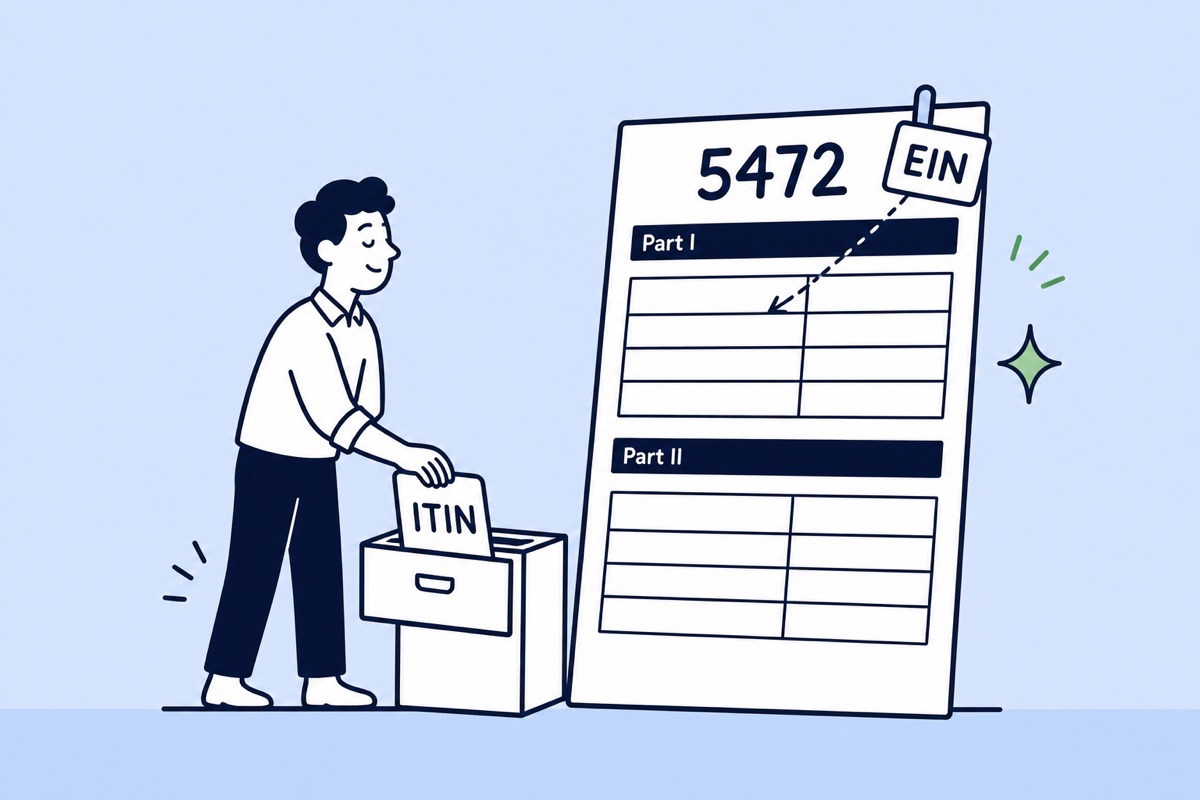
Between forming your LLC and filing your first Form 5472, you will run into four or five different IRS identification documents with confusingly similar names — SS-4, EIN, CP 575, 147C, 8822-B, ITIN. Nobody explains how they relate, so owners apply for things they do not need and skip things they do.
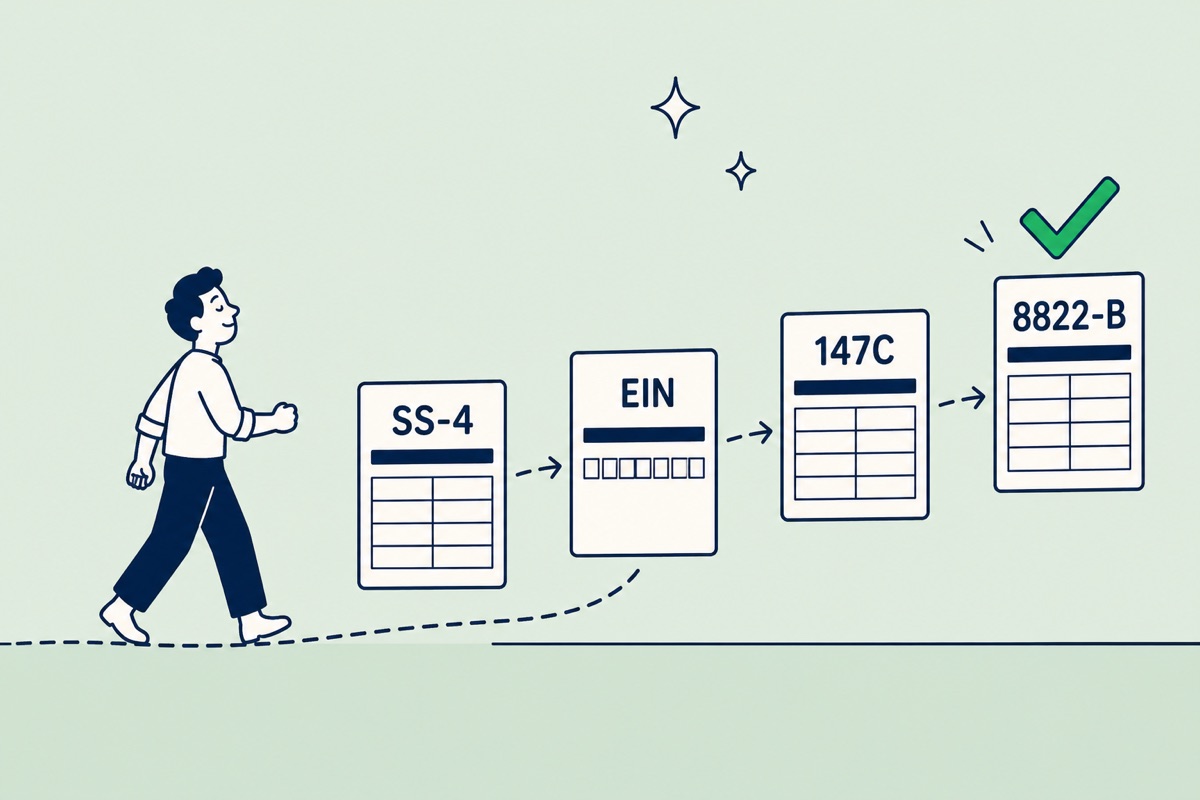
They are not five unrelated hurdles. They are one number and its paperwork: an application, the number itself, two proofs of it, an update form, and one personal ID that most foreign owners never need. This page is the map, with links to the detailed guide for each.
The Map: What Each Document Is
| Document | What it is | Do you need it? |
|---|---|---|
| Form SS-4 | The application for an EIN | Yes— it is how the EIN is obtained |
| EIN | The nine-digit number identifying your LLC to the IRS | Yes— every foreign-owned LLC needs one |
| CP 575 | The one-time notice confirming the EIN was assigned | Arrives automatically — keep it safe, it is never reissued |
| Letter 147C | An EIN verification letter you can request any time | Only when a bank or processor asks for proof |
| Form 8822-B | Updates your address or responsible party with the IRS | Only when one of those changes — then within 60 days |
| ITIN | A personal taxpayer ID for individuals with no SSN | Usually not— see below |
The distinction that resolves most confusion: an EIN identifies your company. An ITIN identifies you personally. Your LLC needs the first. You personally need the second only if you have your own separate US filing obligation — which most non-resident owners of a disregarded LLC do not.
Step 1: The EIN — the number everything hangs off
The Employer Identification Number is your LLC’s federal tax ID. Despite the name, you need one whether or not you ever employ anybody. It is required to:
- File Form 5472 and the pro forma Form 1120
- Open a US business bank account
- Set up Stripe, PayPal, or similar processors
- Register as a seller on most US marketplaces
An EIN is permanent. It never expires and is never reassigned to a different entity. Full detail in our EIN guide for foreign-owned LLCs.
Step 2: Form SS-4 — how you get the EIN
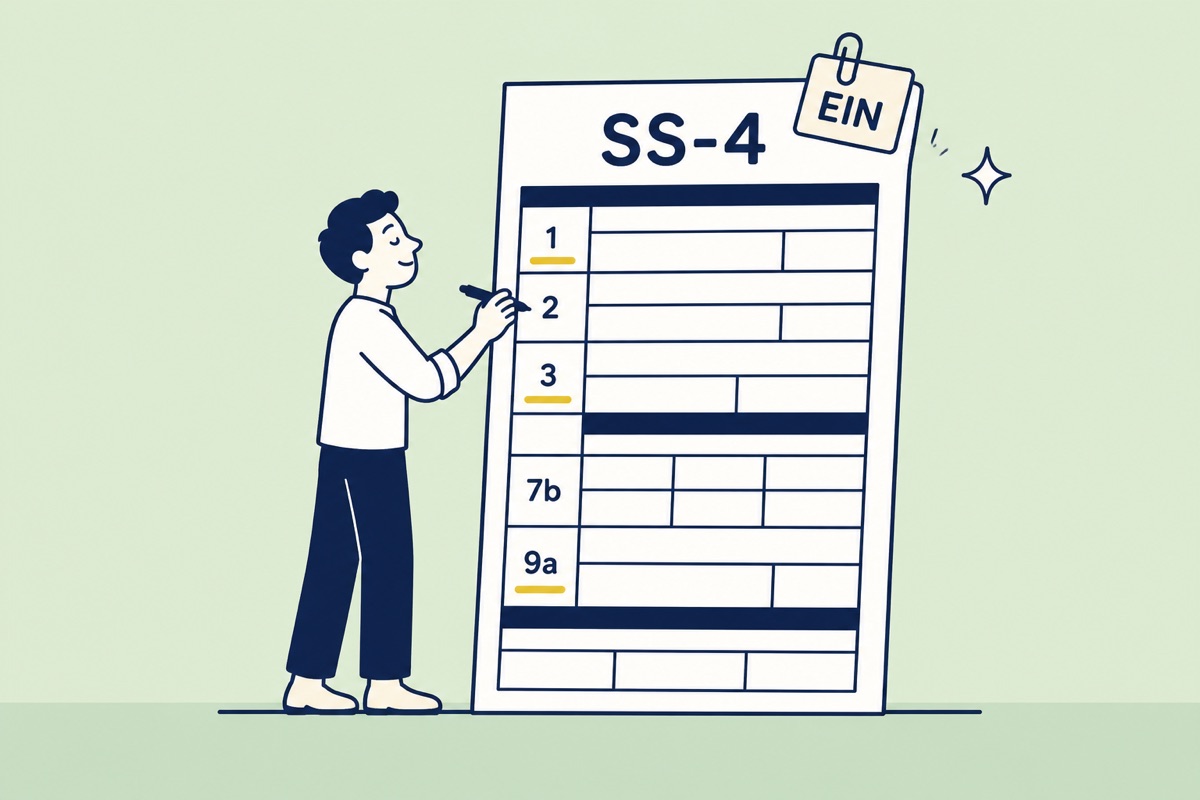
Form SS-4 is the one-page application. For a non-resident it has two properties worth knowing before you start:
- You cannot use the IRS online tool.It requires the responsible party to already hold an SSN, ITIN, or EIN. Your routes are fax, phone, or mail — and the international fax number differs from the domestic one.
- Four of its lines have a different correct answer for youthan for a US applicant — particularly line 7b (no SSN), line 8c (was the LLC organized in the US — yes, it was), and line 9a (entity type, where none of the printed checkboxes fit).
Our line-by-line Form SS-4 walkthrough covers every field, the international submission routes, and the six mistakes that delay foreign applications.
Step 3: CP 575 and Letter 147C — proving the EIN
These two documents do the same job and are constantly mixed up.
The CP 575 is the confirmation notice the IRS sends when the EIN is first assigned. The critical fact: the IRS issues it exactly once and will never reissue it. If it is lost, or if a formation company received it and never forwarded it, it is gone permanently.
Letter 147Cis the answer to that. It is an EIN verification letter you can request as many times as you like, free, and every bank and payment processor accepts it in place of the CP 575. It has to be requested by phone — there is no online option — but the IRS can fax it back within minutes.
See the Letter 147C guide for the exact numbers to call from abroad and what you need to pass identity verification. If you have lost the number itself rather than just the letter, start with recovering a lost EIN — and do not reapply, which creates a duplicate EIN.
EIN sorted? The annual filing is the part that carries a $25,000 penalty. Form5472.io generates your IRS-ready Form 5472 and pro forma 1120 in about 15 minutes — from $147, no CPA required.
Start your filing →Step 4: Form 8822-B — keeping the record current
The EIN record the IRS created from your SS-4 includes a mailing address and a responsible party. When either changes, Form 8822-B updates it — and responsible-party changes carry a 60-day deadline.
This is the most-skipped document on this page, because it carries no headline penalty. The cost of skipping it is indirect: the IRS keeps mailing to the old address, and it treats mail sent to your last known address as validly delivered. When the letter it sends is a CP215 penalty notice with a 90-day response window, an outdated address turns a $25,000 problem into an uncapped one.
There is also a specific trap worth checking today: if a formation service listed its own employee as your responsible party, the IRS currently believes a stranger controls your LLC. Details and the fix are in our Form 8822-B guide.
Step 5: The ITIN — the one you probably do not need
An Individual Taxpayer Identification Number identifies a person, not a company. Foreign owners are routinely upsold ITIN applications they have no use for.
For the standard case — a non-resident owner of a single-member US LLC filing Form 5472 with a pro forma 1120 — no ITIN is required. Not for the SS-4, not for the 5472, not for the 1120. A reference identifier is used instead where a personal tax ID would otherwise go.
An ITIN becomes genuinely necessary only when you personally acquire a US filing obligation — for example needing to file Form 1040-NR, or claiming treaty benefits in your own name. Our dedicated guide, do you need an ITIN to file Form 5472, covers exactly when the answer flips to yes and how the Form W-7 process works.
The Order It Actually Happens In
- Form the LLC with a US state — see choosing a state.
- File Form SS-4 to apply for the EIN. By fax from abroad, expect roughly four business days.
- Store the CP 575 the moment it arrives. It is never reissued.
- Open banking and payment accounts using the EIN. If any of them ask for verification, request Letter 147C.
- File Form 5472 + pro forma 1120 annually, by the April 15 deadline for calendar-year filers.
- File Form 8822-B whenever your address or responsible party changes, within 60 days.
Steps 1–3 happen once. Step 5 repeats every year for as long as the LLC exists — including years with no revenue and no activity, which is the single most expensive misunderstanding in this whole area. See filing with no activity.
Key Takeaways
- SS-4 → EIN → CP 575 is one sequence: application, number, proof.
- Letter 147C permanently replaces a lost CP 575. Free, by phone, faxed back in minutes.
- Form 8822-Bkeeps the record current — 60 days for responsible-party changes, and the reason IRS mail reaches you at all.
- EIN identifies the company; ITIN identifies you. Most foreign owners never need an ITIN.
- Non-residents cannot use the online EIN tool — fax, phone, or mail only.
Frequently Asked Questions
What is the difference between an EIN, an SS-4, and a 147C letter?
They are three stages of the same thing. Form SS-4 is the application you submit. The EIN is the nine-digit number the IRS assigns in response. Letter 147C is the verification letter the IRS issues later if you need official proof of that number. One application, one number, one proof document.
Do I need all of these documents?
Every foreign-owned LLC needs an EIN, and therefore needs to submit Form SS-4 to get one. Letter 147C is only needed when a third party such as a bank asks you to verify the EIN. Form 8822-B is only needed when your address or responsible party changes. Most owners never need an ITIN at all.
In what order do I get them?
Form the LLC with the state first, then file Form SS-4 to obtain the EIN. Everything else is reactive: request Letter 147C when someone asks for verification, file Form 8822-B when something changes, and pursue an ITIN only if a specific personal filing obligation triggers it.
Can I file Form 5472 without an EIN?
No.Both Form 5472 and the pro forma Form 1120 require the LLC’s EIN on the header, so the EIN must exist before you can file. If your deadline is close and you have no EIN, apply by phone or fax rather than mail — and note that waiting on an EIN is not a recognized reason to file late.
Which of these documents actually expire?
None of the entity-level ones. An EIN is permanent and is never reissued to another entity. Letter 147C does not expire, though a bank may ask for a recently dated one. ITINs are the exception: an ITIN not used on a federal tax return for three consecutive years expires and must be renewed.
Does a formation company applying on my behalf cause problems?
It can. Some services list one of their own staff as the responsible party on Form SS-4 to speed up issuance. The result is that the IRS believes someone else controls your entity, which can mean your mail goes elsewhere and you fail identity verification when calling the IRS. Check whose name is on your EIN paperwork, and file Form 8822-B if it is not yours.
File Your Form 5472 in Minutes
Skip the paperwork. Our digital tool generates IRS-ready Form 5472 and Pro Forma 1120 instantly.
Start Filing Now