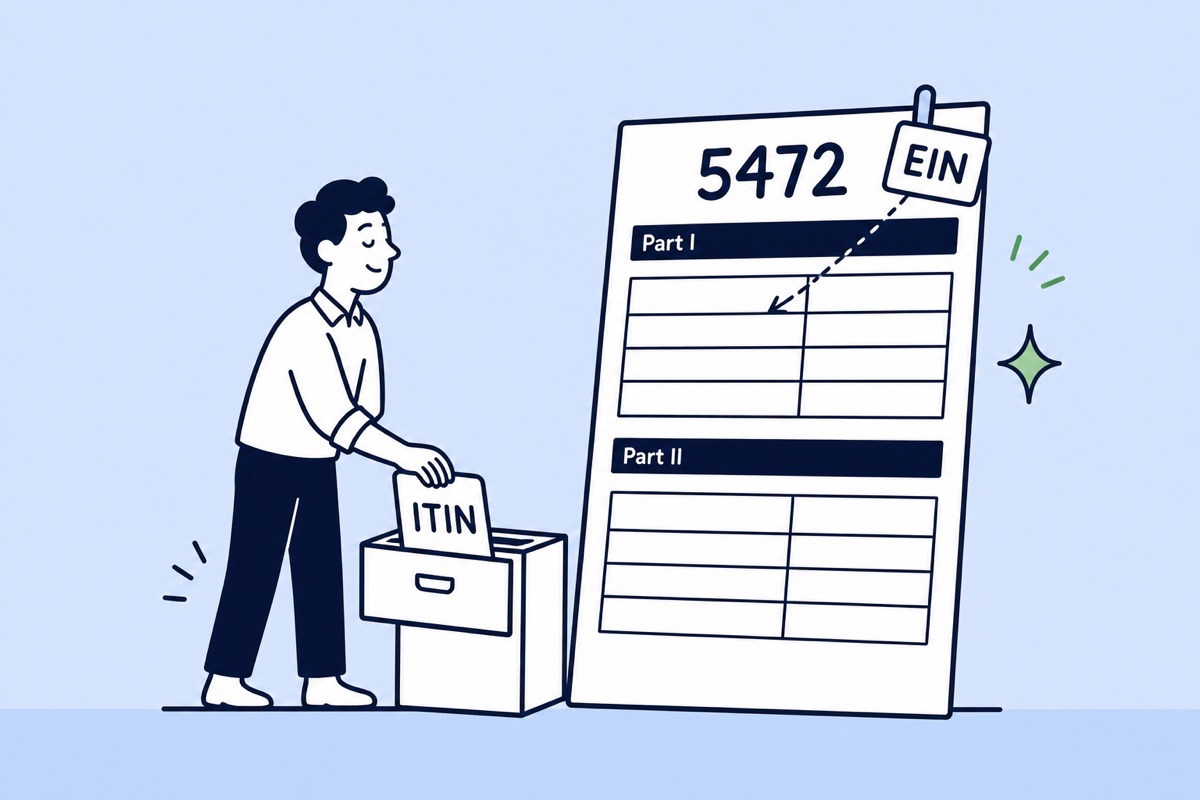
Somewhere between forming your LLC and hitting the April 15 deadline, someone a formation service, a forum thread, a well-meaning friend told you that you need an ITIN before you can file Form 5472. Cue weeks of panic about a W-7 application, notarized passport copies, and IRS processing queues.
Take a breath: for the overwhelming majority of foreign owners, that advice is simply wrong. Thousands of Form 5472 filings go in every year for owners who have never held an ITIN or SSN including the filings we prepare.
This guide walks through what the TIN fields on Form 5472 actually ask for, what to write when you have no US number, the rare cases where an ITIN genuinely is required, and how to spot the ITIN upsell that formation services love to add to your cart.
TL;DR: No a foreign owner does not need an ITIN or SSN to file Form 5472. The LLCneeds an EIN; the owner enters their foreign tax ID number if they have one, and the IRS instructions provide for entering “None” and using a reference ID number when no number exists. An ITIN only matters if you must file a US income tax return.
The Short Answer: No ITIN Needed
A foreign owner does not need an ITIN or SSN to file Form 5472. The form identifies the LLC by its EIN and the foreign owner by a foreign taxpayer identification number and the IRS instructions expressly cover owners who have no identifying number at all.
The confusion comes from mixing up two different questions. “Who is filing?” the LLC, which needs an EIN. “Who is being reported?” you, the foreign owner, who just needs to be identified accurately. Form 5472 is an information return: it reports transactions, it does not calculate anyone’s income tax. And because nobody is computing tax on it, nobody on it needs a US taxpayer number. New to the form itself? Start with our complete Form 5472 guide.
What Goes in the TIN Fields Instead
Form 5472 asks for identifying numbers in two places, and each has a clear answer for a foreign-owned single-member LLC:
| Where on Form 5472 | Whose number | What to enter |
|---|---|---|
| Part I, line 1b(1) | The LLC (reporting corporation) | The LLC’s EIN required, no substitutes. See our EIN guide for foreign owners if you do not have one yet |
| Part II (25% foreign shareholder) | You, the foreign owner | Your US identifying number if you happen to have one; otherwise your foreign taxpayer identification number (FTIN) from your home country e.g. a PAN in India or a tax number in Germany |
| Part II, if no FTIN exists | You, the foreign owner | Enter “None”(or “N/A”) in the FTIN block and use a reference ID number an alphanumeric label (up to 50 characters) you create yourself and reuse each year |
Two details worth getting right. First, the reference ID number is not something you apply for the instructions let the filer establish it, and its only job is to keep the same owner traceable from year to year, so pick something stable and reuse it. Second, you may see older guides telling you to write “FOREIGNUS” in the TIN box. That convention comes from other IRS contexts, and the current Form 5472 instructions do not use it for Part II they ask for the FTIN if any, or “None” plus a reference ID. Always cross-check the wording in the current instructions on irs.gov for the year you are filing, since the IRS revises them periodically. Our part-by-part Form 5472 guide covers every other line.
EIN vs ITIN vs SSN: Who Gets Each, and What For
These three numbers get tangled together constantly, so here is the clean separation:
| EIN | ITIN | SSN | |
|---|---|---|---|
| Identifies | A business entity | An individual with no SSN eligibility | An individual (citizens and work-authorized residents) |
| Who needs it here | Your LLC yes, required for Form 5472 | You no, not for Form 5472 | You no; most foreign owners cannot get one anyway |
| Main purpose | Business filings, banking, payroll | Filing US income tax returns (e.g. Form 1040-NR) | Work, benefits, personal tax |
| How obtained | Form SS-4 free, no US number needed | Form W-7, usually with a tax return attached | Social Security Administration |
| Cost from the IRS | Free | Free (agents charge for help) | Free |
Notice the pattern: the only number Form 5472 cannot live without is the LLC’s EIN and foreign owners can get an EIN with no ITIN and no SSN, by filing Form SS-4 by fax or phone.
Have your EIN and ready to file? Form5472.io generates your IRS-ready Form 5472 + pro forma 1120 in about 15 minutes for $147 no ITIN, no SSN, no CPA required.
Start your filing →When You DO Actually Need an ITIN
An ITIN exists for one core reason: so a person who cannot get an SSN can still appear on a US income tax return. So the real question is never “do I need an ITIN for Form 5472?” it is “do I need to file a US income tax return?” Common triggers:
- US-source income that is taxed to you. If your LLC’s activity rises to a US trade or business with effectively connected income (for example, people or dependent agents working for you inside the US), you generally must file Form 1040-NR and that return needs an ITIN.
- Claiming a treaty benefit or a withholding refund. If US tax was withheld on your income (royalties, dividends, platform payouts) and a tax treaty entitles you to a lower rate or a refund, the return or claim usually requires an ITIN.
- Selling US real estate. FIRPTA withholding and the related filings require the foreign seller to have an ITIN.
- Some banking and credit situations. A few US banks, brokers, and credit products ask for an ITIN even though the IRS does not. This is the institution’s policy, not a tax rule many fintech options work fine without one.
A typical non-resident running a services or e-commerce LLC from abroad, with no US employees, office, or dependent agents, often has no US income tax return to file at all only the information filing. Whether that describes you is a facts-based question, so confirm your position with a cross-border tax professional. The information filing itself, though, is unconditional: skip it and the $25,000 penalty applies whether or not any tax was due.
How to Get an ITIN If You Genuinely Need One
If one of the situations above applies, the process runs through Form W-7:
- Complete Form W-7 with the reason code that matches your situation (filing a return, treaty claim, and so on).
- Attach the tax return the ITIN is for in most cases the W-7 must ride along with an actual return, such as Form 1040-NR, unless you fit an exception category.
- Prove your identity. Send your original passport or a certified copy from the issuing agency or keep your passport by using an IRS-authorized Certifying Acceptance Agent (CAA) or an IRS Taxpayer Assistance Center. Details are on irs.gov.
- Wait. The IRS quotes roughly seven weeks in normal periods, and longer often 9 to 11 weeks or more during peak season or for applications from abroad.
The timing is exactly why you should not chase an ITIN “just in case” while a Form 5472 deadline approaches: the ITIN is not needed for that filing, and waiting on one is never a valid reason to file late. File the 5472 package on time our step-by-step guide shows the whole sequence and pursue the ITIN separately if a real trigger exists.
The ITIN Upsell: Myths Worth Ignoring
ITIN applications are a popular add-on at checkout when you form an LLC often at $300 to $500. Common claims, corrected:
- “You need an ITIN to stay compliant with the IRS.” Not for a disregarded LLC’s annual filings. Form 5472 needs the LLC’s EIN and your foreign tax ID (or “None” plus a reference ID). An unused ITIN adds zero compliance value and ITINs not used on a return actually expire.
- “You need an ITIN to get an EIN.” False. Form SS-4 line 7b accepts “Foreign” in place of an SSN/ITIN, and foreign owners get EINs by fax or phone every day.
- “You need an ITIN to open a business account.” The widely used fintech options for non-residents onboard with a passport and the LLC’s EIN. Some traditional banks do ask for an ITIN that is a bank policy, not an IRS requirement.
- “Everyone with a US LLC eventually needs one.” Only if a US income tax return enters the picture. Many foreign owners run US LLCs for years without one, fully compliant the entire time.
The Bottom Line
You do not need an ITIN or an SSN to file Form 5472. The LLC files under its EIN; you appear in Part II with your foreign tax ID or, if you have none, “None” plus a self-assigned reference ID number, exactly as the IRS instructions provide. Save the W-7 for the day a US income tax return actually requires it, and never let an ITIN application delay the April 15 filing the $25,000 penalty does not wait. Form5472.io prepares your complete Form 5472 + pro forma 1120 package for $147, no US tax number required.
Frequently Asked Questions
Can I file Form 5472 without an ITIN?
Yes. Form 5472 never requires the foreign owner to hold an ITIN. The LLC needs an EIN, and the owner is identified by a foreign taxpayer identification number or by “None” plus a reference ID number if no foreign tax ID exists. This is standard, not a workaround.
What do I write in the TIN box if my country has no tax ID?
Enter “None” (or “N/A”) in the FTIN block and identify yourself with a reference ID number an alphanumeric label up to 50 characters that you create and reuse every year. Check the current IRS instructions for exact wording, as the IRS revises them periodically.
Does my LLC need an EIN even though I have no US tax number?
Yes the EIN is the one number you cannot skip. Form 5472 and the pro forma 1120 are filed under the LLC’s EIN. Foreign owners get one free from the IRS with Form SS-4 by fax or phone, writing “Foreign” where an SSN or ITIN would go.
Will getting an ITIN reduce my US taxes?
No. An ITIN is an identification number, not a tax status. It changes nothing about whether your LLC’s income is taxable in the US that depends on the facts of your business. If you do end up owing US tax, the ITIN is simply what lets you file the return that reports it.
My formation service says I need an ITIN package. Should I buy it?
Only if a real trigger exists a US income tax return, a treaty or withholding claim, a US property sale, or a specific bank demanding one. For the annual Form 5472 obligation itself, the answer is no: the filing works without any ITIN, and an ITIN that never appears on a return eventually expires unused.
File Your Form 5472 in Minutes
Skip the paperwork. Our digital tool generates IRS-ready Form 5472 and Pro Forma 1120 instantly.
Start Filing Now