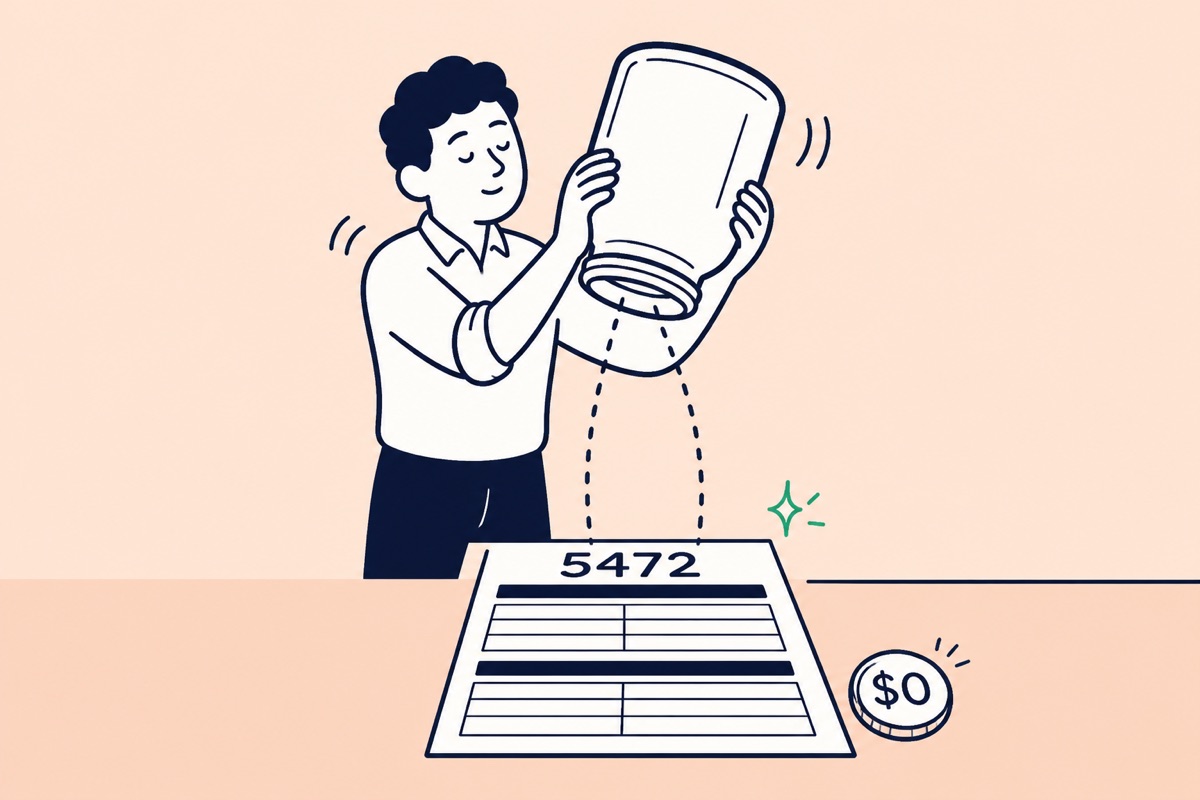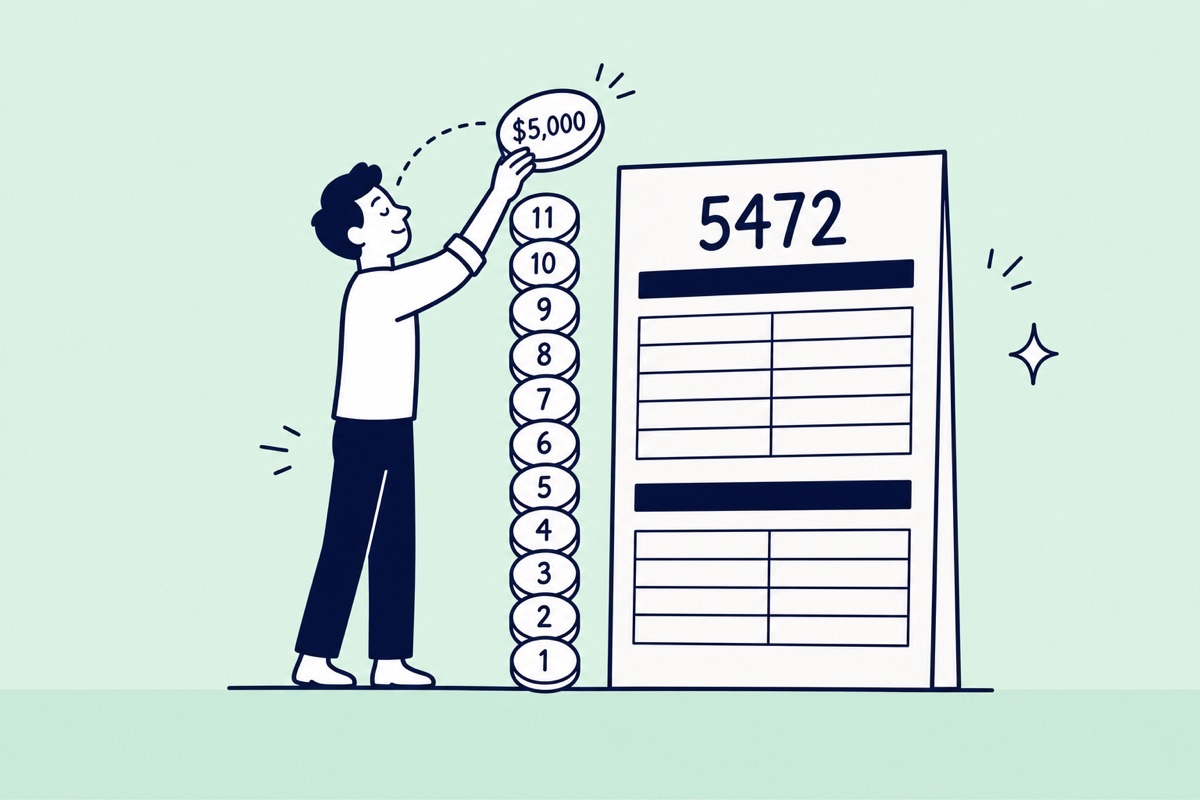
The single most common question we get about Form 5472 is not about deadlines or penalties. It is: “wait, does that count?” Most foreign owners assume “reportable transaction” means big-company stuff transfer pricing, royalties, million-dollar loans. Then they learn that the $102 they paid Wyoming from a personal card counts too, and suddenly every small money movement looks suspicious.
This guide removes the guesswork with 12 concrete form 5472 reportable transaction examples, each with a real dollar scenario and the exact place it goes on the form. They cover almost everything a typical foreign-owned single-member LLC does in a year.
TL;DR: Almost any money or property moving between a foreign-owned US LLC and its owner (or another related party) is reportable. For a foreign-owned disregarded entity, contributions and distributions go in Part V, monetary related-party transactions (loans, service fees) in Part IV, and nonmonetary transfers like contributing a laptop in Part VI. Even funding your own LLC’s bank account is reportable.
What Makes a Transaction “Reportable”?
A reportable transaction is, in plain English, any exchange of money or property between the LLC and a related party and for a single-member LLC, you (the owner) are the related party the IRS cares about most. For foreign-owned US disregarded entities (DEs), the IRS instructions cast the net even wider: amounts paid or received in connection with the formation, dissolution, acquisition, and disposition of the entity, including contributions to and distributions from the entity, are all reportable.
The direction of the money does not matter. The size does not matter there is no minimum dollar threshold. What matters is that value moved between the company and someone related to it. For the full conceptual breakdown, see our guide to reportable transactions explained. Here, we go straight to examples.
12 Reportable Transaction Examples, With Dollar Amounts
Each example below tells you the category and where it lands on the form. One note on form geography first: a foreign-owned US DE reports its owner contributions and distributions in Part V, while monetary transactions like loans and service payments use the line items in Part IV and nonmonetary transfers use Part VI.
1. You paid the $102 Wyoming formation fee from your personal card
You never touched the LLC’s bank account it did not exist yet. You still made a capital contribution of $102: you used personal funds to pay a company expense. Formation costs paid by the owner are explicitly reportable for foreign-owned DEs. Where it goes: Part V (contribution, described in the attached statement or entered per the form’s layout).
2. You wired $5,000 to open the LLC’s bank account
The classic first transaction. Moving $5,000 of your personal money into the company account is a $5,000 capital contribution probably the single most common reportable transaction in existence. Where it goes: Part V. This one example is why “my LLC had no activity” is almost never true; see our post on filing with no activity or income.
3. The LLC paid your personal Upwork subcontractor’s invoice
You hired a freelancer for a personal project, and the $800 invoice got paid from the LLC’s card because that is the card you had open. The company paid a personal expense of the owner economically, an $800 distribution to you. Where it goes: Part V. (If the freelancer had been working for the LLC’s business, it would be an ordinary business expense to an unrelated party not reportable at all.)
4. You took $2,000 out of the LLC to pay your rent
A single-member LLC owner does not take a paycheck; money you pull out for personal living costs is a distribution. The $2,000 you transferred to your personal account for rent is a $2,000 reportable distribution and so is every similar draw during the year, which you total up. Where it goes: Part V.
5. You lent the LLC $10,000
The company hit a slow quarter, so you transferred $10,000 in and recorded it as a loan rather than a contribution. Amounts the reporting company borrows from a related party are a monetary transaction with their own line. Where it goes: Part IV (amounts borrowed). Label it consistently: if you call it a loan this year, its repayment needs to match next year.
6. The LLC repaid your $10,000 loan
A year later the company pays the $10,000 back. Loan repayments to a related party are also reportable the transaction is the mirror image of example 5. Where it goes: Part IV. If the company paid you interest on top, the interest is its own reportable line item too.
7. You paid the $125 registered agent fee personally
Same logic as the formation fee: an owner paying a company bill from personal funds has made a $125 capital contribution, even though no money ever entered the LLC’s account. Where it goes: Part V. Annual report fees, state franchise fees, and mail-forwarding subscriptions paid personally all work the same way.
8. The LLC pays you a monthly “salary” or management fee
You set up a $1,500/month transfer and think of it as your salary. Two things to know. First, a single-member LLC owner is not a W-2 employee of their own disregarded entity this is not employment wages. Second, it is absolutely reportable: a documented fee for services you provide is a monetary payment for services to a related party ($18,000 for the year), while an informal draw with no service agreement behind it is better treated as a distribution. Where it goes: Part IV (consideration paid for services) if it is genuinely a service fee, or Part V if it is really just an owner draw.
9. You bought groceries on the LLC debit card
A $160 supermarket run on the company card is not a business expense it is the company paying your personal cost, which makes it a $160 distribution. Scattered personal spending on the business card is one of the most common record-keeping messes we see; total it up at year end and report the sum. Where it goes: Part V.
10. You contributed your $1,400 laptop to the business
Not all contributions are cash. Handing your personally owned laptop over to the LLC is a nonmonetary transaction property moved from a related party to the company for less than full consideration. Where it goes: Part VI, which asks for a description of the nonmonetary transaction on an attached statement (what was transferred, by whom, and a reasonable estimate of its fair market value here, $1,400).
11. The LLC paid your home-country company $6,000 for services
Your US LLC outsources development work to the company you own back home. Because you control both entities, your home-country company is a foreign related party and the $6,000 in service payments is a monetary reportable transaction. This may also mean your LLC files more than one Form 5472: one per foreign related party it transacted with. Where it goes: Part IV (consideration paid for services), on the Form 5472 filed for that related company.
12. A year with truly zero movement
The LLC sat dormant: no contributions, no distributions, no fees paid by anyone, no loans not one dollar or asset moved between the company and any related party all year. With no reportable transaction, no Form 5472 is due for that year. Be honest with yourself before relying on this: if you personally paid the registered agent or the state’s annual fee, you are back in example 7 territory. Genuine zero-movement years are rare in practice.
Recognize your own transactions in this list? Form5472.io asks you these exact questions in plain English and generates your IRS-ready Form 5472 + pro forma 1120 for $147 every transaction in the right Part, no CPA required.
Start your filing →Summary Table: Where Each Example Goes on Form 5472
The quick reference. Remember the pattern: for a foreign-owned US DE, contributions and distributions → Part V; monetary related-party transactions like loans and service fees → Part IV; nonmonetary transfers → Part VI.
| # | Example | Category | Form 5472 location |
|---|---|---|---|
| 1 | $102 formation fee paid personally | Capital contribution | Part V |
| 2 | $5,000 wire to open the bank account | Capital contribution | Part V |
| 3 | LLC pays owner’s personal $800 invoice | Distribution | Part V |
| 4 | $2,000 withdrawn for personal rent | Distribution | Part V |
| 5 | Owner lends LLC $10,000 | Monetary amounts borrowed | Part IV |
| 6 | LLC repays the $10,000 loan | Monetary loan repayment | Part IV |
| 7 | $125 registered agent fee paid personally | Capital contribution | Part V |
| 8 | $18,000/year management fee to owner | Payment for services (or distribution) | Part IV (or Part V) |
| 9 | $160 groceries on the LLC card | Distribution | Part V |
| 10 | $1,400 laptop contributed to the LLC | Nonmonetary property transfer | Part VI |
| 11 | $6,000 paid to owner’s foreign company | Monetary services, foreign related party | Part IV |
| 12 | Zero movement all year | No reportable transaction | No filing due (rare) |
For a walkthrough of every section of the form itself Parts I through IX, box by box see our Form 5472 instructions, part by part.
What Is Not a Reportable Transaction
The rule targets related parties, not the world. These ordinary activities are not reportable on Form 5472:
- Sales to customers. Your LLC invoicing an unrelated client $12,000 is just revenue no related party involved.
- Ordinary business expenses to unrelated vendors. Paying AWS, a US freelancer working for the LLC, or your software subscriptions from the LLC account.
- Bank fees and payment-processor fees. Stripe, PayPal, and Mercury are not your related parties.
The trap is that one year usually mixes both kinds. A year of normal client revenue plus a single $500 owner draw still has a reportable transaction and skipping the form risks the $25,000 penalty, which does not scale down just because the transaction was small.
The Bottom Line
If money or property moved between your foreign-owned LLC and you (or any related party) in either direction, in any amount it is almost certainly a reportable transaction. Contributions and distributions of a foreign-owned DE go in Part V, monetary items like loans and service fees in Part IV, and nonmonetary transfers in Part VI. The form is due with a pro forma 1120 by April 15 (October 15 with an extension), and missing it carries a $25,000 penalty per year. New to the form entirely? Start with our complete Form 5472 guide, or let Form5472.io turn your year’s transactions into an IRS-ready package for $147.
Frequently Asked Questions
Is there a minimum amount for a transaction to be reportable?
No. There is no de minimis threshold for a foreign-owned US DE. A $50 state fee paid from your personal card is as reportable as a $50,000 contribution. Small amounts do not create small penalties either the failure-to-file penalty is $25,000 regardless of transaction size.
Do I report each transaction separately or as yearly totals?
Yearly totals by category. Form 5472 asks for aggregate amounts total contributions, total distributions, total amounts borrowed, and so on for the tax year. You do not list all 14 owner draws individually; you report their sum as distributions, with descriptions attached where the form requires them.
Is funding my own LLC really a reportable transaction?
Yes. A capital contribution from a foreign owner to a US DE is expressly reportable under the regulations covering foreign-owned DEs, including amounts connected to forming the entity. This is why nearly every foreign-owned LLC owes a Form 5472 for its first year: the formation payment itself triggers it.
What if I cannot remember the exact amounts?
Reconstruct in good faith from records. Pull bank and card statements and total each category as accurately as you can. A reasonable, documented reconstruction is what the form expects; do not skip filing because your numbers are approximate. Keep the workpapers in case anyone ever asks how you got there.
Does paying myself from the LLC make me an employee?
No. The owner of a single-member disregarded LLC is not a W-2 employee of it, and regular transfers to yourself are not wages. They are either distributions or, if backed by a real service arrangement, payments for services both reportable on Form 5472, just in different places.
File Your Form 5472 in Minutes
Skip the paperwork. Our digital tool generates IRS-ready Form 5472 and Pro Forma 1120 instantly.
Start Filing Now