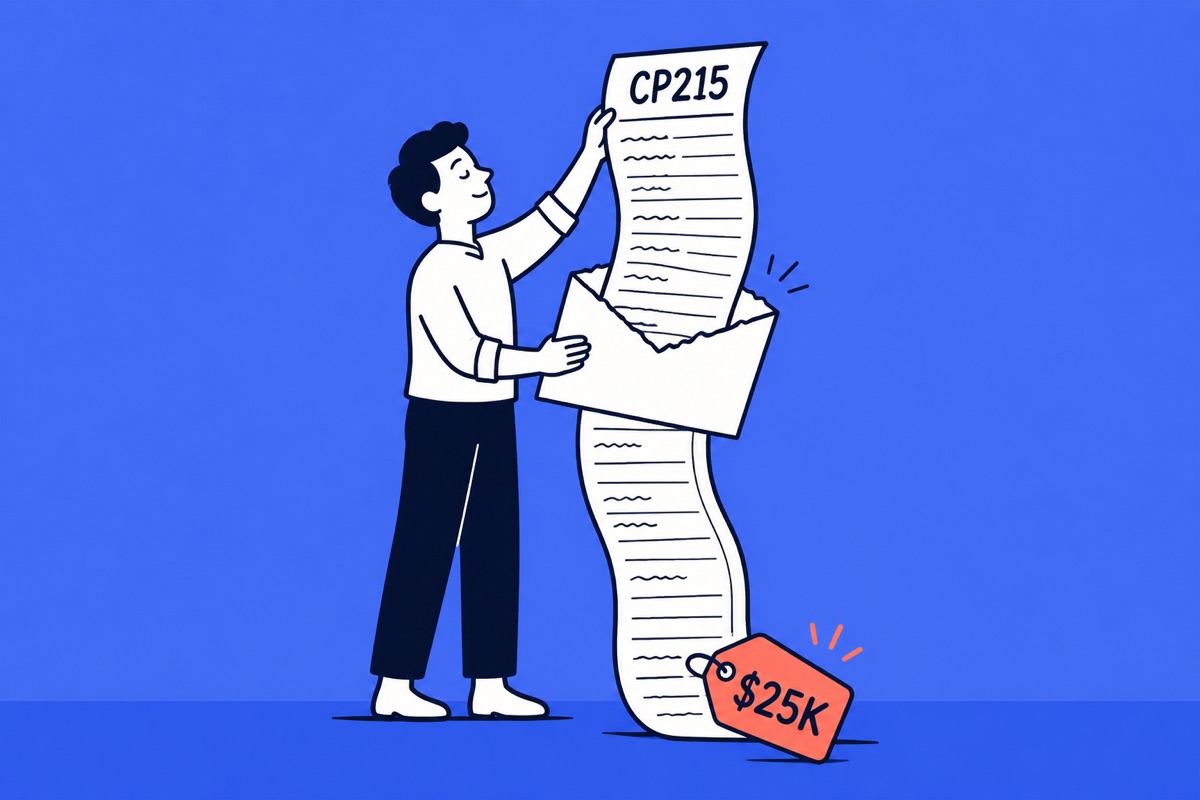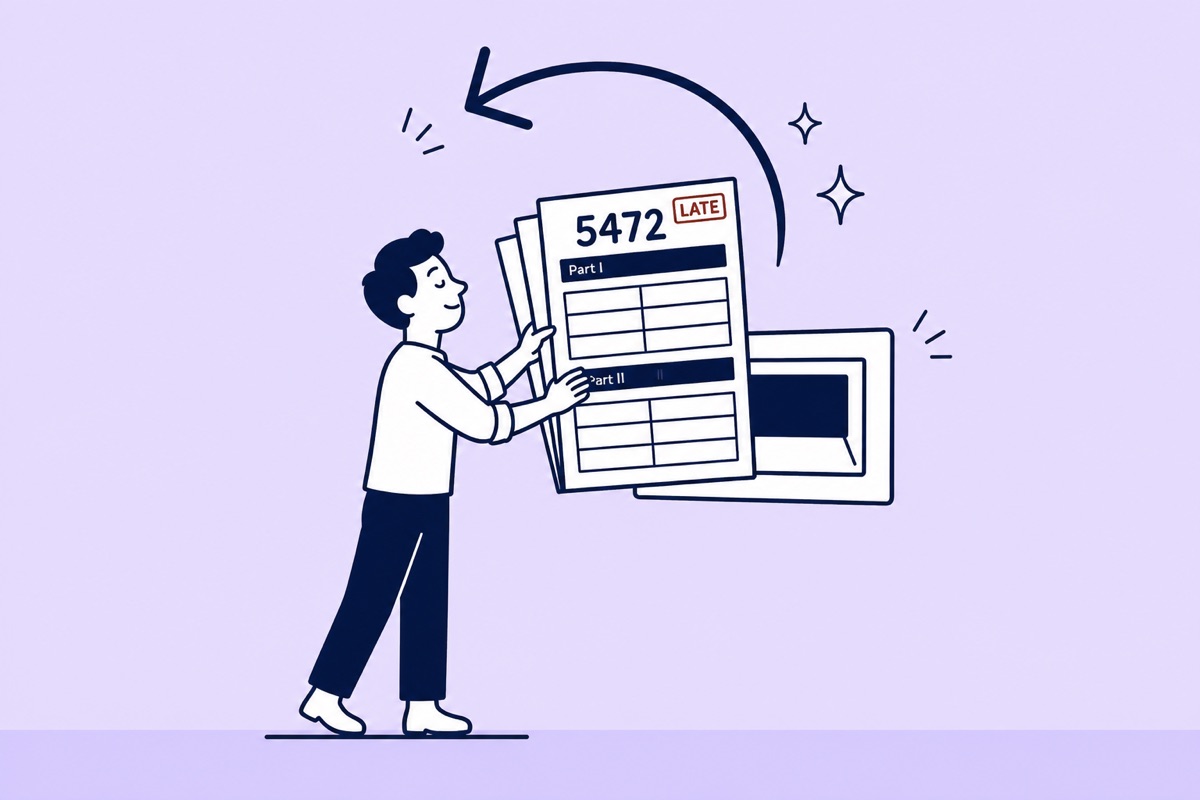
You just found out your foreign-owned US LLC was supposed to file Form 5472 every year and you have missed one, two, maybe four of them. Each missed form carries a $25,000 penalty, so the instinct to freeze is understandable.
Here is the good news: there is a well-worn path for owners who need to file Form 5472 late for prior years, and the sooner you walk it, the better your position. This guide covers the exact process: which years you owe, where to get the right forms, what to attach, and where to send everything.
It is the same process we use to prepare multi-year catch-up packages for foreign founders every week nothing here requires a US tax background, just your bank statements and a few careful hours.
TL;DR:To file Form 5472 late, prepare a separate package that year’s Form 5472 attached to a pro forma Form 1120 for every missed year since formation, attach a reasonable cause statement, and fax to (855) 887-7737 or mail to the IRS in Ogden, UT, oldest year first. Filing before the IRS contacts you is the strongest position available for getting the $25,000-per-year penalty abated or never assessed.
First: Do Not Panic File
The single most important fact about late Form 5472 filings is this: coming forward voluntarily, before the IRS contacts you, puts you in a materially better position than waiting for a penalty notice.
Why? The $25,000 penalty under IRC §6038A is not automatic the moment you are late it is assessed when the IRS identifies the failure. And once the IRS formally notifies you, a continuation penalty of an additional $25,000 per 30-day period can begin stacking 90 days after the notice, with no cap. Every part of that sequence is easier to avoid or unwind when you self-correct first: your reasonable cause story is stronger, the continuation clock never starts, and outcomes for proactive filers are consistently better than for those who react to notices.
Doing nothing accomplishes the opposite. The exposure does not expire for unfiled returns the assessment window generally stays open and every new April 15 you skip adds another $25,000 to the pile. If you want the full picture of what continued silence looks like, read what happens if you never file Form 5472. Otherwise, let’s get you caught up. Five steps.
Step 1: Figure Out Which Years You Owe
Your Form 5472 obligation starts with the first tax year your LLC existed and had a reportable transaction with its foreign owner and for nearly everyone, that means the formation year itself. The money you used to open the bank account, pay the state filing fee, or cover the registered agent is a reportable capital contribution. Profit is irrelevant; a dormant LLC with zero revenue still owes the form. (Unsure the rules apply to you at all? Start with our complete Form 5472 guide.)
Count forward from formation to the most recent tax year whose deadline has passed. As of the 2026 filing season, it looks like this:
| LLC formed in | Returns you likely owe | Base exposure |
|---|---|---|
| 2025 | 2025 | $25,000 |
| 2024 | 2024, 2025 | $50,000 |
| 2023 | 2023, 2024, 2025 | $75,000 |
| 2022 | 2022, 2023, 2024, 2025 | $100,000 |
| 2021 or earlier | Every year from formation through 2025 | $125,000+ |
Two adjustments to check. First, if you filed some years but not others, you only owe the gaps. Second, if your LLC was formed late in a year and truly had no transaction at all that year no funding, no fees paid, nothing that year may not require a filing. That is rare; when in doubt, treat the formation year as owed.
Step 2: Get the Right Year’s Forms
Here is a detail that trips up do-it-yourself filers: each tax year should be filed on that year’s form revision. A 2023 return belongs on the Form 5472 revision in use for 2023, not on the current version. The IRS revises the form periodically, and using the right vintage keeps each package clean and processable.
Prior-year forms and instructions are free on the IRS website the prior year forms and instructions page at irs.gov lets you search “5472” and “1120” and pick the revision for each year you need. Download both forms, plus the matching instructions, for every missed year before you start filling anything in.
While you are gathering documents, pull together the other constants: your LLC’s EIN (required if you never got one, see our EIN guide for foreign-owned LLCs), your foreign address and tax ID, and the LLC’s formation documents.
Step 3: Complete a Full Package for Each Year
For a foreign-owned single-member LLC, one filing = two forms: a Form 5472 reporting the year’s transactions between you and the company, attached to a pro forma Form 1120 cover page with “Foreign-owned U.S. DE” written across the top. Every missed year gets its own complete, self-contained package never one combined form covering multiple years.
Work through your bank and payment records year by year and total, for each year separately: capital contributions (money in from you), distributions (money out to you), and any other payments between you and the LLC. Then apply two rules that keep a multi-year catch-up credible:
- Keep the numbers consistent across years. The ending picture of one year should line up with the beginning of the next. If you report $10,000 contributed in 2023, your 2024 form should not quietly imply that money never existed. The IRS reads catch-up filings as a set.
- Favor completeness over false precision. A good-faith, well-organized reconstruction from bank statements is what the form expects. If some records are gone, document what you did to recover them and estimate reasonably.
Fill in each year’s Form 5472 with that year’s figures owner information in Part II, the transaction totals with the owner in the relevant parts and complete only the header items on the pro forma 1120. Repeat per year until every package is done.
Behind on multiple years? Form5472.io generates a complete, IRS-ready Form 5472 + pro forma 1120 package in about 15 minutes for $147 per year with an optional reasonable cause abatement letter for $39.99. No CPA required.
Start your catch-up filing →Step 4: Attach a Reasonable Cause Statement
This is the piece that separates a smart catch-up from a bare one. A reasonable cause statement is a short, signed letter explaining why the filings are late and what you did to fix the problem once you learned of it. Attached to a voluntary late filing, it is your request made before the IRS has to ask that penalties not be assessed, or be abated if they are.
The strongest statements are specific and honest: who you are (a first-time foreign owner with no US tax background), why the failure happened (no one involved in your formation service, agent, or bank mentioned the obligation), and how quickly you corrected it (you filed every missed year within weeks of learning about it). Reliance on a professional who never flagged the form, or serious events like illness or civil unrest, carry additional weight. Do not invent facts the statement is signed under penalties of perjury, and a modest true story beats an impressive false one.
One statement can cover all the years if the explanation is the same, but include a copy with each year’s package so every submission stands on its own. For full templates and wording that has worked, see our reasonable cause statement examples. No one can guarantee abatement outcomes vary with the facts but a specific statement filed voluntarily is the best posture the rules allow.
Step 5: Submit Oldest Year First
Form 5472 with a pro forma 1120 cannot be e-filed. You have two submission routes:
- Fax (usually fastest): send each package to (855) 887-7737 and keep every transmission confirmation. Our fax filing guide covers cover sheets and online fax services that work from abroad.
- Mail: send to the IRS service center in Ogden, UT (the address is in the Form 5472 instructions at irs.gov) using a tracked courier, and keep the tracking record.
We recommend separate submissions for each year, sent oldest first. Separate submissions keep each year’s paperwork from being processed as one blob, give you distinct proof of filing per year, and make any later abatement correspondence cleaner. Oldest-first simply stops the oldest exposure the one with the weakest “I just learned” story from waiting any longer.
Whatever route you choose, keep the proof for years. The legally meaningful fact is the date you filed, and fax confirmations or tracking numbers are how you establish it.
What Happens Next
Paper filings are processed manually, so expect months of silence that is normal, not a signal of trouble. From there, catch-up filers generally land in one of two places (outcomes vary case by case):
| Outcome | What it looks like | What you do |
|---|---|---|
| Nothing arrives | No notice, no bill. The filings were processed and no penalty was assessed a common result for voluntary filers with a reasonable cause statement attached. | Keep your proof of filing, and file the current year on time every April 15 from now on. |
| A CP215 penalty notice arrives | A notice assessing $25,000 for one or more late years. Not the end of the road it is the start of the abatement process. | Respond by the notice deadline with a penalty abatement request restating your reasonable cause. See our CP215 notice guide for the exact steps. |
Either way, the hard part is behind you: your exposure has stopped growing, the continuation-penalty clock has nothing to attach to, and your good-faith record is on file. The mechanics of how the penalty itself works and how abatement decisions get made are covered in our $25,000 penalty guide.
Do You Need a CPA, or Will a Filing Service Do?
An honest answer, because the two situations are genuinely different:
- Consider a CPA or tax attorney if: you are many years behind with large or complicated transactions, you have already received IRS notices, other filings may be missing too (1120 with actual US income, 1065, FBAR-adjacent issues), or the total exposure is large enough that professional representation pays for itself. Multi-year cases with six-figure exposure deserve a professional’s judgment.
- A filing service works well if: your LLC is a straightforward single-member company with simple, low-volume transactions the classic “formed it, funded it, paid some fees, maybe ran some sales” pattern. The forms themselves are mechanical once the transaction totals are known; what you are paying for is getting every field, attachment, and submission detail right, per year, at a fraction of multi-year CPA fees.
Plenty of owners split the difference: use a service to produce clean packages for the simple zero-activity years, and get an hour of professional advice on anything unusual.
The Bottom Line
Filing Form 5472 late is a solved problem with a known process: identify every missed year from formation onward, prepare a separate Form 5472 + pro forma 1120 on each year’s form revision, attach a specific reasonable cause statement, and submit oldest-first by fax to (855) 887-7737 or by tracked mail to Ogden keeping proof of everything. Acting before the IRS contacts you is the strongest position available, and every month of delay only adds exposure. Form5472.io prepares each year’s IRS-ready package for $147, with the reasonable cause abatement letter as a $39.99 add-on.
Frequently Asked Questions
Can I still file Form 5472 for prior years?
Yes, at any time. There is no cutoff after which a late Form 5472 stops being accepted. Filing late is exactly what you are supposed to do once you discover the gap each missed year gets its own complete package, and filing stops the exposure from growing.
Will I definitely be fined $25,000 for each late year?
No it is exposure, not an automatic bill. The penalty is assessed when the IRS identifies the failure, and many voluntary catch-up filers with reasonable cause statements are never assessed anything. Outcomes vary with the facts, but proactive filing with a specific statement is the best available defense.
Can I put all my missed years on one Form 5472?
No. Each tax year requires its own Form 5472 attached to its own pro forma Form 1120, prepared with that year’s figures on that year’s form revision. We also recommend submitting each year separately so every filing has its own proof of delivery.
Do I need a reasonable cause statement for every year?
Include one with every package. A single statement can explain all the years if the story is the same, but each submission should carry a copy so it stands alone. Make it specific: who you are, why the failure happened, and how promptly you fixed it once you knew.
Should I fax or mail my late filings?
Fax is usually the better choice for late filings: it is instant, works from anywhere, and the transmission confirmation is clean proof of the filing date. Mailing to the Ogden, UT service center works too just use a tracked courier and keep the records. Never send originals you cannot replace.
What about the current year while I catch up?
Do not let it become another late year. The current year’s Form 5472 is still due April 15 of next year (extendable to October 15 with Form 7004). Put the deadline on your calendar now a clean on-time filing after a catch-up is also the best evidence that your compliance problem is truly fixed.
File Your Form 5472 in Minutes
Skip the paperwork. Our digital tool generates IRS-ready Form 5472 and Pro Forma 1120 instantly.
Start Filing Now