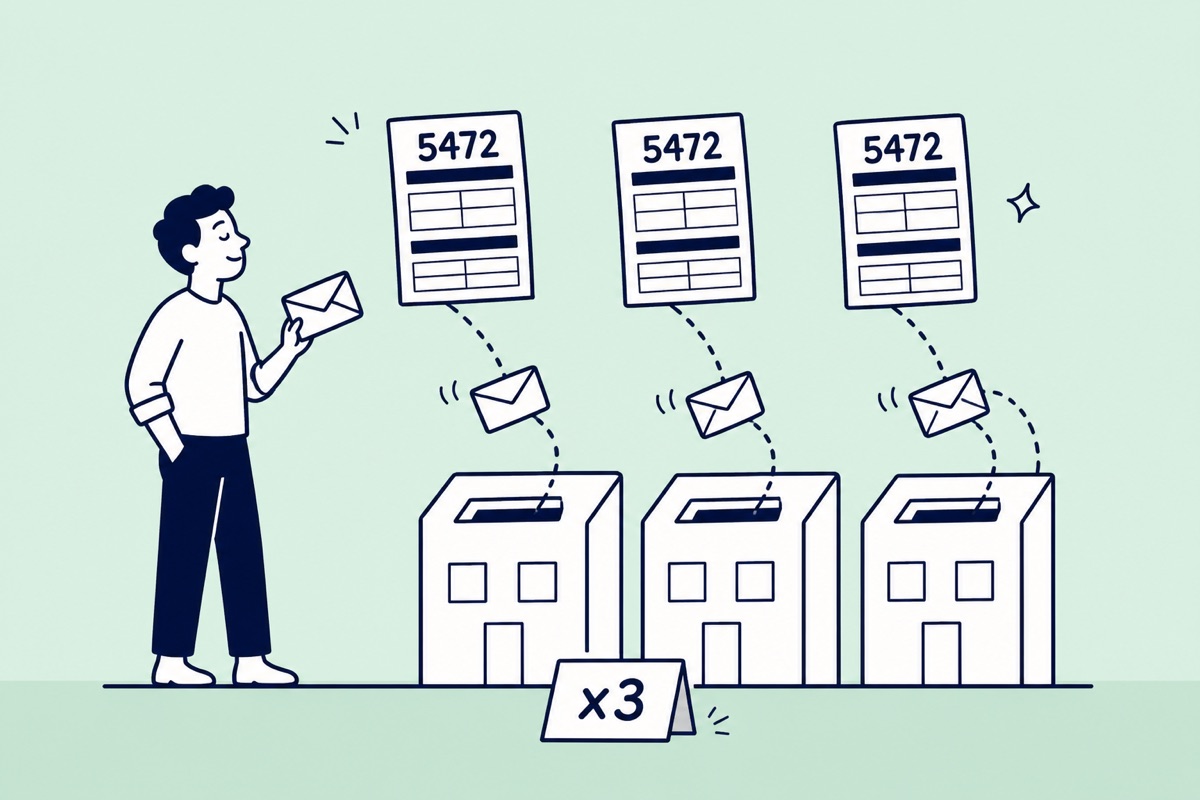
If you are a non-resident who owns two, three, or five US LLCs, the rule you need is simple and expensive to get wrong: every foreign-owned LLC files its own Form 5472 on its own pro forma Form 1120. There is no combined return, no portfolio filing, and no discount for common ownership and the $25,000 penalty applies per form, per entity, per year.
Founders who scale from one LLC to a small portfolio usually keep filing the way they did with one company: they file for the entity that made money, forget the dormant one, and treat money moving between their own companies as internal bookkeeping rather than reportable transactions.
This guide covers the multi-entity workflow nobody publishes: what each LLC needs in its package, why transfers between your own LLCs are related-party transactions, when a single LLC needs more than one Form 5472, how the penalty math compounds, and a tracking system that keeps every entity on schedule.
Do You File One Form 5472 for All Your LLCs, or One per LLC?
One per LLC always. Each LLC is a separate reporting entity with its own EIN, its own tax year, its own related-party transactions, and its own filing deadline. Two LLCs means two complete, independently transmitted packages.
The confusion comes from corporate tax, where affiliated corporations can elect to file a consolidated return. Foreign-owned single-member LLCs cannot do that. They are disregarded entities that the regulations treat as corporations solely for Form 5472 reporting purposes a narrow, entity-by-entity fiction that exists to produce one disclosure per company. There is nothing to consolidate.
Why Each LLC Is Its Own Reporting Entity
Form 5472 is filed by a reporting corporation, and for our purposes each foreign-owned US LLC is one. The obligation attaches to the entity, not to you as the owner, which is why owning five companies creates five separate obligations rather than one larger one. Three practical consequences follow:
- Dormant entities still file. An LLC you formed and never launched has formation costs and probably a capital contribution, both reportable. Read our guide on zero-activity LLCs before you assume the quiet ones can be skipped.
- Each entity carries its own penalty. Filing perfectly for four LLCs does not protect the fifth.
- Each package is signed separately. The pro forma 1120 for each LLC needs its own signature and date you cannot sign once for the group.
For the underlying mechanics of the form itself, start with our complete Form 5472 guide for foreign-owned LLCs, then come back here for the portfolio layer.
What Each LLC Needs: The Per-Entity Filing Package
Every LLC needs an identical, self-contained package, and almost nothing on this list can be shared across entities.
| Item | Shared across LLCs? | What it means when you own 3 LLCs |
|---|---|---|
| EIN | No | 3 separate EINs, 3 separate Form SS-4 applications |
| Pro forma Form 1120 | No | 3 cover pages, each marked “Foreign-owned U.S. DE” |
| Form 5472 | No | At least 3 more if an LLC has several related parties |
| Signature on the 1120 | No | 3 signatures, one per package |
| Fax or mail transmission | No | 3 separate transmissions, 3 confirmation pages to keep |
| Form 7004 extension | No | 3 extensions if you need more time for all three |
| Foreign owner details (Part II) | Yes | Same name, address, country, reference ID on each form |
| IRS fax number and Ogden address | Yes | Same destination for every package |
If any row in the “No” block is shared in your current process, that is the leak. The most common one is a single fax containing everything, which we cover further down.
Separate EINs: One per LLC, No Exceptions
An EIN identifies one legal entity, and Form 5472 cannot be filed without one. You cannot reuse the EIN of your first LLC on your second, even when you own 100% of both and they share an address, a bank, and a business.
Non-resident owners without an SSN or ITIN apply for each EIN using Form SS-4, submitted by fax or phone. Plan for this: EIN turnaround is the biggest scheduling risk in a multi-entity year, because you cannot file for an LLC whose EIN has not arrived. Our EIN guide for foreign-owned LLCs walks through the application, and note that an ITIN is not required to file Form 5472 itself.
One filing detail matters when your LLCs deal with each other: on each Form 5472, the other LLC is identified as a related party by its own name and EIN. Get the EINs wrong and you have filed forms that are substantially incomplete which carries the same penalty as not filing at all.
Transactions Between Your Own LLCs Are Related-Party Transactions
This is the insight that costs multi-entity founders the most money: money moving between two LLCs you control is reportable. Because you own both, the entities are related to each other, and the transfer is not internal bookkeeping it is a related-party transaction the IRS expects to see disclosed.
The related-party definition in the Form 5472 instructions reaches well past the direct 25% foreign owner. It includes persons related to the reporting corporation or to its 25% foreign shareholder under IRC §267(b) and §707(b)(1), and persons related under §482. Commonly controlled entities land squarely inside that net. The instructions carve out only corporations filing a consolidated return with the reporting corporation something foreign-owned disregarded entities never do.
So when your consulting LLC pays your holding LLC a management fee, both entities have something to report: the payer reports a payment to a related party, and the recipient reports a receipt from one. Two entities, two forms, one transaction.
Typical inter-company flows that founders wrongly treat as invisible:
- Cash sweepsmoving surplus from the operating LLC to the holding LLC “to keep it safe”
- Inter-company loansLLC A funds LLC B’s launch, repaid later or never
- Management or service fees one entity invoices the other for shared staff, software, or admin
- Expense reimbursementsone LLC’s card pays the other LLC’s ad spend, hosting, or registered agent
- Asset transfers moving a brand, domain, or inventory from one entity to another, including at no charge
Note the last one. A reportable transaction does not need to involve cash: non-monetary transfers and services provided without charge count too. Our breakdown of Form 5472 reportable transactions covers the full catalogue, and it applies to every entity in your portfolio independently.
Worked example. Nadia owns two Wyoming LLCs. In 2026 she wires $30,000 of personal savings into Holdings LLC, Holdings lends $18,000 to Studio LLC, and Studio pays Holdings a $6,000 management fee. That is three reportable transactions across two entities: Holdings reports the owner contribution and both legs of its dealings with Studio; Studio reports the loan it received and the fee it paid. Neither LLC earned a dollar of US-source income, and both still file.
When One LLC Needs More Than One Form 5472
A single LLC files a separate Form 5472 for each related party it had reportable transactions with during the year. So one LLC in a portfolio can easily need two or three forms inside its one pro forma 1120 package.
Picture Studio LLC in the example above. During 2026 it transacted with you personally (capital contribution), with Holdings LLC (loan received, fee paid), and with your foreign consulting company back home (a services invoice). That is three related parties and therefore three Forms 5472 attached to one pro forma 1120. The form asks for the total number of 5472s being filed, so the count has to be accurate.
Work it out entity by entity: list each LLC, list every related party it touched, and count one form per pairing. The part-by-part instructions show which boxes change between forms Part I (the reporting LLC) stays identical across every form in the same package, while Parts III, IV, and V change with each related party.
Filing for more than one LLC? Form5472.io is priced for portfolios: Business at $197 covers 2 LLCs and Enterprise at $297 covers up to 5each entity gets its own IRS-ready Form 5472 and pro forma 1120, its own compliance check, and its own direct fax to the IRS. One-time price, 30-day money-back guarantee, about 15 minutes per entity. CPAs typically charge $800–$1,500 per LLC.
File for all your LLCs →Penalty Exposure Multiplies by Entity
The $25,000 penalty under IRC §6038A is assessed per form, per entity, per tax year. It is not capped at the owner level, and it is not reduced because your companies are small, dormant, or unprofitable. Portfolio owners therefore carry the largest exposure of any group of foreign-owned LLC filers.
| LLCs owned | 1 missed year | 2 missed years | 3 missed years |
|---|---|---|---|
| 1 LLC | $25,000 | $50,000 | $75,000 |
| 2 LLCs | $50,000 | $100,000 | $150,000 |
| 3 LLCs | $75,000 | $150,000 | $225,000 |
| 5 LLCs | $125,000 | $250,000 | $375,000 |
Those are base figures assuming one Form 5472 per LLC per year. An entity that needed three forms multiplies again. And if a filing is still missing 90 days after an IRS notice, an additional $25,000 applies for each 30-day period the failure continues, with no upper limit on each form separately.
Run your own numbers with the Form 5472 penalty calculator, and if you are already behind on one or more entities, read the $25,000 late-filing penalty guide before you contact the IRS. Filing late voluntarily, with a reasonable-cause statement per entity, is materially better than waiting for a CP215 notice to arrive.
Deadlines Across a Portfolio Are Not All the Same Date
Most portfolios of foreign-owned single-member LLCs share one deadline: April 15 following the tax year, extendable to October 15. But the moment one of your entities has a second member, its deadline moves.
| Entity type in your portfolio | Forms filed | Original deadline | With Form 7004 |
|---|---|---|---|
| Foreign-owned single-member LLC (disregarded) | Form 5472 + pro forma 1120 | April 15 | October 15 |
| Foreign-owned multi-member LLC (partnership) | Form 1065 + Schedule K-1 per partner | March 15 | September 15 |
A founder with three single-member LLCs and one partnership therefore has a March 15 obligation a month before everything else and it is the one most often missed, because the April 15 date is the one people remember. If a partnership is in your mix, our Form 1065 guide for foreign-owned LLCs covers its separate penalty regime, which is charged per partner per month rather than as a flat amount.
Check each entity individually with the deadline calculator rather than assuming the portfolio moves as one.
Extensions: One Form 7004 per LLC
Form 7004 extends the return of a single entity, not a portfolio. If you need more time for four LLCs, you file four Forms 7004, each naming that LLC and its EIN, each submitted by that entity’s original due date.
Two rules make this trickier than it sounds for foreign-owned DEs. First, the 7004 goes to the IRS by fax or mail, the same as the return itself there is no e-file path. Second, the extension must be in the IRS’s hands by the original deadline; a 7004 filed on April 16 does nothing. Our Form 7004 guide for foreign LLCs covers the boxes, and the official form details are on irs.gov.
A practical tip: extend the whole portfolio or none of it. Mixed deadlines two LLCs due in April, three in October are exactly how an entity slips through unfiled.
One Fax per Entity: How to Transmit Multiple Packages
Foreign-owned disregarded entities cannot e-file. Each package goes to the IRS by fax to (855) 887-7737 or by mail to the Ogden, Utah address reserved for these returns not the regular Form 1120 addresses. Send one transmission per LLC.
Combining entities into one long fax is the multi-LLC mistake with the worst downside. Each pro forma 1120 is the cover page of its own return; stack five entities into one transmission and the IRS may process them as attachments to the first, leaving four entities unfiled with no way for you to prove otherwise. You also lose the per-entity confirmation page the closest thing to proof of timely filing this paper-only process offers. Do it this way instead:
- Assemble one PDF per LLC: pro forma 1120 first, then every Form 5472 for that entity behind it.
- Fax entity 1. Wait for the confirmation page. Save it named with the LLC and tax year.
- Repeat, one entity at a time, until every package is confirmed.
- Store confirmations together with each entity’s transaction log.
Our guide to faxing Form 5472 covers cover sheets and confirmation handling, and the mailing address and transmission rules are set out in the official IRS Instructions for Form 5472.
A Tracking System for Multi-Entity Compliance
Multi-LLC filings fail for administrative reasons, not technical ones. Nobody misreads §6038A they forget the third company. A one-page master tracker removes the failure mode.
Step 1: Build the master entity table
One row per LLC, rebuilt at the start of every filing season.
| Column | What goes in it |
|---|---|
| Legal name & state | Exactly as on the formation documents |
| EIN | The entity’s own EIN, never another LLC’s |
| Tax classification | Disregarded entity or partnership this sets the deadline |
| Related parties this year | You, your other LLCs, any foreign company you control |
| Forms 5472 required | One per related party with a reportable transaction |
| Deadline / extended deadline | April 15 or March 15; October 15 or September 15 with 7004 |
| Transmission status | Date faxed and confirmation page filename |
Step 2: Keep a transaction log per entity
Log every movement of money or value in or out of each LLC with the date, amount, direction, and counterparty. Tag the counterparty as related or unrelated at the moment you record it reconstructing this in April, across several companies, is where errors are born.
Step 3: Reconcile the inter-company entries
Every transfer between two of your LLCs should appear twicein your records: once in each entity’s log, with matching dates and amounts and opposite directions. A transfer that appears only once is a form you are about to file incorrectly.
Step 4: Confirm entity by entity, then close the season
Do not consider the season finished until every row of the master table has a confirmation page attached. Not sure whether a quiet entity even needs to file? Run it through the filing requirement quiz once per LLC, since the answer can differ across your portfolio.
Common Multi-LLC Mistakes
These are the patterns that turn a manageable portfolio into a penalty case, and most come from treating several companies as one business.
- Filing only for the LLC that earned money. Revenue is irrelevant reportable transactions trigger the form.
- Reusing one EIN across entities. An incorrect EIN makes the form substantially incomplete.
- Ignoring inter-company transfers. The most expensive error in this article, and the least discussed elsewhere.
- Filing one Form 7004 for the whole portfolio. Every other entity is then late.
- One combined fax. Risks four of five entities being treated as unfiled.
- Counting one Form 5472 per LLC by default. Count related parties, not companies.
- Forgetting a dissolved entity. An LLC wound up during the year still files for that year, and dissolution amounts are themselves reportable.
- Missing March 15 when one entity is a multi-member LLC.
Several of these overlap with the single-entity errors in our guide to common Form 5472 mistakes the difference is that in a portfolio, each mistake is multiplied by the number of companies you own.
Key Takeaways
- Every foreign-owned US LLC files its own Form 5472 attached to its own pro forma Form 1120. There is no combined or consolidated filing.
- Each LLC needs its own EIN; you cannot reuse one across entities, and the form cannot be filed without it.
- Transactions between LLCs you controlare related-party transactions and are reportable on both entities’ forms.
- One LLC files one Form 5472 per related party, so a single entity may need two or three forms in one package.
- The $25,000 penalty is per form, per entity, per year three LLCs and two missed years is $150,000 of base exposure.
- An extra $25,000 per 30-day period can apply to each form still unfiled 90 days after an IRS notice.
- Deadlines are per entity: April 15 for disregarded LLCs, March 15 for multi-member LLCs filing Form 1065.
- Extensions are per entity too one Form 7004 per LLC, filed by that entity’s original deadline.
- Send one fax per entity to (855) 887-7737 and keep each confirmation page; never combine entities in one transmission.
- A master entity table plus a per-entity transaction log prevents the real failure mode: forgetting a company.
The Bottom Line
Owning several US LLCs as a non-resident does not make filing harder in kind it makes it harder in volume and bookkeeping. The form is the same; what changes is that you now run the same process several times, track several EINs and deadlines, and disclose the money moving between your own companies rather than netting it out. Get the per-entity discipline right and a five-LLC portfolio is a manageable afternoon. Get it wrong on one entity and the penalty is identical to ignoring the rules entirely.
Frequently Asked Questions
Can I file one Form 5472 for all of my LLCs?+
No. Each foreign-owned US LLC is its own reporting entity with its own EIN, and each files its own Form 5472 attached to its own pro forma Form 1120. There is no combined or consolidated filing for foreign-owned disregarded entities. Two LLCs means two complete packages sent separately.
Do I need a separate EIN for each LLC?+
Yes. An EIN identifies one legal entity, and Form 5472 cannot be filed without one. You cannot reuse the EIN from your first LLC on a second LLC, even if you own both entirely. Apply for each EIN separately using Form SS-4.
Are transfers between two LLCs I own reportable transactions?+
Yes. Because you control both entities, they are related parties to each other. A loan, service fee, expense reimbursement, or cash sweep between your own LLCs is a reportable transaction that must appear on the Form 5472 of the LLC doing the reporting, and on the other LLC's form as well.
How much is the penalty if I miss filing for several LLCs?+
The $25,000 penalty under IRC section 6038A applies per form, per entity, per tax year. Three LLCs that each missed two years is $150,000 of base exposure, and an additional $25,000 per 30-day period can apply to each form that stays unfiled more than 90 days after an IRS notice.
Does one Form 7004 extension cover all my LLCs?+
No. Form 7004 extends the return of one entity, so you file one Form 7004 per LLC by that LLC's original due date. Filing a single 7004 and assuming it covers your whole portfolio leaves every other LLC late and exposed to the full penalty.
Can I fax all of my LLC filings together in one transmission?+
Do not combine them. Send one fax per entity so each package arrives as a self-contained return with its own pro forma 1120 cover page. Faxing several entities in a single transmission risks the IRS treating them as attachments to one return, and you lose the per-entity confirmation page that proves each filing.
File Your Form 5472 in Minutes
Skip the paperwork. Our digital tool generates IRS-ready Form 5472 and Pro Forma 1120 instantly.
Start Filing Now