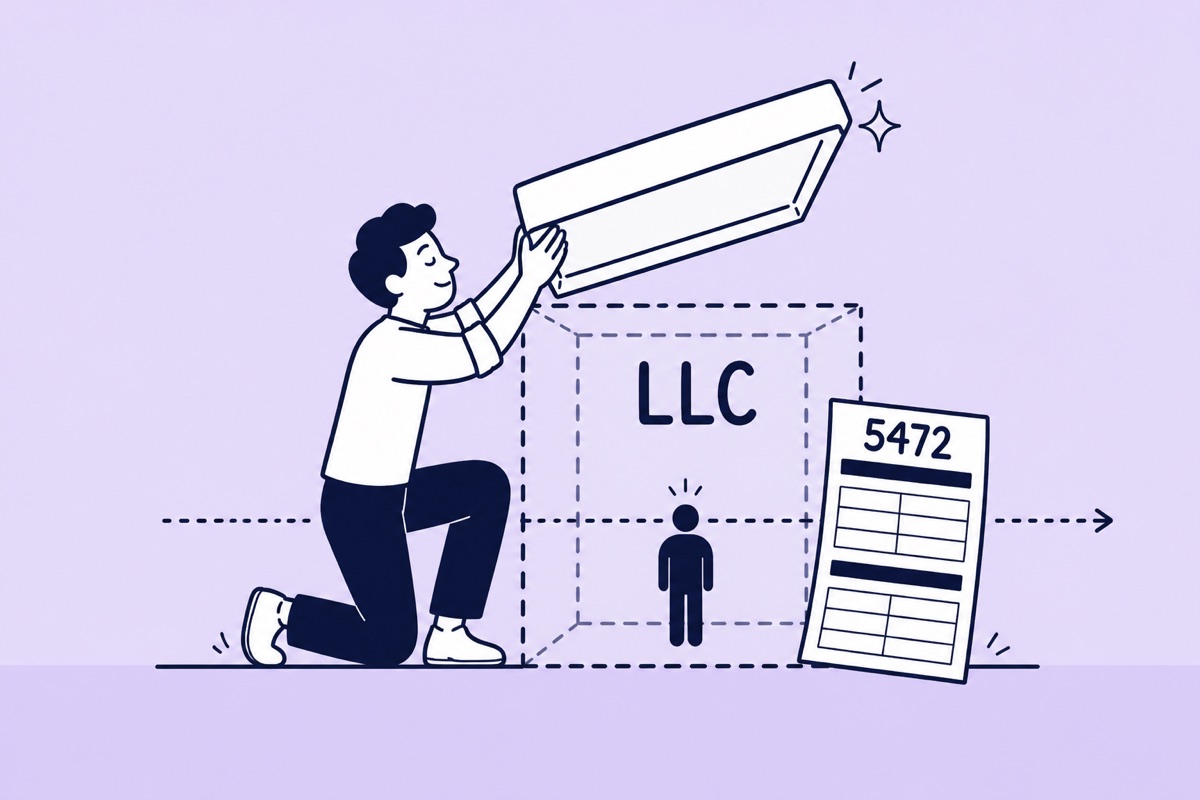
If you own a US LLC as a non-resident, a payer has almost certainly asked you for a “tax form” at some point Stripe during onboarding, a US client before the first invoice, a marketplace before your first payout. You signed a W-8BEN, the request went away, and it felt like US tax compliance was handled. It was not. Form W-8BEN and Form 5472 are not alternatives: the W-8BEN is a certificate you hand to a company and that never reaches the IRS, while Form 5472 is an annual return you file with the IRS, carrying an automatic $25,000 penalty when it is missed.
This guide separates the two systems for good: what each form does, which of the W-8 variants a foreign LLC owner is actually supposed to sign, why payers so often ask for the wrong one, and which forms your specific setup requires.
The Short Answer: They Are Not Alternatives
You almost certainly need both, and they never substitute for each other. A W-8BEN is a withholding certificate: it tells one specific payer that you are not a US person, so the payer applies the correct withholding rate. Form 5472 is an information return: it tells the IRS what money moved between your US LLC and you.
The cleanest way to hold the distinction in your head is to ask who receives the paper. The W-8BEN goes into a company’s compliance file and stays there. The IRS never sees it, never logs it, and cannot credit you for it. Form 5472 goes to an IRS service center in Ogden, Utah, and creates the only record that exists of your LLC’s related-party activity.
What Is Form W-8BEN?
Form W-8BEN(“Certificate of Foreign Status of Beneficial Owner for United States Tax Withholding and Reporting”) is signed by a non-resident alien individual who receives, or may receive, payments from a US source. It certifies two things: that you are a foreign person, and optionally, in Part II that you qualify for a reduced rate under an income tax treaty.
The instruction that settles most arguments is printed in the IRS guidance itself: do not send Form W-8BEN to the IRS; give it to the person requesting it from you. The requester is your withholding agent the payment processor, bank, broker, marketplace, or client. They keep the form to justify the rate they withheld if the IRS ever asks them. You can read the official text at irs.gov/instructions/iw8ben.
What a W-8BEN actually accomplishes:
- Stops a payer from treating you as a US person and applying 24% backup withholding
- Lets you claim a treaty rate on US-source income such as royalties, interest, or dividends
- Documents your foreign status for the payer’s own reporting obligations
What it does not accomplish:it is not a tax return, it does not register you with the IRS, it does not report a single transaction to the government, and it has no effect whatsoever on your LLC’s annual filing duties.
What Is Form W-8BEN-E, and When Does an LLC Owner Use It?
Form W-8BEN-E is the entity version of the same certificate. It does the identical job certify foreign status to a payer, claim treaty benefits but it is signed by a foreign entity rather than a human being, and it is far longer because it also carries FATCA classification.
Here is where foreign-owned LLC owners get tangled. Your instinct is that because the payment is being made to your LLC, the LLC should sign the entity form. The IRS instructions say the opposite: the owner of a disregarded entity, rather than the disregarded entity itself, submits the appropriate Form W-8. A foreign-owned single-member LLC is transparent for tax purposes the IRS looks straight through it to whoever owns it.
So the test is simply: who owns the LLC?
- An individual owns the LLC→ you sign your own W-8BENas a person, naming the LLC on the disregarded-entity or reference line where the payer’s form provides one.
- A foreign company owns the LLC→ that company signs a W-8BEN-E.
In practice, many payers’ onboarding flows insist on a W-8BEN-E in the LLC’s name and will not accept anything else. That is a limitation of their software, not a change in the rules, and it rarely causes harm as long as the beneficial owner information is accurate. But if you have a choice, the individual owner’s W-8BEN is the technically correct instrument for an individually-owned disregarded entity. Our guide to disregarded entity tax filing explains why the look-through rule works this way.
What Is Form 5472?
Form 5472 is an information return filed with the IRS, once a year, by a US entity that is 25% or more foreign-owned and had at least one reportable transaction with a foreign related party. Since tax year 2017, foreign-owned single-member LLCs are pulled in too: they are treated as corporations solely for this reporting purpose.
It calculates no tax. It reports facts specifically, money moving between your LLC and you or any other related foreign party. Capital contributions, distributions, loans in either direction, payments for services or rent, and amounts paid in connection with forming or dissolving the entity are all reportable. Funding the bank account counts. Paying the state fee from your personal card counts.
The form travels attached to a pro forma Form 1120 a cover page carrying your LLC’s name, address, EIN and tax year with “Foreign-owned U.S. DE” written across the top. The package is due April 15 for calendar-year filers, extendable to October 15 with Form 7004, and it cannot be e-filed by a foreign-owned disregarded entity it goes by fax to (855) 887-7737 or by mail to Ogden, Utah. For the full mechanics, see our complete Form 5472 guide.
W-8BEN vs W-8BEN-E vs Form 5472: Side-by-Side
The differences are structural, not cosmetic. Read the second row first once you see who receives each document, everything else follows.
| Form W-8BEN | Form W-8BEN-E | Form 5472 | |
|---|---|---|---|
| Who signs it | A non-resident alien individual | A foreign entity (company, trust, partnership) | The US entity your LLC |
| Given to whom | The payer / withholding agent never the IRS | The payer / withholding agent never the IRS | The IRS, attached to a pro forma 1120 |
| Purpose | Certify foreign status; claim treaty rate | Certify foreign status and FATCA class; claim treaty rate | Disclose related-party transactions |
| When | On request, before payment | On request, before payment | Annually, by April 15 (Oct 15 with Form 7004) |
| How long it lasts | Generally 3 calendar years after signing | Generally 3 calendar years after signing | One tax year a new form every year |
| Penalty for getting it wrong | No IRS penalty; payer withholds 24%–30% instead | No IRS penalty; payer withholds 24%–30% instead | $25,000per form, per year (IRC §6038A) |
| Type of document | Withholding certificate | Withholding certificate | Information return |
Note the penalty row. Getting a W-8 wrong is a cash-flow problem a payer withholds too much and you claw it back later. Getting Form 5472 wrong is a penalty problem, and the penalty does not scale to your revenue.
Why So Many LLC Owners Think the W-8BEN Was Enough
The confusion is structural, not careless. Three things line up to create a false sense of completion.
First, the W-8BEN is the only tax form most non-resident founders are ever asked for. Nobody emails you about Form 5472. Stripe, PayPal, and marketplaces chase you relentlessly for a W-8 because their own reporting depends on it. The IRS chases you for nothing until a CP215 penalty notice arrives.
Second, the W-8BEN has “tax” in its purpose. It is a US tax document, signed under penalty of perjury, that determines a withholding rate. It genuinely feels like a filing. It just is not one.
Third, the payer goes quiet afterwards. Silence reads as approval. In reality the payer got the answer to itsquestion how much to withhold and had no reason to ask any further question on the IRS’s behalf.
If you get paid through payment processors, our guide to Stripe and PayPal for foreign-owned LLCs walks through what those platforms do and do not report. And if you work through freelance marketplaces specifically, the Form 5472 guide for freelancers maps the whole client-to-platform-to-LLC-to-you money loop onto what is reportable.
Handed over your W-8BEN but never filed a Form 5472? Form5472.io generates your Form 5472 and the matching pro forma 1120 IRS-ready, digitally signed, faxed straight to Ogden in about 15 minutes for $147one-time. CPAs typically charge $800–$1,500 for the same package.
Start your filing →Which Forms Do You Actually Need? By Scenario
Your obligations depend on two things: who owns the LLC, and whether anyone is paying you from a US source. Find your row.
| Your situation | W-8 you supply | Form 5472? | Why |
|---|---|---|---|
| Non-resident individual owns a US single-member LLC; clients pay the LLC | W-8BEN (yours, as owner) | Yes | DE looks through to you; contributions and withdrawals are reportable |
| A foreign company owns the US single-member LLC | W-8BEN-E(the parent company’s) | Yes | The parent is a foreign related party |
| Non-resident owns a dormant US LLC with no clients at all | None nobody is asking | Yes | Formation costs and any funding are still reportable transactions |
| Non-resident freelancer paid personally, no US LLC | W-8BEN | No | No US entity exists to file for |
| US-resident owner of a single-member LLC | W-9, not a W-8 | No | No foreign ownership, so §6038A does not apply |
| Multi-member LLC with foreign partners | W-8BEN per foreign partner | Usually no Form 1065 + K-1 instead | Partnership rules replace the DE regime |
Not sure which row is yours? Run the two-minute filing requirement quiz it asks about ownership and transactions and tells you exactly which package you owe.
The W-9 Trap: When a Payer Asks for the Wrong Form
Never sign a Form W-9 if you are not a US person. This happens constantly: a US client sees a US LLC with a US EIN and a US address, assumes a domestic vendor, and sends a W-9 request. The W-9 certifies under penalty of perjury that the signer is a US person. Signing one as a non-resident is a false certification, and it also invites 1099 reporting that misstates your status.
The correct response is short and works nearly every time:
- Explain that the LLC is a foreign-owned disregarded entity and that its owner is not a US person.
- Supply the owner’s W-8BEN, entering the LLC name on the disregarded-entity or reference line if the form offers one.
- If their system will only accept an entity form, supply a W-8BEN-Ein the LLC’s name with accurate beneficial-owner details rather than defaulting to the W-9.
Whichever W-8 you end up handing over, nothing about that exchange touches your annual US filing obligations. The EIN that made the client think you were domestic is the same EIN that Form 5472 requires.
Treaty Benefits Live on the W-8, Not on Form 5472
A tax treaty can reduce withholding. It cannot reduce an information-return obligation. Treaty relief is claimed in Part II of the W-8BEN, where you name your treaty country, the article you are relying on, and the rate you are claiming. It applies to defined categories of US-source income royalties, interest, dividends, sometimes business profits where you have no US permanent establishment.
Form 5472 has no rate, no tax, and no treaty interaction at all. It reports amounts. A founder in a country with a generous US treaty and a founder in a country with no treaty at all file exactly the same Form 5472 and face exactly the same $25,000 penalty for missing it. Treaty status changes what you pay; it never changes what you disclose.
One related point worth clearing up: claiming treaty benefits on a W-8BEN can require a US taxpayer identification number, which is why many founders start looking at ITINs. Filing Form 5472 itself does not require an ITIN only an EIN for the LLC. See whether you need an ITIN for Form 5472.
How Long Each Form Lasts (and When to Redo It)
A W-8BEN expires; Form 5472 is filed fresh every single year. A W-8BEN is generally valid from the date you sign it through the end of the third following calendar year. A form signed in March 2026 typically runs through 31 December 2029, at which point the payer will ask for a new one.
It can also die early. A change in circumstances a new address, especially a US address, a change in treaty eligibility, or becoming a US resident invalidates the certificate, and you are expected to notify the withholding agent within 30 days.
Form 5472 works on a completely different clock. There is no multi-year validity: each tax year in which your LLC had a reportable transaction needs its own Form 5472 attached to its own pro forma 1120. A perfect 2025 filing does nothing for 2026. If you have skipped years, you can still file prior-year Forms 5472 late one package per missed year.
What Goes Wrong If You Get Either One Wrong
The two failure modes are not remotely equivalent in cost, which is the practical reason to keep them straight.
Get the W-8 wrong or never supply one and the payer defaults to the safe position for itself: it withholds at 24% backup withholding or 30% on US-source income, and remits that to the IRS. You are out the cash until you recover it, which may mean filing a US return to claim a refund. Painful, but recoverable, and no penalty attaches to you.
Get Form 5472 wrong and the IRS assesses $25,000 per form, per yearunder IRC §6038A plus a further $25,000 for each 30-day period the failure continues after the IRS sends notice, with no cap. The penalty is automatic and revenue-blind: a dormant LLC and a $10 million LLC pay the same. Note too that a substantially incomplete or inaccurate Form 5472 draws the same penalty as a missing one.
If a penalty has already been assessed, it is not necessarily final read our guide to the $25,000 late-filing penalty and the reasonable-cause route. The official Form 5472 instructions are at irs.gov/instructions/i5472.
Key Takeaways
- W-8BEN and Form 5472 are not alternatives. Most non-resident LLC owners need both, for entirely different reasons.
- W-8BEN is never sent to the IRS. The instructions say to give it to the person requesting it your payer or withholding agent.
- Form 5472 is filed with the IRS, attached to a pro forma 1120, by April 15 (October 15 with Form 7004), by fax to (855) 887-7737 or mail to Ogden, Utah.
- W-8BEN is for individuals; W-8BEN-E is for entities. The owner of a disregarded entity, not the LLC itself, submits the appropriate form.
- If you personally own the LLC, your own W-8BEN is the correct form even though the money is paid to the LLC.
- Never sign a W-9 as a non-US person. It certifies US status under penalty of perjury.
- Treaty benefits are claimed on the W-8, and have zero effect on the Form 5472 obligation or its penalty.
- A W-8BEN lasts about three years; Form 5472 lasts one. Every year with a reportable transaction needs its own filing.
- The cost asymmetry is the point: a botched W-8 means over-withholding you can recover; a missed Form 5472 means an automatic $25,000 penalty you probably cannot.
The Bottom Line
The W-8BEN answered a question your payer asked. Form 5472 answers a question the IRS asks and nobody sends you a reminder about it. If you are a non-resident who owns a US single-member LLC and any money moved between you and that LLC during the year, keep supplying W-8BENs when payers request them, and file Form 5472 with a pro forma 1120 by April 15. The first protects your cash flow. The second protects you from a $25,000 penalty that arrives without warning.
Frequently Asked Questions
Do I need both a W-8BEN and Form 5472?+
Usually yes, and they are unrelated. You give a W-8BEN to any US payer that asks for one so it does not over-withhold on payments to you. You file Form 5472 with the IRS every year if your single-member LLC is 25% or more foreign-owned and had any reportable transaction with you. One is a certificate handed to a company; the other is an annual return filed with the government.
Is Form W-8BEN filed with the IRS?+
No. The IRS instructions say directly: do not send Form W-8BEN to the IRS, give it to the person requesting it from you. It goes to the withholding agent or payer, who keeps it on file to justify the withholding rate they applied. The IRS never receives your copy, so submitting one creates no filing record and satisfies no filing requirement.
As the individual owner of a US LLC, do I give a W-8BEN or a W-8BEN-E?+
If you personally own the single-member LLC, you give your own Form W-8BEN as an individual. The IRS instructions state that the owner of a disregarded entity, rather than the entity itself, submits the appropriate Form W-8. W-8BEN-E is for entities, so it applies only when the owner of your US LLC is itself a foreign company rather than a person.
A US client is asking me for a W-9 for my LLC. Should I sign it?+
No, not if you are a non-US person. Form W-9 certifies that you are a US person, and signing one when you are not is a false certification. The correct response is to explain that the LLC is a foreign-owned disregarded entity and supply the owner's Form W-8BEN instead, showing the LLC name on the disregarded-entity line if the payer's system provides one.
Does a tax treaty claimed on my W-8BEN reduce my Form 5472 duty?+
No. Treaty benefits reduce withholding rates on specific categories of US-source income, and they are claimed in Part II of the W-8BEN. Form 5472 is an information return with no tax and no rate attached, so nothing in a treaty removes the obligation to file it or reduces the $25,000 penalty for missing it.
How long does a W-8BEN stay valid?+
A W-8BEN is generally valid from the date it is signed through the end of the third following calendar year, unless a change in circumstances makes the information incorrect. You must notify the withholding agent within 30 days of such a change, for example a new address or becoming a US resident. Form 5472, by contrast, is never valid beyond its year you file a fresh one annually.
File Your Form 5472 in Minutes
Skip the paperwork. Our digital tool generates IRS-ready Form 5472 and Pro Forma 1120 instantly.
Start Filing Now